
Fontana di Trevi in Rom, a baroque theatre of water and stone
Published on 08/19/2026 at 21:39 | Editorial responsibility: Rafael Müller, Editor-in-Chief AD HOC NEWS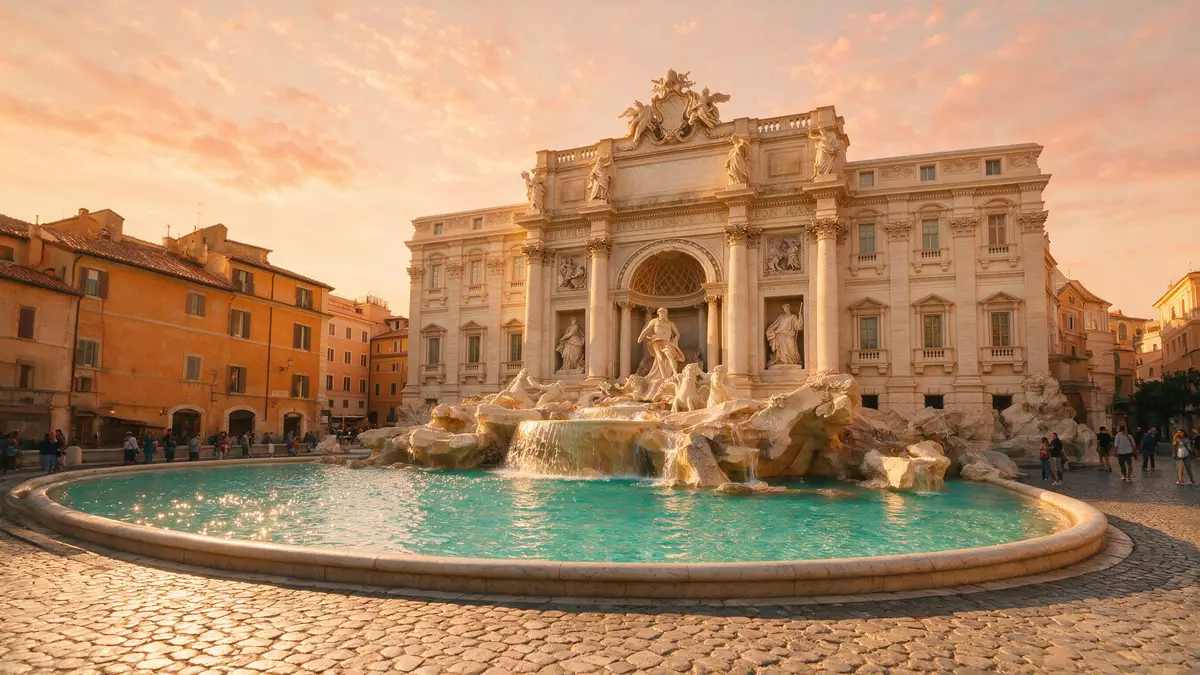
Fontana di Trevi in Rom is a monumental baroque fountain that turns the rear façade of Palazzo Poli into a vast stage where water and carved stone share a single composition. Built in the eighteenth century and completed in 1762, it stands at the end of the ancient Aqua Virgo aqueduct, tying imperial engineering to late baroque theatricality in one crowded corner of the city.
A palace façade transformed into a fountain
Fontana di Trevi is set against the rear of Palazzo Poli in the Trevi district, so the palace elevation and fountain are a single architectural surface rather than separate structures.abutting the Palazzo Poli The baroque design uses the palace’s high central bay as a backdrop for the main composition, framed by colossal columns and a triumphal arch that rises above the basin. The stonework of the building runs uninterrupted into the rocky forms of the fountain, so the distinction between architecture and sculpture becomes deliberately blurred.
The central focus of the elevation is the large statue of Oceanus, drawn in a shell-shaped chariot and flanked by allegorical figures representing abundance and health.Trevi Fountain central figures Below them, sculpted rock formations spread across the lower part of the façade and down towards the basin, with water emerging from concealed points in the stone. The composition reads as a cliff pressed against the rear of the palace, with the water spilling out into the urban space. Balconies and windows in the upper storeys overlook the fountain, so residents of Palazzo Poli live directly above one of Rom’s most theatrical public spaces.
A late baroque masterpiece at the end of Aqua Virgo
The story of Fontana di Trevi is tied to Aqua Virgo, an ancient Roman aqueduct completed in 19 BC under Augustus that still brings water into this part of the city.water supply from Aqua Virgo The aqueduct’s urban “showcase” in the Trevi district began as a simpler fountain, but the eighteenth-century project expanded it into a monumental display that celebrated both the water source and baroque artistry. In 1730 Pope Clement XII organised a competition for a new design, and in 1732 the commission went to the Roman architect Nicola Salvi, whose proposal integrated palace and fountain into one façade.
Construction of the fountain began in the 1730s and continued for three decades, with Salvi overseeing the work until his death in 1751, after which Giuseppe Pannini directed its completion and the fountain was inaugurated in 1762.completion under Giuseppe Pannini The completed structure is in late baroque style, with a height of about 26 m (86 ft) and a width of around 49 m (161 ft), making it one of the largest baroque fountains in Rome.dimensions and baroque style Sculptors including Pietro Bracci and others carved the animated figures, horses and personifications that fill the lower part of the façade, while the architectural framework keeps the composition symmetrical around the central arch. The combination of aqueduct endpoint, palace elevation and allegorical programme gives Fontana di Trevi a layered identity as infrastructure, architecture and artwork at once.
Myth, allegory and urban theatre
The iconography of Fontana di Trevi centres on sea and river imagery, tying the city’s water supply to wider themes of abundance. Oceanus stands at the centre of the composition, flanked by figures representing the benefits of clean water, while Tritons guide rearing horses below, one calm and one restive, reflecting different moods of the sea.Oceanus and allegorical figures Around them, carved vegetation, rocks and architectural fragments amplify the sense that nature and masonry are entwined at the point where the aqueduct meets the city. Reliefs on the upper part of the façade depict the legendary discovery of the Aqua Virgo source and the technical achievement of bringing its water into Rom.
The square in front of Fontana di Trevi is relatively narrow, so the viewer stands close to the basin and the façade rises almost like a stage set on the opposite side of the space. The fountain occupies the junction of three streets, a fact echoed in the name “Trevi”, linked to “tre vie”, the three roads that converge here.junction of three streets Water pours from multiple points into the basin below, and the continuous movement contrasts with the fixed stone figures, giving the whole ensemble the character of a living theatre embedded in the everyday circulation of the city.
Visiting Fontana di Trevi: what travellers from Western Europe should know
- Fontana di Trevi stands in the Trevi district of central Rom, a short walk north of Piazza Venezia and east of the Quirinale Palace.
- The fountain occupies a compact square with stepped approaches and cobbled surfaces, so reaching the basin involves short slopes and several changes in level on foot.
- Rom is served by a dense public transport network; the Trevi district can be reached from main railway hubs such as Roma Termini by Metro and city buses.
- The official language is Italian and the currency is the euro.
Searching for Fontana di Trevi on social platforms
These links open searches for Fontana di Trevi on each platform.
Frequently asked questions about Fontana di Trevi
Where is Fontana di Trevi located in Rom?
Fontana di Trevi stands in the Trevi district of central Rom, set against the rear façade of Palazzo Poli at the junction of three streets.
What can visitors expect when they reach the fountain?
Visitors step into a compact square dominated by the high baroque façade, with water cascading from sculpted rock into a broad basin at their feet.
What makes Fontana di Trevi distinctive among Rom’s fountains?
The fountain’s distinctive character lies in its integration with Palazzo Poli, its late baroque scale and allegorical programme, and its role as the city-end of Aqua Virgo.


