
Fontana di Trevi and the theatre of stone and water
Published on 09/23/2026 at 10:19 | Editorial responsibility: Rafael Müller, Editor-in-Chief AD HOC NEWS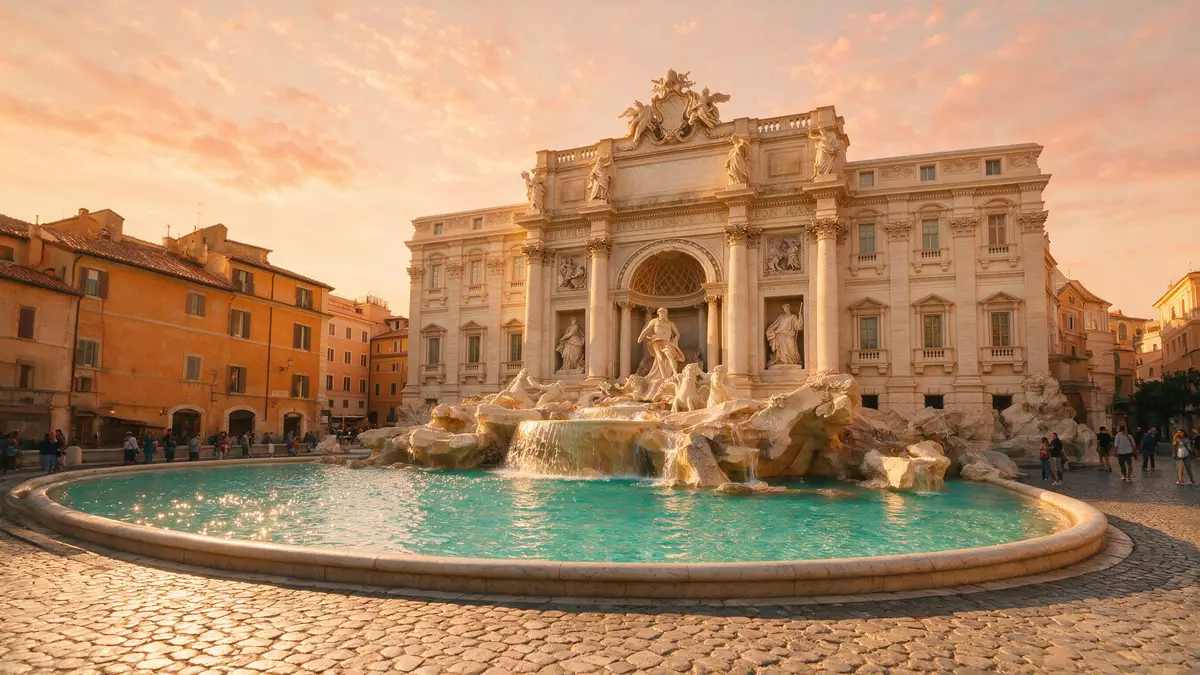
Fontana di Trevi fills the end of Piazza di Trevi with a Baroque composition of water, marble and carved rock. Nicola Salvi designed the fountain in 1732, and Giuseppe Pannini completed it in 1762. Its central figures, broad basin and palace façade form a single architectural scene.
Fontana di Trevi as a palace-sized fountain
The fountain is attached to Palazzo Poli, whose façade rises behind the sculpture. This relationship gives Fontana di Trevi an unusual scale: the water occupies the square, while the building provides a formal architectural backdrop.
At the centre stands Oceanus, the god associated with the world’s waters. He rides a shell-shaped chariot drawn by sea horses, accompanied by Tritons. The figures occupy an arched central opening framed by columns, entablature and sculpted decoration. The composition belongs to Rome’s late Baroque.
Below the statuary, travertine is carved into ledges, cliffs and irregular surfaces. Water passes across these forms before reaching the large basin. The contrast between ordered architecture and rough stone is visible throughout the fountain.
Nicola Salvi, Giuseppe Pannini and the eighteenth century
Pope Clement XII opened a competition for a new Trevi fountain in 1732. Nicola Salvi’s design was selected, linking architectural mass, sculpture and the water of the Acqua Vergine. The project belongs to the eighteenth-century artistic culture of papal Rome.
Salvi died in 1751, before the work was complete. Giuseppe Pannini continued the project and finished the fountain in 1762, with changes to parts of the original scheme. The completion date is recorded in the Trevi Fountain’s history.
The fountain therefore carries the names of two architects across its finished form. Salvi created the overall design, while Pannini brought the work to completion after Salvi’s death. Their collaboration is part of the monument’s identity.
Acqua Vergine and the theatre of movement
Fontana di Trevi marks the endpoint of the Acqua Vergine, an aqueduct whose Roman history reaches back to 19 BC. The water connects the monument with Rome’s long tradition of public fountains and urban water systems.
The basin sits below the sculptural group, with water spreading across the foreground beneath Oceanus. The sound and movement of water are built into the composition, but the fountain remains an architectural monument as much as a hydraulic work.
Its decoration combines mythological figures, animals, plants and artificial rock. The carved details surround the central group without isolating it from the palace façade. The result is a continuous scene extending from the upper architecture to the water’s edge.
The official completion in 1762 followed about thirty years of work. Fontana di Trevi therefore belongs to a particular historical period, yet its form incorporates older Roman water infrastructure. The Piazza di Trevi location places that history within the city’s historic centre.
Visiting Fontana di Trevi: what travellers from Western Europe should know
- Fontana di Trevi stands in Piazza di Trevi, in central Rom. The surrounding streets connect the square with the historic centre on foot and by Rome’s public transport network.
- The monument occupies the end of a compact urban square. Stone paving, steps and the basin edge define the space around the water.
- The water comes from the Acqua Vergine system, whose ancient route remains part of the fountain’s historical meaning.
- The official language is Italian and the currency is the euro.
Searching for Fontana di Trevi on social platforms
These links open searches for Fontana di Trevi on each platform.
Frequently asked questions about Fontana di Trevi
Where is Fontana di Trevi?
Fontana di Trevi is in Piazza di Trevi, in the historic centre of Rom. It is attached to Palazzo Poli.
What can visitors expect at the monument?
The square contains a broad basin, flowing water, travertine rockwork and a large sculptural group beneath the palace façade.
What makes Fontana di Trevi distinctive?
Nicola Salvi’s late Baroque design combines a monumental building front with mythological sculpture and the Acqua Vergine.


