
Fo Guang Shan Fojitu Jinianguan at Kaohsiung’s Buddha Museum
Published on 09/09/2026 at 06:55 | Editorial responsibility: Rafael Müller, Editor-in-Chief AD HOC NEWS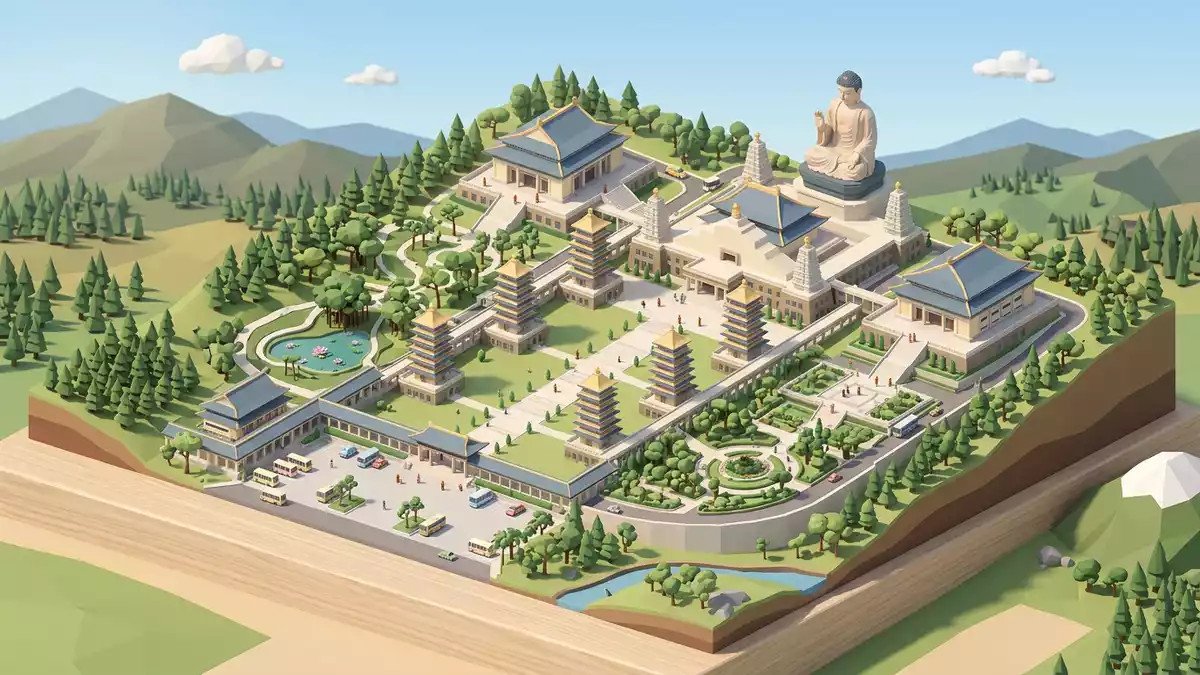
Fo Guang Shan Fojitu Jinianguan sits within the expansive Fo Guang Shan Buddha Museum complex in Dashu District on the outskirts of Kaohsiung in southern Taiwan, bringing Buddhist devotion and museum culture into a single landscape. The complex was founded by Venerable Master Hsing Yun of the Fo Guang Shan order, and the Buddha Museum was opened to the public in 2011 as a major Mah?y?na Buddhist cultural and educational centre.
A modern Buddhist museum shaped around a relic
The Fo Guang Shan Buddha Museum was created to enshrine a Buddha tooth relic, turning Dashu’s low hills into a large religious and cultural campus built around this single sacred object.Buddha tooth relic The project belongs to the wider Fo Guang Shan movement, a Buddhist organisation headquartered at Fo Guang Shan Monastery in Dashu District which has grown into one of the most prominent Buddhist orders in Taiwan.Fo Guang Shan Monastery
Construction of the Buddha Museum lasted nine years, and the complex opened on 25 December 2011, giving the site a clear late early twenty-first-century character.opened to the public on 25 December 2011 The museum was conceived as a cultural, religious and educational institution rather than only a temple, combining exhibition spaces, ritual halls and public courtyards in one continuous layout. Dashu District’s position north-east of central Kaohsiung and its gently rising terrain give the complex a broad footprint with long axial vistas.
Architecture, layout and the great seated Buddha
The Buddha Museum blends architectural references from Chinese and Indian traditions, with long colonnaded walkways, tiled roofs and axial courtyards leading towards the main structures.blends Indian and Chinese styles Approaching Fo Guang Shan Fojitu Jinianguan, visitors first encounter a broad ceremonial approach framed by pagodas and gateways that emphasise the processional character of the site. The museum buildings are organised around this central axis, creating a sequence of outdoor and indoor spaces connected by terraces and stairways.
High above the main complex rises a monumental seated Buddha known as Fo Guang Buddha, described as the largest and tallest seated Buddha statue in Asia.Asia's largest and tallest seated Buddha The statue anchors the entire composition, sitting on a great base that forms part of the museum structure beneath it. Within the museum, galleries display Buddhist art and artefacts from different regions and periods, while devotional halls focus on chanting, meditation and rituals connected to the relic. This mix of exhibits, ritual spaces and large-scale sculpture shapes the experience of Fo Guang Shan Fojitu Jinianguan.
Fo Guang Shan Fojitu Jinianguan within the wider Dashu landscape
Dashu District lies within Kaohsiung City in southern Taiwan, and the Buddha Museum occupies a sizeable site there connected directly to Fo Guang Shan Monastery.located in Dashu District, Kaohsiung, Taiwan The complex stands near Tongling Road in Dashu, where the address “No. 1, Tongling Road, Dashu District, Kaohsiung City” identifies the main public entrance to the museum grounds.No. 1 Tongling Road, Dashu District The surrounding landscape of low hills and planted slopes provides a backdrop to the pagodas, courtyards and long terraces that define the site.
Fo Guang Shan Fojitu Jinianguan is integrated into this wider ensemble. Within the museum complex, open plazas give way to covered corridors, and higher platforms provide views back across the Eight Pagodas and towards the seated Buddha. The site’s scale means that a visit involves moving through varied spaces: broad outdoor paths, interior exhibition rooms, and ceremonial halls with statues and altars. The result is a campus-like environment in which Fo Guang Shan Fojitu Jinianguan forms one element of a much larger composition devoted to Buddhist culture and education.
Visiting Fo Guang Shan Fojitu Jinianguan: what travellers from Western Europe should know
- Fo Guang Shan Fojitu Jinianguan is part of the Fo Guang Shan Buddha Museum complex in Dashu District north-east of central Kaohsiung; the main entrance stands on Tongling Road within the Fo Guang Shan monastery area.
- The terrain consists of low hills and extensive paved plazas with stairways and long walkways, so a visit involves walking over moderate gradients and using steps between levels.
- Fo Guang Shan Buddha Museum lies in Kaohsiung City, which is served by Taiwan High Speed Rail at Zuoying Station and Kaohsiung’s MRT network; onward travel to Dashu District continues by road.
- The official language is Chinese and the currency is the New Taiwan dollar.
- Entry requirements depend on your nationality; UK travellers can check the FCDO travel advice at gov.uk/foreign-travel-advice, Irish travellers the Department of Foreign Affairs at ireland.ie.
Searching for Fo Guang Shan Fojitu Jinianguan on social platforms
These links open searches for Fo Guang Shan Fojitu Jinianguan on each platform.
Frequently asked questions about Fo Guang Shan Fojitu Jinianguan
Where is Fo Guang Shan Fojitu Jinianguan located?
Fo Guang Shan Fojitu Jinianguan forms part of the Fo Guang Shan Buddha Museum complex in Dashu District within Kaohsiung City in southern Taiwan, with access from Tongling Road in Dashu.
What should visitors expect during a visit?
A visit involves walking through a large religious and museum campus with courtyards, pagodas, interior galleries and ritual halls, all organised along a broad central axis beneath a towering seated Buddha statue.
What makes Fo Guang Shan Fojitu Jinianguan distinctive?
Fo Guang Shan Fojitu Jinianguan is distinctive because it stands within a modern Buddhist museum created to enshrine a Buddha tooth relic, combining Mah?y?na Buddhist architecture, large-scale sculpture and curated exhibition spaces in one site.


