
Fo Guang Shan Fojitu Jinianguan and its avenue to the giant Buddha
Published on 09/10/2026 at 15:52 | Editorial responsibility: Rafael Müller, Editor-in-Chief AD HOC NEWS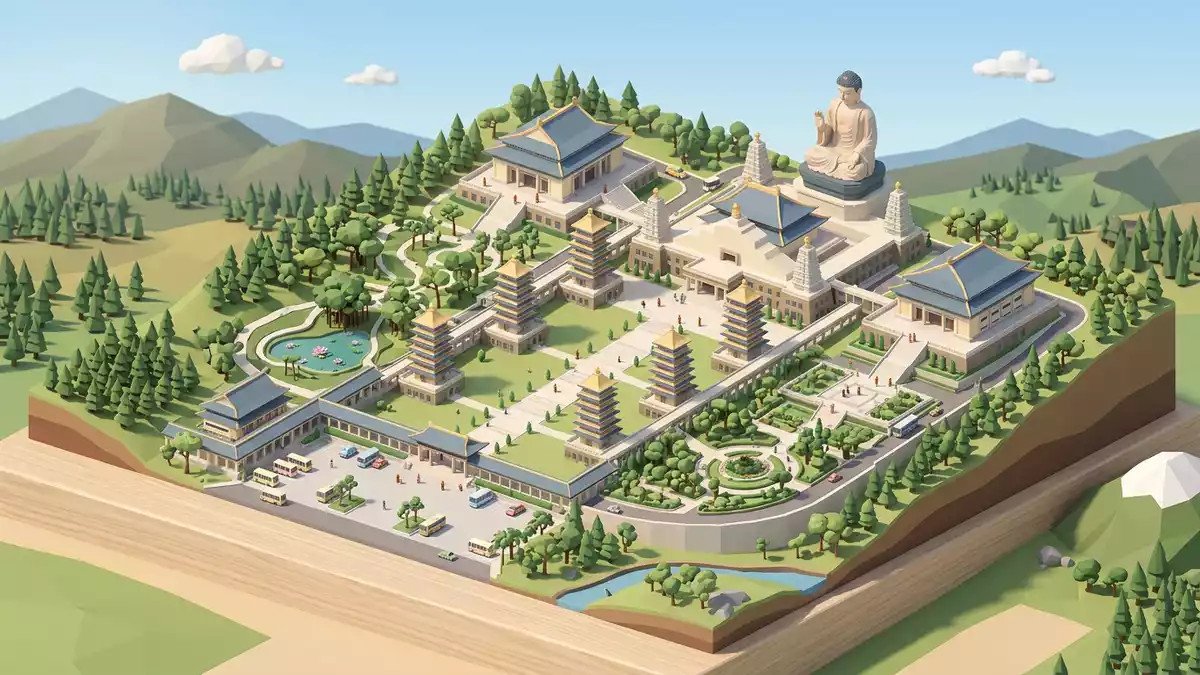
Fo Guang Shan Fojitu Jinianguan, known in English as the Fo Guang Shan Buddha Museum, is a vast Buddhist complex in Dashu District on the outskirts of Kaohsiung in southern Taiwan. Completed in 2011, it extends along a central axis culminating in a colossal seated Buddha rising above the main hall and surrounding pagodas, turning the museum into a monumental landscape of religious architecture.Completed in 2011
An axial walk through pagodas and plazas
The defining experience at Fo Guang Shan Fojitu Jinianguan is the long processional route leading from the entrance plaza towards the main hall and the giant Buddha. From the gateway, the site unfolds along a straight avenue flanked by a series of pagodas, creating a sense of symmetry that frames the distant statue on the skyline.Built along a central axial line The broad paving, low balustrades and open terraces give clear views back towards the entrance and out to the surrounding hills.
Near the far end of this avenue stands the main hall, behind which rises the large seated figure known as the Fo Guang Buddha.Fo Guang Buddha The Buddha statue sits on a high base, set above the roofline of the main hall and visible from many points along the approach. Around it, the layout brings together Indian and Chinese architectural references, combining pagoda forms with monumental halls and courtyards in a single sequence.
A modern Buddhist museum shaped by relics and teaching
Fo Guang Shan Fojitu Jinianguan functions as both a religious site and an educational museum dedicated to Mah?y?na Buddhism. It was founded by Venerable Master Hsing Yun of Fo Guang Shan, the monastic order whose main monastery stands adjacent to the museum complex in the hills between Kaohsiung and Pingtung.Founded by Venerable Master Hsing Yun The museum’s origin lies in the wish to enshrine Buddha relics, including a tooth relic housed within a dedicated shrine inside the complex.Buddha tooth relic
Within the main hall and adjoining structures, multiple exhibition spaces present Buddhist art, scriptures and artefacts. Some areas are arranged as thematic galleries, while others display ritual objects and statuary connected to different traditions within Mah?y?na practice.Multiple museums within the Main Hall A network of underground palaces beneath the complex contains further relics and collections, extending the museum below the surface as well as above it.Underground palaces
Architecture between Indian and Chinese traditions
Architecturally, Fo Guang Shan Fojitu Jinianguan brings together forms associated with different parts of the Buddhist world. The complex has been described as blending Indian and Chinese styles, with pagodas and tiled halls on the axial route leading towards a Buddha figure whose placement recalls large image halls and stupa compounds.Blends Indian and Chinese styles The eight pagodas lining the approach each carry their own internal spaces and symbolic design elements linked to Buddhist teachings.Eight pagodas
The seated Buddha dominates the skyline at the end of the axis and has been described as one of the largest figures of its kind in Asia, standing high above the surrounding rooftops.Asia's tallest seated Buddha Around the central route, side courts, gardens and smaller shrines create quieter pockets within the 100-hectare complex, while the adjacent Fo Guang Shan monastery adds further temples, living quarters and study spaces to the wider religious landscape.100 hectare complex
Visiting Fo Guang Shan Fojitu Jinianguan: what travellers from Western Europe should know
- Fo Guang Shan Fojitu Jinianguan stands in Dashu District north-east of central Kaohsiung, reached by road via National Highways connecting Kaohsiung with the Dashu exit and Provincial Highway 29.
- The terrain of the complex is broadly level but expansive, with a long paved avenue between pagodas and extensive plazas around the main hall and Buddha statue that involve substantial walking.
- The complex lies in southern Taiwan’s subtropical hills, so outdoor areas around the pagodas and courtyards can be exposed to sun and weather on the open axial route.
- The official language is Mandarin Chinese and the currency is the New Taiwan dollar.
- Entry requirements depend on your nationality; UK travellers can check the FCDO travel advice at gov.uk/foreign-travel-advice, Irish travellers the Department of Foreign Affairs at ireland.ie.
Searching for Fo Guang Shan Fojitu Jinianguan on social platforms
These links open searches for Fo Guang Shan Fojitu Jinianguan on each platform.Frequently asked questions about Fo Guang Shan Fojitu Jinianguan
Where is Fo Guang Shan Fojitu Jinianguan located?
Fo Guang Shan Fojitu Jinianguan stands in Dashu District in Kaohsiung City, in southern Taiwan, beside the Fo Guang Shan monastery in a hilly area outside the urban centre.Dashu District, Kaohsiung
What should visitors expect on a visit?
Visitors encounter a large Buddhist museum complex with exhibition halls, shrines and courtyards arranged along a long axial avenue between pagodas, leading to a towering seated Buddha above the main hall.Avenue and seated Buddha
What makes Fo Guang Shan Fojitu Jinianguan distinctive among Buddhist sites?
The combination of Buddha relics, extensive museum galleries, an axial design lined with pagodas and one of Asia’s tallest seated Buddha statues gives Fo Guang Shan Fojitu Jinianguan an unusually large scale and integrated museum-monastery setting.Relics and tall seated Buddha


