
Fo Guang Shan Fojitu Jinianguan and its avenue of pagodas
Published on 08/20/2026 at 16:17 | Editorial responsibility: Rafael Müller, Editor-in-Chief AD HOC NEWS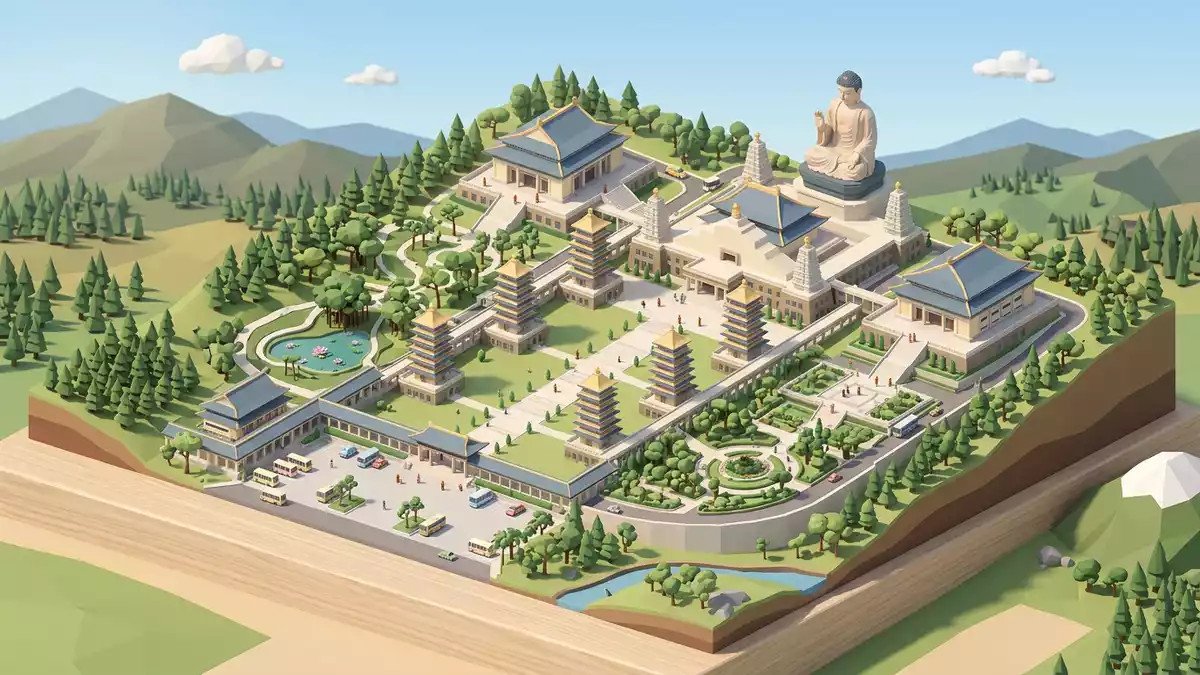
Fo Guang Shan Fojitu Jinianguan, also known in English as the Fo Guang Shan Buddha Museum, stretches across a broad hillside in Dashu District on the outskirts of Kaohsiung in Taiwan. Its defining sight is a long ceremonial axis framed by pagodas and culminating in a seated Buddha that rises above the complex, turning a walk into a gradual reveal of the entire layout.
An axis from mountain gate to Buddha
The museum forms part of the wider Fo Guang Shan monastery complex, which grew from the Buddhist order founded by Venerable Master Hsing Yun in the twentieth century.Fo Guang Shan monastery The Fojitu Jinianguan occupies a site in Dashu District, aligned roughly west to east between the visitor entrance and the great Buddha statue that crowns the far end of the grounds.Fo Guang Shan Buddha Museum
Planning for the museum began in the early 2000s and led to a dedicated memorial complex that opened in 2011 as the Buddha Memorial Center, later renamed Fo Guang Shan Buddha Museum.The memorial centre opened in 2011 The complex covers more than 100 hectares (around 250 acres), giving enough space for formal processional spaces, exhibition halls and gardens.
Pagodas, plazas and the Main Hall
The approach sequence is marked by eight pagodas facing each other in pairs along a central avenue, creating a perspective that draws the eye towards the Buddha statue at the far end.Eight pagodas line the main axis Between them lies a broad plaza in stone, with planted areas and pavilions set to the sides.
Beyond the pagodas stands the Main Hall, a stepped building whose roofline rises in stages towards the Buddha behind. Inside, it houses exhibition spaces and shrines, including a Jade Buddha Shrine where a tooth relic of the historical Buddha is enshrined.The Jade Buddha Shrine Beneath the complex, builders created dozens of underground chambers used to store Buddhist relics and artefacts, turning the site into a layered repository as well as a visible monument.Underground chambers store relics
A seated Buddha over the Dashu hills
At the eastern end of the axis rises a large seated Buddha image in bronze-coloured material, placed on a high base above the Main Hall terrace.The seated Buddha crowns the complex Its form recalls traditional Amitabha or Shakyamuni representations, with the figure facing along the line of pagodas towards the entrance plaza.
The Dashu hills around the site frame the complex with low ridges and greenery, so that the Buddha and pagodas stand against a backdrop of rising land rather than dense city streets.The complex stands between Kaohsiung and Pingtung Within this setting, the long processional route, the series of towers and the elevated statue together give Fo Guang Shan Fojitu Jinianguan a distinctive stepped profile when seen from a distance.
Visiting Fo Guang Shan Fojitu Jinianguan: what travellers from Western Europe should know
- Fo Guang Shan Fojitu Jinianguan stands in Dashu District, north-east of central Kaohsiung, and is reached by road towards the wider Fo Guang Shan monastery area.
- The formal axis from the entrance plaza to the Main Hall and Buddha involves a long walk over paved terraces, with shallow steps and broad open spaces exposed to the weather.
- The official language is Mandarin Chinese and the currency is the New Taiwan dollar.
- Entry requirements depend on your nationality; UK travellers can check the FCDO travel advice at gov.uk/foreign-travel-advice, Irish travellers the Department of Foreign Affairs at ireland.ie.
Searching for Fo Guang Shan Fojitu Jinianguan on social platforms
These links open searches for Fo Guang Shan Fojitu Jinianguan on each platform.
Frequently asked questions about Fo Guang Shan Fojitu Jinianguan
Where is Fo Guang Shan Fojitu Jinianguan?
Fo Guang Shan Fojitu Jinianguan stands in Dashu District in Kaohsiung, in southern Taiwan, as part of the wider Fo Guang Shan Buddhist complex.
What can visitors expect inside the complex?
Visitors encounter an avenue lined by pagodas, a broad plaza, the multi-level Main Hall with exhibition and shrine spaces, and a large seated Buddha above the Dashu hills.
What makes Fo Guang Shan Fojitu Jinianguan distinctive among Buddhist sites?
The combination of a processional axis, eight aligned pagodas, extensive underground relic chambers and a hillside Buddha image gives the museum a scale and layout that mark it out among Taiwanese Buddhist centres.


