
Flamsbana descends from mountain railway to fjord
Published on 09/24/2026 at 06:26 | Editorial responsibility: Rafael Müller, Editor-in-Chief AD HOC NEWS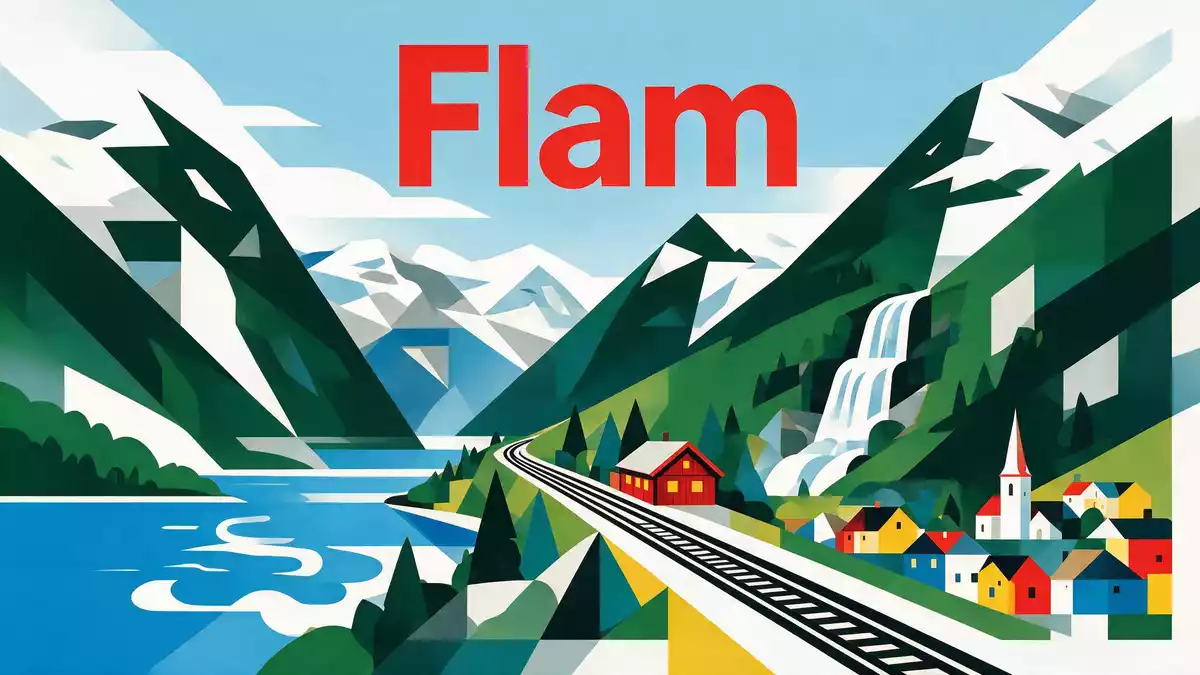
Flamsbana is a railway journey between Myrdal and Flam, linking a high mountain station with the village at the head of Aurlandsfjord. The line descends through steep terrain, tunnels and waterfalls, turning a railway into a changing cross-section of western Norway.
Flamsbana and the vertical landscape of Flam
The railway connects Myrdal, on the Bergen Line, with Flam beside Aurlandsfjord. Myrdal stands at 867 metres above sea level, while Flam lies at about 2 metres, creating an elevation difference of roughly 865 metres along the route. Myrdal and Flam stations mark two sharply different railway environments.
The route runs through the Flam valley, where mountain slopes rise above the track and the Flamselvi follows the valley floor. Waterfalls appear on the rock faces, while cultivated ground and scattered farm buildings occupy sections of the lower valley. At Kjosfossen, water drops beside the railway in a setting closely associated with the line.
Twenty kilometres shaped by tunnels and gradients
Flamsbana extends for about 20 kilometres and was constructed between 1923 and 1940. The Norwegian Government approved the railway in 1908, work began in 1923, and the completed line opened with steam trains in 1940. Passenger operation followed in 1941, and the railway was electrified in 1944. The railway’s construction history belongs to the period when Norway was extending connections between inland railways and fjord settlements.
The line contains twenty tunnels, including sections cut through the mountain rather than carried across open slopes. Curves, retaining structures and tunnel entrances appear repeatedly as the track changes elevation. The railway uses standard-gauge track and adhesion traction, without a rack system. Its steep profile is part of the visible character of the journey, especially where the track crosses exposed mountain shelves.
From Bergen Line connection to cultural railway
Flamsbana was established as a branch from the Bergen Railway at Myrdal to the fjord at Flam. The connection placed the village within Norway’s national railway network and linked the inland route with Aurlandsfjord. The line’s original transport role remains legible in its stations, track alignment and relationship with the Bergen Line.
Its historical identity is also tied to the people who built it. Hans Gløersen, a forester from Voss, presented early plans for a branch line in 1871. Construction then belonged to a much longer period of surveys, decisions and railway works before the line reached Flam. Historical milestones of Flamsbana show how the railway developed from a transport proposal into a lasting part of the region’s identity.
Visiting Flamsbana: what travellers from Western Europe should know
- Flamsbana runs between Flam at Aurlandsfjord and Myrdal on the Bergen Line. Flam connects with fjord transport, while Myrdal connects with the railway between Oslo and Bergen.
- The route crosses steep mountain terrain and includes tunnels, exposed slopes and sections beside waterfalls. The railway itself provides the passage through this landscape.
- Flam lies in Aurland municipality in western Norway. The official language is Norwegian and the currency is the Norwegian krone.
- Myrdal connects with Rallarvegen, a historic mountain road associated with construction work on the Bergen Railway. The route continues through highland terrain above the Flam valley.
Searching for Flamsbana on social platforms
These links open searches for Flamsbana on each platform.
Frequently asked questions about Flamsbana
Where is Flamsbana?
Flamsbana is in western Norway. It links Flam at the head of Aurlandsfjord with Myrdal on the Bergen Line.
What does the journey include?
The railway passes through mountain tunnels, beside steep slopes and near waterfalls. The route also crosses the cultivated lower Flam valley.
What makes Flamsbana distinctive?
Its defining feature is the descent between Myrdal and Flam across about 20 kilometres. The railway combines a high mountain connection, standard-gauge track and a fjord-side terminus in one route.


