
Fes el Bali: the living medieval heart of Fes
Published on 09/14/2026 at 13:44 | Editorial responsibility: Rafael Müller, Editor-in-Chief AD HOC NEWS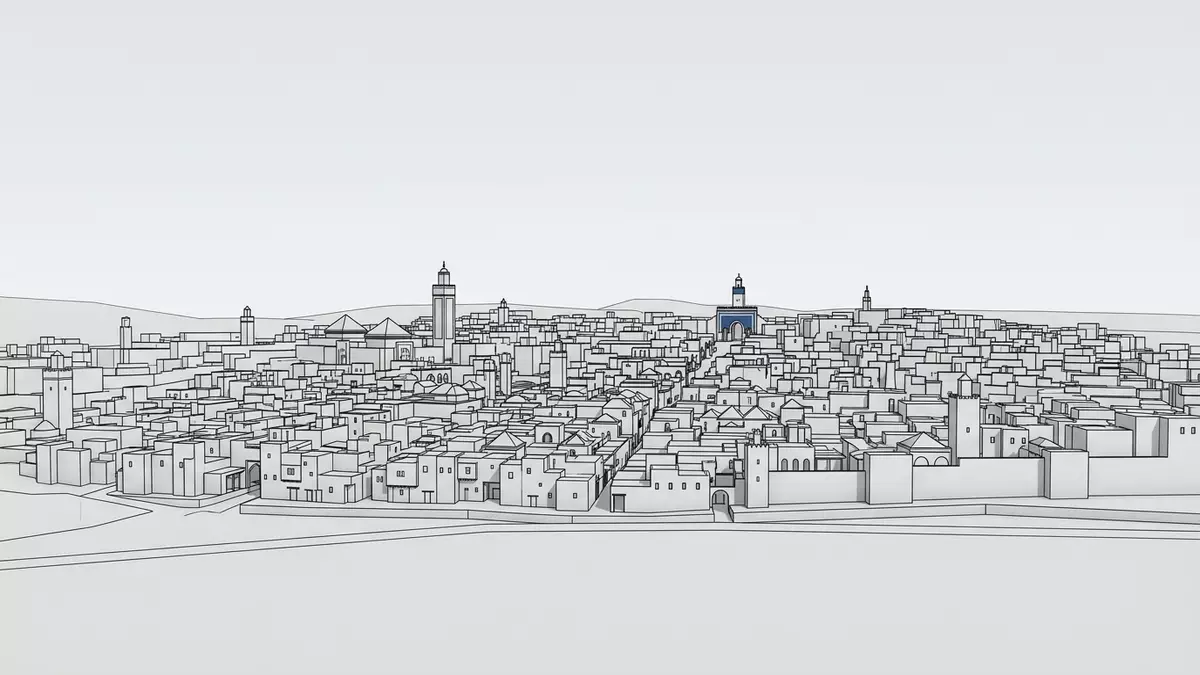
Fes el Bali is the walled historic core of Fes in northern Morocco, a dense hillside medina where a medieval street pattern and traditional buildings remain closely packed within ancient ramparts. Founded under the Idrisid dynasty in the late eighth and early ninth centuries, it forms the oldest part of the city and anchors Fes as a historic urban centre in Morocco.
Medina of Fes: a UNESCO-listed historic city
The district known as Fes el Bali forms part of the Medina of Fes, recognised by UNESCO as a cultural World Heritage Site under the name “Medina of Fez” in 1981.Medina of Fez inscription Together with neighbouring Fes Jdid and later French-built quarters, it represents a long urban history shaped over many centuries of Islamic rule in Morocco.oldest part of Fez
Fes el Bali stretches across a sizeable area enclosed by walls, with sources giving figures around a few hundred hectares for the historic medina, and it has been described as one of the largest contiguous pedestrian urban zones in the world.area and UNESCO criteria Narrow lanes, covered passages and stepped alleys form a complex network that supports a high residential population, while religious, educational and commercial buildings fill the interior blocks.
Founding under the Idrisids and medieval growth
The origins of Fes el Bali lie in the Idrisid period, when Idris I and his successor Idris II established the early city between 789 and 809 as a political and religious centre.Idrisid foundation between 789 and 808 Later dynasties, including the Almoravids in the eleventh century and the Almohads in the twelfth and thirteenth centuries, extended and unified the town within continuous ramparts, roughly giving the medina its present outline.Almoravid and Almohad expansion
Across the medieval centuries, religious foundations such as mosques and madrasas, commercial buildings including caravanserais and souks, and dense housing grew along sloping streets that follow the hillside and the course of the Oued Fes. The University and Mosque of Al Quaraouiyine, dating back to the ninth century, became a major centre of learning within the medina and contributed to Fes el Bali’s role in Islamic scholarship and regional trade.Al Quaraouiyine in the ninth century
Urban fabric, car-free lanes and craft traditions
One of the most striking features of Fes el Bali is its urban fabric: an intricate lattice of lanes and alleyways too narrow for vehicles, lined with stone and brick buildings that often rise several storeys and open onto small courtyards.world’s largest contiguous car-free urban area The medina contains thousands of streets and cul-de-sacs, creating a labyrinthine layout in which residential quarters, mosques, madrasas, hammams, and fondouks sit within walking distance of one another.network of narrow streets
Traditional crafts still occupy many ground-floor spaces, with tanners, metalworkers, woodcarvers and textile artisans using workshops that open directly onto the lanes. Historic tanneries, for instance, form visible basins and working terraces within the fabric of the district, demonstrating continuity of leatherworking practices over generations. Souks dedicated to particular trades cluster in different areas, illustrating how the medieval organisation of commerce remains legible in the present-day structure of the medina.
Visiting Fes el Bali: what travellers from Western Europe should know
- Fes el Bali occupies the historic centre of Fes in northern Morocco and is reached from newer districts by passing through a series of historic gates along main roads and pathways that descend into the walled medina.
- The terrain inside the medina is stepped and uneven, with long stretches on foot along narrow alleys, staircases and slopes that can feel demanding for visitors who are unused to walking on irregular surfaces.
- The official language is Arabic and the currency is the Moroccan dirham.
- Entry requirements depend on your nationality; UK travellers can check the FCDO travel advice at gov.uk/foreign-travel-advice, Irish travellers the Department of Foreign Affairs at ireland.ie.
Searching for Fes el Bali on social platforms
These links open searches for Fes el Bali on each platform.
Frequently asked questions about Fes el Bali
Where is Fes el Bali located?
Fes el Bali lies in the city of Fes in northern Morocco, forming the oldest enclosed medina within the city’s historic ramparts.
What can visitors expect inside the medina?
Visitors encounter a dense network of pedestrian lanes, historic mosques, madrasas, souks and residential quarters, with traditional crafts and markets woven into the everyday streetscape.
What makes Fes el Bali distinctive among historic cities?
Its combination of Idrisid foundations, continuous habitation, car-free medieval street layout and recognition as a UNESCO World Heritage Site makes Fes el Bali a distinctive example of an Islamic historic city.


