
Fes el Bali and the labyrinthine medieval core of Fes
Published on 09/10/2026 at 21:48 | Editorial responsibility: Rafael Müller, Editor-in-Chief AD HOC NEWS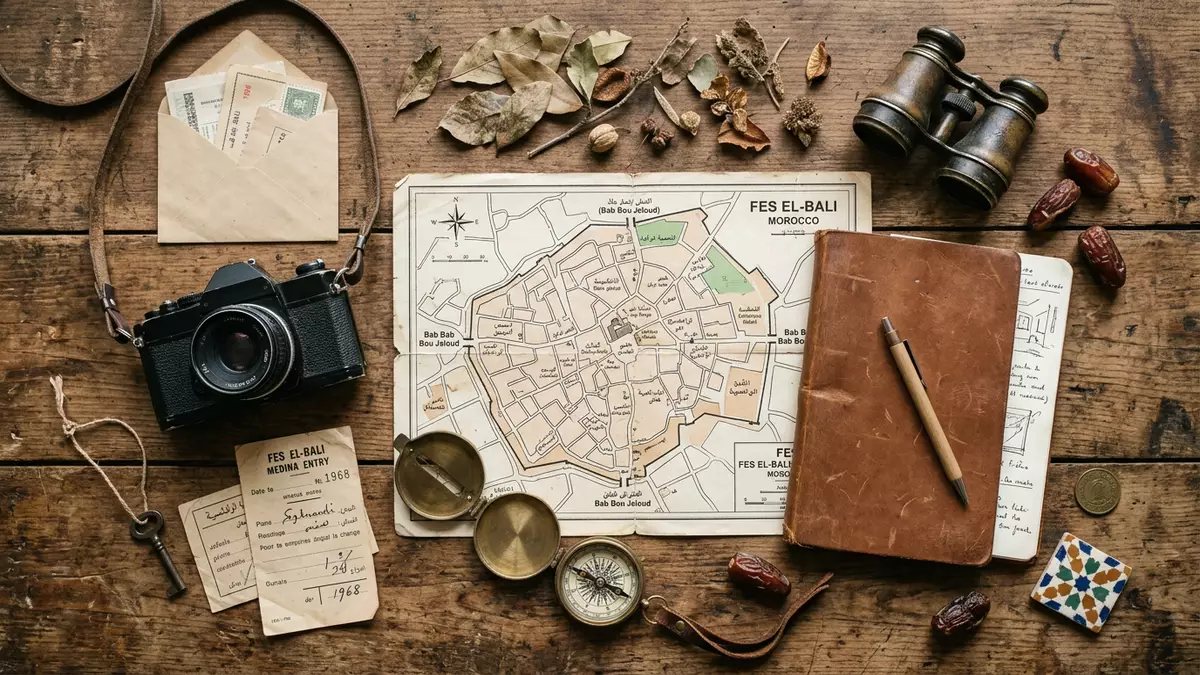
Fes el Bali is the oldest walled quarter of Fes in northern Morocco, a dense medieval medina where streets narrow into passages and houses rise close over the lanes. Founded as a capital under the Idrisid dynasty between 789 and 808, it forms the historic heart of one of Morocco’s imperial cities and anchors the wider urban story of Fes.Founded between 789 and 808
A walled Idrisid capital turned living city
At its core, Fes el Bali is a fortified district, enclosed by walls that separate the old city from the surrounding plain and later neighbourhoods.Oldest walled part of Fez The quarter began under Idris ibn Abdallah, whose dynasty established Fes as a centre of power in the western Islamic world.Idris ibn Abdallah as founder His son Idris II extended settlement on the opposite bank of the river, and over the eleventh century the two early towns were drawn together into a single urban whole.
Within the walls, the fabric of Fes el Bali is a compact lattice of lanes, covered passages and small squares. Houses, caravanserais and religious buildings stand close together, many built in plastered masonry with timber details and internal courtyards. The medina’s gates pierce the walls at intervals, marking points where routes from the countryside and newer districts enter the older city before dissolving into the winding interior streets.
Religious learning, markets and the Al Quaraouiyine mosque
Fes el Bali developed as a centre of religious and legal scholarship around the mosque and university complex of Al Quaraouiyine, founded in the ninth century by Fatima al-Fihri.Al Quaraouiyine founded by Fatima al-Fihri The institution grew from a mosque and madrasa into a prominent centre of higher learning, with teaching spaces, library rooms and courtyards woven into the surrounding urban fabric.Centre of higher learning
Around these religious institutions, Fes el Bali’s markets and workshops occupy long streets and covered alleys. Souks cluster by craft and trade, with areas devoted to leatherworking, textiles, metalwork and food. Many trading spaces retain their historic built form, with arcaded fronts, internal galleries and storage rooms above. Mosques and madrasas punctuate the commercial quarters, their minarets rising above the roofs and their entrances opening directly off busy lanes.
UNESCO status and a largely car-free urban maze
Fes el Bali, together with the neighbouring district of Fes Jdid, forms the Medina of Fez, inscribed as a UNESCO World Heritage Site in 1981.UNESCO inscription in 1981 The inscription covers the historic urban fabric, the walls and a buffer zone beyond them, recognising the area as one of the best conserved historic towns in the Arab-Muslim world.Description as historic town
The medina’s lanes form an extensive pedestrian zone where motor vehicles do not normally circulate.Large car-free urban area Goods move on handcarts and pack animals along routes that have followed similar alignments for centuries, and many streets are no wider than two people passing. Rooflines step along the slopes of the valley, while terraces, madrasa upper floors and minaret balconies provide views across a dense field of buildings broken only by the lines of main pathways and occasional open spaces.
Visiting Fes el Bali: what travellers from Western Europe should know
- Fes el Bali occupies the historic core of Fes in northern Morocco, enclosed by city walls and reached through several historic gates from the surrounding districts.
- Many streets inside the medina are narrow and stepped, with long stretches accessible only on foot and frequent changes in gradient on the valley slopes.
- The official language is Arabic and the currency is the Moroccan dirham.
- Entry requirements depend on your nationality; UK travellers can check the FCDO travel advice at gov.uk/foreign-travel-advice, Irish travellers the Department of Foreign Affairs at ireland.ie.
Searching for Fes el Bali on social platforms
These links open searches for Fes el Bali on each platform.
Frequently asked questions about Fes el Bali
Where is Fes el Bali located?
Fes el Bali forms the historic walled medina of Fes in northern Morocco, lying along a river valley within the wider urban area of the modern city.
What should visitors expect inside the medina?
Visitors encounter a compact maze of pedestrian lanes, stepped alleys, markets and religious buildings, with long stretches accessible only on foot and routes threading between tightly packed houses.
What makes Fes el Bali distinctive among historic cities?
Fes el Bali stands out for its largely intact medieval Islamic urban fabric, its concentration of mosques and madrasas, and its recognition as part of the Medina of Fez UNESCO World Heritage Site.


