
Fernando de Noronha, Brazil’s volcanic Atlantic archipelago
Published on 09/16/2026 at 20:31 | Editorial responsibility: Rafael Müller, Editor-in-Chief AD HOC NEWS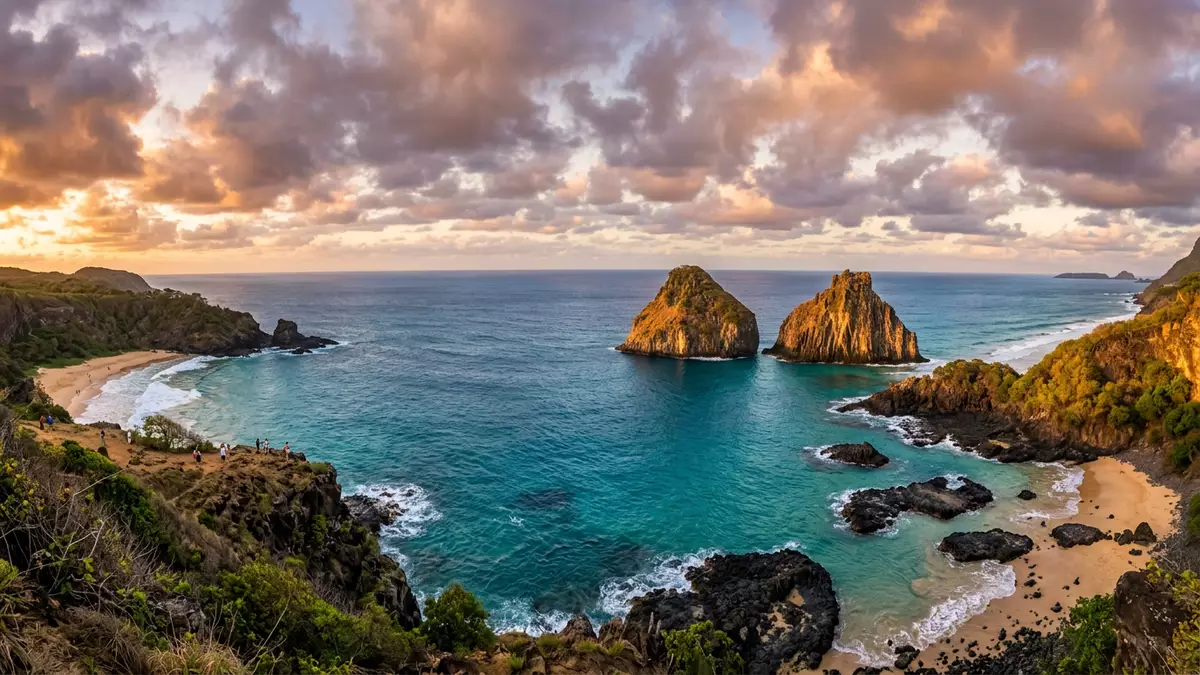
Fernando de Noronha is a small volcanic archipelago in the Atlantic Ocean off north?eastern Brazil, where dark rock slopes rise sharply above translucent water and protected coves shelter rich marine life. The islands form a remote state district of Pernambuco and have become a carefully managed destination for travellers who are willing to trade ease of access for a landscape that still feels shaped by ocean and stone.
Volcanic islands rising from the Atlantic
Fernando de Noronha lies in the equatorial South Atlantic, several hundred kilometres off the Brazilian mainland, and belongs to the state of Pernambuco in north?eastern Brazil.state district of Pernambuco The archipelago is made up of a main inhabited island surrounded by smaller islands and islets, all of volcanic origin, forming the emergent peaks of a submarine ridge in deep ocean water.volcanic mountain along a fracture zone
The largest island carries the name Fernando de Noronha and accounts for most of the land area of the archipelago, with smaller rocky outcrops scattered around it like fragments of the same dark stone.main island comprising most of the area Steep slopes and irregular peaks create a skyline that stands clear against the Atlantic, with cliffs dropping towards beaches and bays. Inland, low hills and rough ground reflect the volcanic foundations, while coastal areas transition quickly from rock to sand and then into water of striking clarity.
Protected waters and World Heritage status
Most of Fernando de Noronha’s surrounding waters form a protected marine national park that was established in the late 1980s to conserve habitats that had benefited from the islands’ isolation from mainland Brazil.marine national park created in 1988 Coral formations, sandy seabeds and rocky drop?offs lie within a relatively compact area, hosting crustaceans, reef fish and sea turtles as well as visiting pelagic species. Spinner dolphins and pantropical spotted dolphins are regularly present offshore, and humpback whales use the wider region as an area for breeding and raising calves.refuge for endemic species and marine mammals
The archipelago, together with Rocas Atoll further west, is recognised as a UNESCO Natural World Heritage Site under the name Brazilian Atlantic Islands, reflecting its role as part of a Southern Atlantic submarine ridge and its concentration of marine biodiversity.Brazilian Atlantic Islands: Fernando de Noronha and Rocas Atoll In addition, the Fernando de Noronha Archipelago is listed as a Ramsar wetland of international importance, signalling the ecological value of its coastal and marine environments.Ramsar wetland designation These formal protections shape how access, infrastructure and activities are organised, leaving wide areas of shoreline and water where natural processes remain visually dominant.
From strategic outpost to controlled tourism
Fernando de Noronha has long been tied to navigation and power in the Atlantic. The archipelago was discovered by the Italian navigator Amerigo Vespucci in 1503 during a Portuguese voyage, and it later served as an outpost on transatlantic routes.discovered by Amerigo Vespucci in 1503 For much of the twentieth century it held the status of a federal territory of Brazil, reflecting its strategic importance and distinct administration, before becoming a state district of Pernambuco in 1988.from federal territory to state district
Today the inhabited island combines small settlements, simple road networks and modest visitor infrastructure with military installations and conservation facilities. Tourism focuses on activities that rely directly on the landscape and seascape, such as boat excursions, diving and walking, rather than on large?scale built attractions.archipelago as Brazilian tourist destination Environmental regulation aims to balance the needs of the resident community with the pressures of visitor interest, reinforcing the impression of a place where the ocean, the volcanic rock and the protected waters remain the defining elements.
Visiting Fernando de Noronha: what travellers from Western Europe should know
- Fernando de Noronha lies in the Atlantic Ocean off Brazil’s north?eastern coast and is reached by flights from mainland Brazilian cities such as Recife in Pernambuco.
- The terrain on the main island combines steep volcanic slopes, rough tracks and sandy beaches, so many viewpoints and bays involve walking over uneven ground and climbing or descending steps.
- The official language is Portuguese and the currency is the Brazilian real.
- Entry requirements depend on your nationality; UK travellers can check the FCDO travel advice at gov.uk/foreign-travel-advice, Irish travellers the Department of Foreign Affairs at ireland.ie.
Searching for Fernando de Noronha on social platforms
These links open searches for Fernando de Noronha on each platform.
Frequently asked questions about Fernando de Noronha
Where is Fernando de Noronha located?
Fernando de Noronha is an Atlantic archipelago belonging to the Brazilian state of Pernambuco, situated off the country’s north?eastern coast.
What should travellers expect on a visit?
Travellers encounter a small inhabited island with limited infrastructure, steep volcanic terrain, sandy beaches and protected marine areas focused on nature?based activities.
What makes Fernando de Noronha distinctive?
The combination of volcanic island scenery, clear equatorial waters, concentrations of marine life and its dual status as UNESCO World Heritage Site and marine national park gives Fernando de Noronha a distinct character.


