
Fernando de Noronha, Brazil’s Atlantic island of cliffs and coves
Published on 08/28/2026 at 14:50 | Editorial responsibility: Rafael Müller, Editor-in-Chief AD HOC NEWS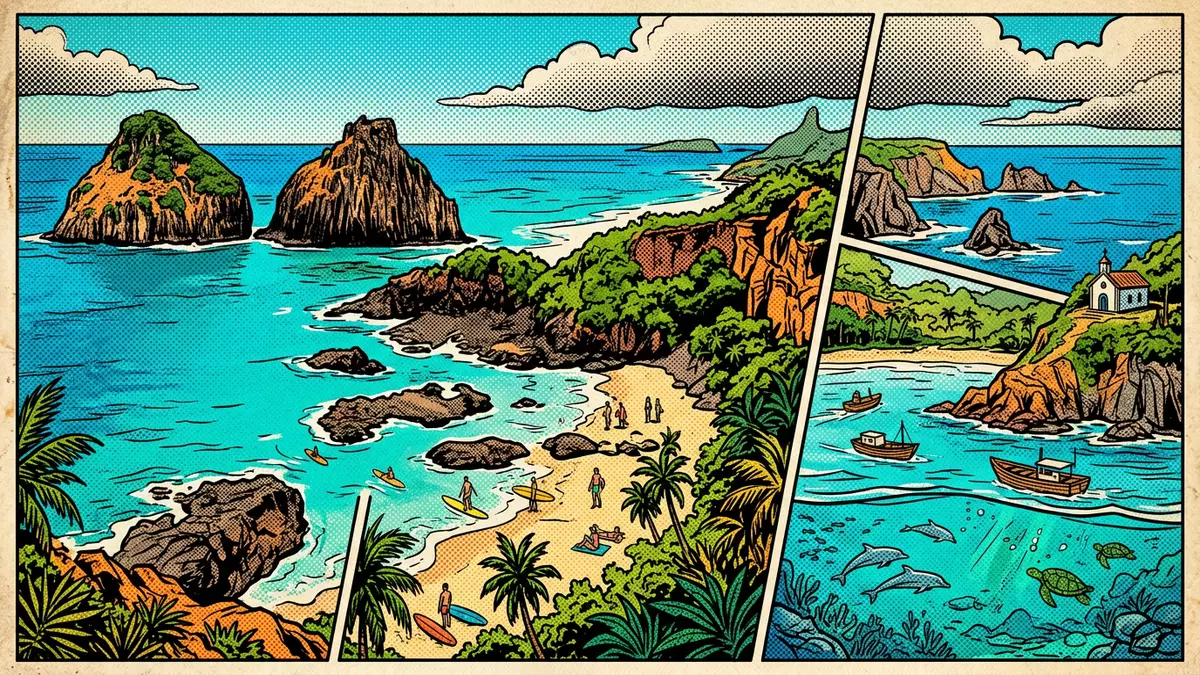
Fernando de Noronha is a remote Atlantic archipelago off north?eastern Brazil, where dark volcanic cliffs fall straight into clear water and small beaches are tucked into protected coves. Recognised as part of the Brazilian Atlantic Islands World Heritage Site in 2001, it combines rugged geology with strict conservation in a way that shapes every visit.
Volcanic peaks in the open Atlantic
The Fernando de Noronha archipelago lies in the Western South Atlantic Ocean, off the coast of Brazil’s state of Pernambuco, and forms the visible peaks of a submerged volcanic mountain chain.Western South Atlantic Ocean The main island concentrates most human settlement, while smaller islands and islets form a broken ring of dark rock around it.main island and smaller islands
Nearly 70% of the main island and many of the surrounding islets fall within legally protected areas that extend into the surrounding sea.70% of the main island Sheer rock faces, headlands and stacks break up the coastline, creating headlands with views over long sweeps of ocean where the next landfall lies far away on the horizon.
A protected marine park and World Heritage Site
In 1988, most of Fernando de Noronha became a national marine park, bringing both the island and surrounding waters under conservation rules.national marine park in 1988 The protected core area covers more than 40,000 ha when combined with the separate Rocas Atoll reserve, forming one of Brazil’s most carefully regulated oceanic conservation zones.core area of 42,270 hectares
UNESCO inscribed the “Brazilian Atlantic Islands: Fernando de Noronha and Atol das Rocas Reserves” on the World Heritage List on 16 December 2001, recognising their importance for marine life, including sharks, sea turtles and marine mammals.World Heritage List on 16 December 2001 Parts of the archipelago are also recognised under the Ramsar Convention as a wetland of international importance, underlining how the islands function as a refuge for coral species and large groups of dolphins and whales.Ramsar wetland of international importance
History, fortifications and island life
The discovery of Fernando de Noronha is linked to the Italian navigator Amerigo Vespucci, who reached the island in 1503 during an expedition commanded by Gonçalo Coelho and financed by the Portuguese merchant Fernão de Loronha.expedition commanded by Gonçalo Coelho Written accounts from that journey describe an uninhabited island with abundant fresh water, dense vegetation and large numbers of birds.
Over the following centuries, the island’s position in the Atlantic sea lanes led to the construction of defensive works whose remains still overlook parts of the coast.defensive works on the island Present?day island life reflects this mixture of small?scale settlement, historic structures and strict environmental limits that keep large areas under conservation.
Visiting Fernando de Noronha: what travellers from Western Europe should know
- Fernando de Noronha lies off the north?eastern coast of Brazil in the Atlantic Ocean, and access is by air from Brazilian mainland cities to the island’s airport.
- Terrain on the main island alternates between paved stretches and uneven paths, and many viewpoints and beaches are reached by stairways or steep tracks over volcanic rock.
- On the seaward side of the island, high cliffs rise above narrow strips of sand, while the landward bays tend to have gentler slopes and more sheltered coves.
- The archipelago belongs to the state of Pernambuco in Brazil, where the official language is Portuguese and the currency is the Brazilian real.
- Entry requirements depend on your nationality; UK travellers can check the FCDO travel advice at gov.uk/foreign-travel-advice, Irish travellers the Department of Foreign Affairs at ireland.ie.
Searching for Fernando de Noronha on social platforms
These links open searches for Fernando de Noronha on each platform.
Frequently asked questions about Fernando de Noronha
Where is Fernando de Noronha?
Fernando de Noronha is an oceanic archipelago in the Atlantic Ocean off north?eastern Brazil, belonging to the state of Pernambuco.
What can visitors expect on a visit?
Visitors encounter steep volcanic landscapes, small beaches in rocky coves, designated viewpoints over the ocean and strict protection of much of the surrounding marine environment.
What makes Fernando de Noronha distinctive?
Fernando de Noronha combines a remote volcanic island setting with national park status and World Heritage recognition for its rich marine life and protected coastal scenery.


