
Fenway Park’s quirky corners and classic baseball geometry
Published on 08/25/2026 at 11:34 | Editorial responsibility: Rafael Müller, Editor-in-Chief AD HOC NEWS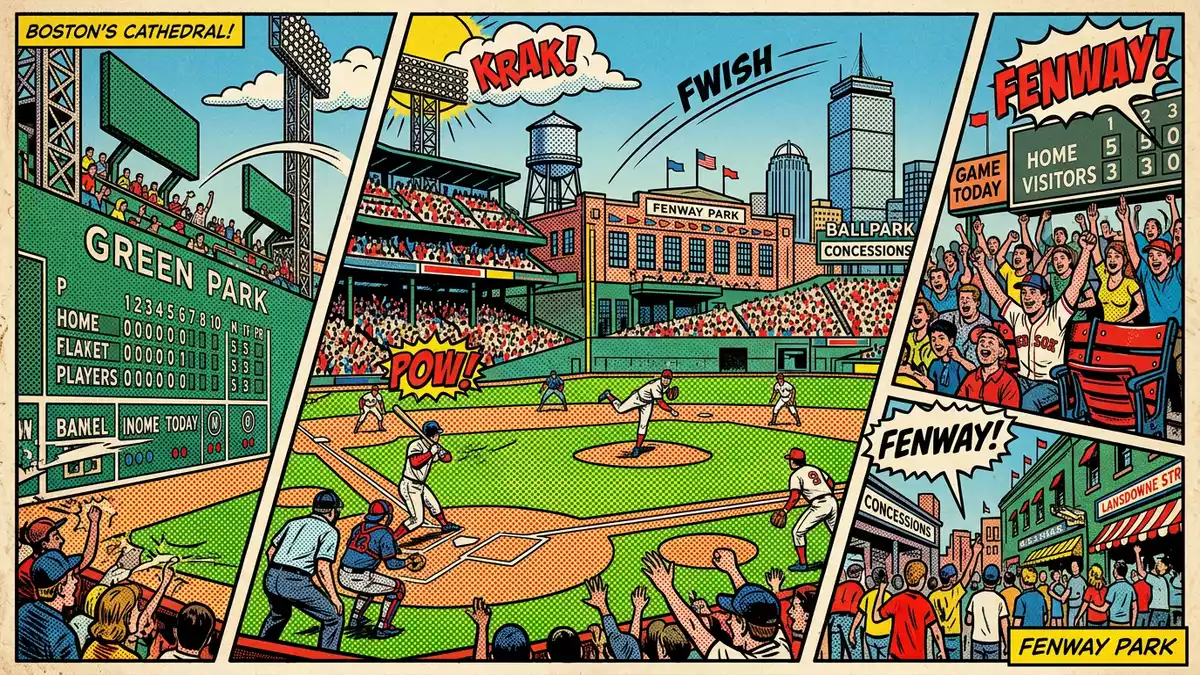
Fenway Park in Boston is a compact, early twentieth-century baseball stadium where irregular field lines, tight seating and looming outfield walls shape a distinctive sense of space. Opened in 1912 as the home of the Boston Red Sox, it remains a working ballpark whose quirks are as much a draw as the games played on its Kentucky bluegrass field.
A century-old ballpark in the Fenway district
Fenway Park stands in the Fenway–Kenmore neighbourhood of Boston, on a block bordered by Brookline Avenue and streets long associated with the ballpark such as Lansdowne Street and Jersey Street.Fenway–Kenmore neighbourhood of Boston The site was acquired in 1911 by Red Sox owner John I. Taylor, whose family interests also included Fenway Realty, and construction began that year on a steel-and-concrete stadium wrapped in a brick exterior.construction began that year
The park opened on 20 April 1912, with the Red Sox defeating the New York Highlanders in the first professional game played in the new stadium.opened on 20 April 1912 It has been the Red Sox home field ever since, and is recognised as the oldest active ballpark in Major League Baseball.oldest active ballpark in Major League Baseball The ballpark’s cultural status was underlined in 2012 when it was added to the National Register of Historic Places, a formal recognition of its historical and architectural significance.added to the National Register of Historic Places
The Green Monster and a field of irregular angles
The first impression on stepping into Fenway Park is the scale and presence of the left-field wall, universally known as the Green Monster, which rises over the field in painted steel and serves as a backdrop to the short distance down the left-field line.Green Monster It stands about 11 m (37 ft) high and has long turned what might be routine fly balls elsewhere into hard-hit plays off the wall, with seats later added along its upper edge.about 11 m (37 ft) high
Fenway’s playing field is markedly asymmetric, with the foul line in left field measuring about 94.5 m (310 ft) and the right-field line listed at about 92 m (302 ft), creating very different profiles for left and right-handed hitters.foul line in left field The power alleys and centre field stretch out further, with centre field reaching about 119 m (390 ft), so the outfield fence traces a jagged line that reflects the constrained block on which the ballpark was laid out.centre field reaching about 119 m
Seats, steel columns and layers of history
Inside the seating bowl, Fenway Park reveals its 1912 origins in structural details such as the steel columns that support the upper decks and create both character and obstructed views.steel columns that support the upper decks The original construction used a combination of concrete, steel and brick, creating a robust shell that has been adapted over the decades with new seating sections, concourses and hospitality areas while retaining the basic bowl and field alignment laid out in the early twentieth century.concrete, steel and brick
The official seating capacity is slightly under 40,000, placing Fenway among the smaller stadiums in Major League Baseball and contributing to an enclosed, intimate feel when the stands are full.smaller stadiums in Major League Baseball Over the decades, ownership and management added features such as a hand-operated scoreboard in the base of the Green Monster, luxury boxes above the main seating bowl and additional seating terraces, so visitors encounter a layered structure in which early twentieth-century fabric sits alongside late twentieth-century and early twenty-first-century additions.hand-operated scoreboard
Visiting Fenway Park: what travellers from Western Europe should know
- Fenway Park stands southwest of central Boston, close to Kenmore Square, and is reached by Boston’s light rail Green Line, which stops at Kenmore station near the ballpark.
- The stadium interior includes stepped terraces and narrow concourses, and many seating sections are accessed by staircases rather than lifts.
- The field sits only a short way above sea level, and the open-air design exposes both field and stands to Atlantic weather moving in from Boston’s harbour.
- English is the official language and the currency is the United States dollar.
- Entry requirements depend on your nationality; UK travellers can check the FCDO travel advice at gov.uk/foreign-travel-advice, Irish travellers the Department of Foreign Affairs at ireland.ie.
Searching for Fenway Park on social platforms
These links open searches for Fenway Park on each platform.
Frequently asked questions about Fenway Park
Where is Fenway Park located?
Fenway Park stands in the Fenway–Kenmore neighbourhood of Boston, on a block framed by Brookline Avenue, Lansdowne Street and Jersey Street.
What can visitors expect during a visit?
Visitors encounter a compact, early twentieth-century ballpark with steel columns, tight seating and sightlines shaped by the Green Monster and an irregular outfield.
What makes Fenway Park distinctive among baseball stadiums?
Its combination of opening in 1912, asymmetric field dimensions and the high left-field wall known as the Green Monster sets it apart from more regular, modern stadium designs.


