
Fenway Park and the geometry of Boston baseball
Published on 09/24/2026 at 09:22 | Editorial responsibility: Rafael Müller, Editor-in-Chief AD HOC NEWS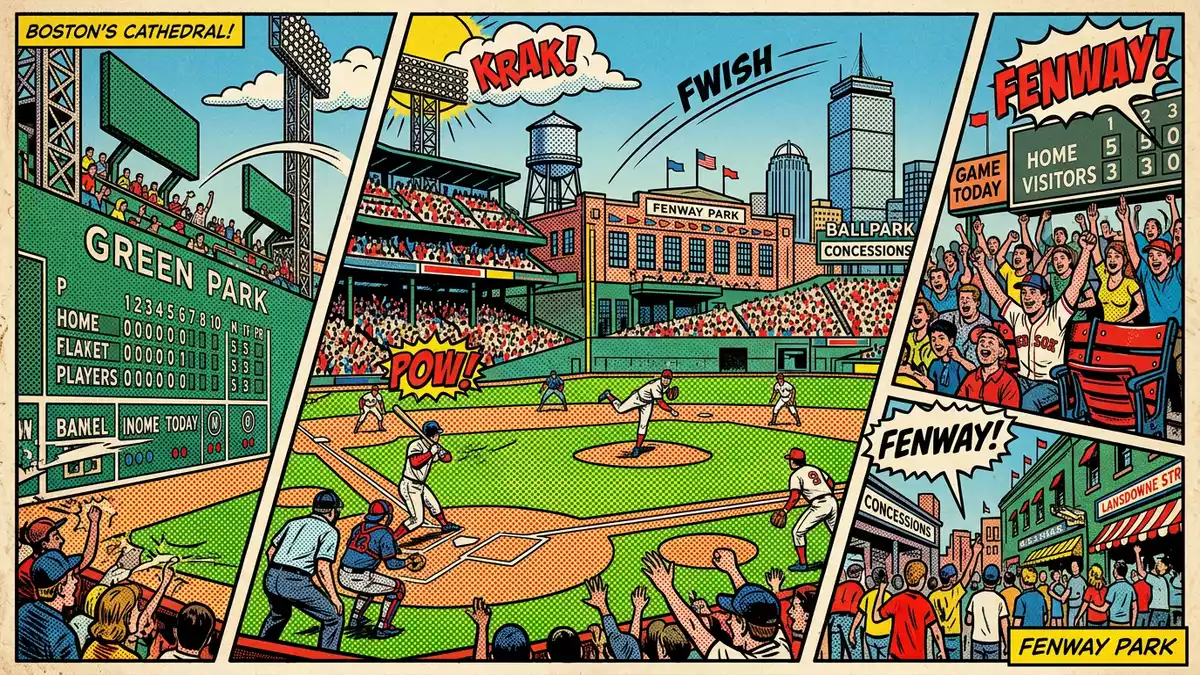
Fenway Park is a baseball ground shaped by asymmetry. The Boston Red Sox have played at this steel-and-reinforced-concrete ballpark since 20 April 1912, while the Green Monster rises behind left field. Its compact footprint, angled stands and changing distances make the playing field part of the place’s identity.
Fenway Park’s uneven field tells its history
The first professional game at Fenway Park took place on 20 April 1912, when Boston defeated the New York Highlanders 7–6 in eleven innings. The Red Sox have used the ground as their home since its opening, giving the stadium a continuous connection with Major League Baseball across more than a century.
The original plans were drawn by James E. McLaughlin, with structural engineering by the Osborn Engineering Company. The stadium belongs to the steel-and-concrete generation of American ballparks, and its form remains visibly different from a regular rectangle. The field dimensions vary around the outfield: the left-field line measures about 310 ft (94.5 m), deep centre reaches about 420 ft (128 m), and the right-field foul pole stands about 302 ft (92 m) from home plate. Fenway’s field geometry remains a defining physical feature.
The Green Monster behind left field
The Green Monster is the tall wall behind left field. It rises about 37 ft (11.3 m) and sits close to the left-field line, where the distance from home plate is about 310 ft (94.5 m). The wall’s height and position give that side of the outfield a strong vertical presence.
The wall was part of Fenway Park from its opening, although its appearance changed. Advertising covered the surface during an earlier phase, and it was painted green in 1947. A manually operated scoreboard occupies part of the wall, while seating is placed above it. The 1912 opening-day history connects the wall with the earliest Red Sox games at the ground.
A Boston landmark with several sporting lives
Fenway Park is associated with Red Sox baseball, but its spaces have also hosted other sporting events, concerts and public gatherings. Its National Register of Historic Places listing dates from 7 March 2012, recognising the ballpark’s historic and architectural significance.
The stadium’s name belongs to the Fenway–Kenmore area of Boston, west of the city centre. Jersey Street runs beside the park, while Lansdowne Street borders the outfield side. Inside, the seating areas, foul poles, scoreboard and wall form a collection of named details rather than a single uniform enclosure. National Register recognition records the place as part of the historic landscape of American professional sport.
Visiting Fenway Park: what travellers from Western Europe should know
- Fenway Park stands at 4 Jersey Street in Boston’s Fenway–Kenmore area, beside Brookline Avenue and Lansdowne Street.
- The MBTA Green Line reaches the park through Kenmore station on the B, C and D branches. Fenway station also serves the D branch.
- The playing field has uneven outfield distances, with the Green Monster in left field and Pesky’s Pole near the right-field foul line.
- Boston’s official language is English, and the national currency is the United States dollar.
Searching for Fenway Park on social platforms
These links open searches for Fenway Park on each platform.Frequently asked questions about Fenway Park
Where is Fenway Park?
Fenway Park is in Boston’s Fenway–Kenmore area, at 4 Jersey Street beside Brookline Avenue and Lansdowne Street.
What can visitors expect to see?
The ballpark contains historic seating areas, an uneven outfield, a manual scoreboard and the Green Monster behind left field.
What makes Fenway Park distinctive?
Its identity comes from the combination of a 1912 ballpark, irregular field dimensions and the tall Green Monster wall.


