
Federation Square and Melbourne’s angular civic landscape
Published on 09/23/2026 at 20:47 | Editorial responsibility: Rafael Müller, Editor-in-Chief AD HOC NEWS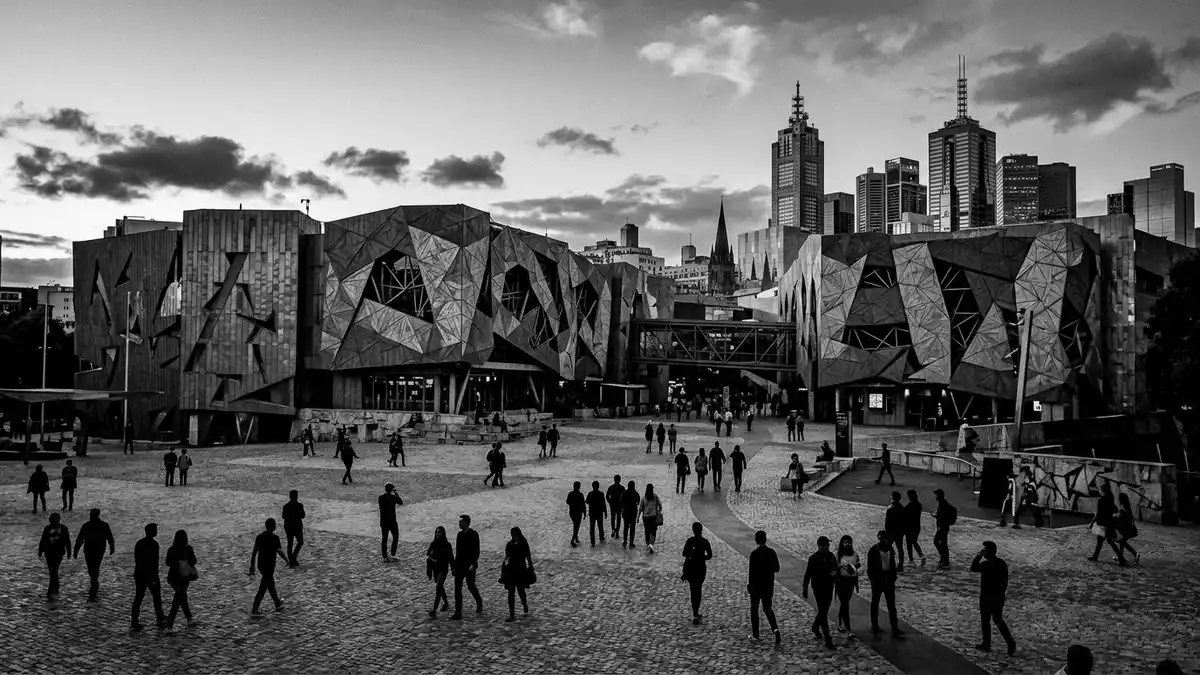
Federation Square is a civic and cultural precinct beside the Yarra River in central Melbourne. Its angular buildings, faceted façades and open public spaces form a visible contrast with the historic railway station opposite. The complex opened on 26 October 2002, and its architecture remains inseparable from the public life of Melbourne.
Federation Square’s faceted architecture
The precinct was designed by LAB Architecture Studio with Bates Smart. Its buildings use intersecting planes, triangular panels and changing surface patterns rather than a single classical façade. Sandstone, zinc and glass appear across the exterior, producing a varied material palette around the open spaces.
The Atrium forms a major interior public space beneath a glass roof. St Paul’s Court connects the precinct with nearby streets and the cathedral, while the paved Plaza contains Nearamnew, a large permanent artwork integrated into the ground surface. The square also includes bluestone steps, planters and Yellow Gum trees.
The architectural design was selected through an international competition, with the winning proposal announced on 28 July 1997. LAB Architecture Studio and Bates Smart became joint architects and interior designers for the project.
From railway deck to cultural precinct
Federation Square occupies a deck above railway lines and platforms near Flinders Street Station. The layered setting is part of its physical character: trains operate below, while cultural buildings, laneways and civic spaces sit above them.
The precinct commemorates the Federation of Australia in 1901. Its opening in 2002 followed a construction period dated from 1996 to 2002. Federation Square opened in 2002 after the centenary year had passed.
The site contains cultural institutions, performance spaces, restaurants and areas for public gatherings. The Australian Centre for the Moving Image occupies a prominent position within the precinct, with exhibitions and cinemas dedicated to film, television, videogames and digital culture.
Federation Square also forms part of Melbourne’s civic geography. Flinders Street Station lies across Swanston Street, St Paul’s Cathedral stands nearby, and the Yarra River runs beside the southern edge of the precinct. The arrangement places transport, religion, water and public culture within a compact urban setting.
Heritage, public art and urban identity
Federation Square entered the Victorian Heritage Register on 12 September 2019 as Registered Place H2390. The listing recognises historical, architectural, aesthetic, cultural and technical significance.
Victorian heritage registration gives the precinct a formal place in the state’s architectural history. Federation Square is also associated with Melbourne’s long civic interest in a substantial public square.
The surface patterns are among the precinct’s most recognisable details. Small triangular components combine into larger panels across walls and roofs, while the changing angles create a fragmented visual language. This geometry continues through the Atrium, the surrounding façades and the public routes between them.
Nearamnew, by artist Paul Carter, is embedded in the Plaza. Inscriptions appear in the bluestone steps and apron facing St Paul’s Court. These elements place text, planting and artwork directly within the everyday fabric of the square.
Federation Square is therefore both architecture and public ground. Its identity comes from the relationship between angular buildings, open paving, cultural venues, transport infrastructure and the river corridor. The result is a civic landscape shaped as much by surfaces and connections as by enclosed rooms.
Visiting Federation Square: what travellers from Western Europe should know
- Federation Square is in central Melbourne beside the Yarra River, opposite Flinders Street Station and near St Paul’s Cathedral.
- Train services arrive at Flinders Street Station, while trams and city streets connect the precinct with Melbourne’s central grid.
- The precinct combines open plazas, steps, laneways and enclosed cultural venues, with different surfaces underfoot across the complex.
- The Australian Centre for the Moving Image, the Atrium, St Paul’s Court and the Plaza are named places within Federation Square.
- The official language is English and the currency is the Australian dollar.
Searching for Federation Square on social platforms
These links open searches for Federation Square on each platform.Frequently asked questions about Federation Square
Where is Federation Square?
Federation Square is beside the Yarra River in central Melbourne, opposite Flinders Street Station and close to St Paul’s Cathedral.
What can visitors expect at Federation Square?
The precinct contains open plazas, laneways, public art, restaurants and cultural institutions, including the Australian Centre for the Moving Image.
What makes Federation Square distinctive?
Its faceted architecture, triangular surface patterns, glass-roofed Atrium and position above railway lines give the civic precinct a distinctive urban form.


