
Fasil Ghebbi, the walled royal enclosure of Gondar
Published on 09/08/2026 at 14:40 | Editorial responsibility: Rafael Müller, Editor-in-Chief AD HOC NEWS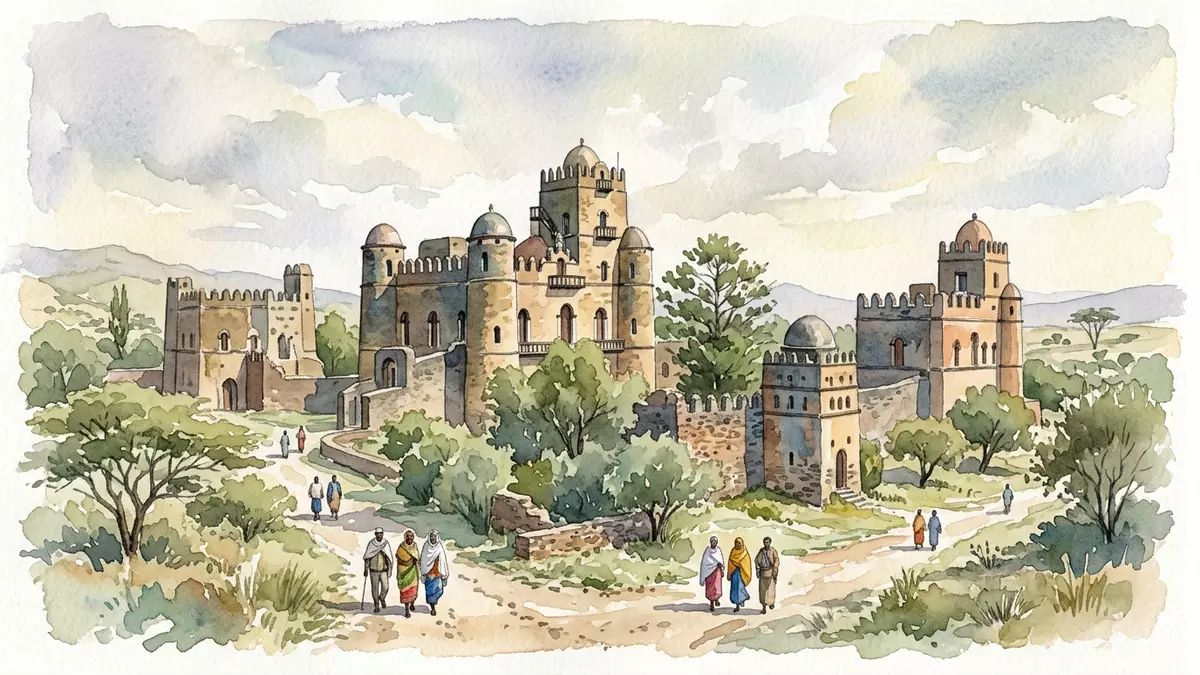
In the highland city of Gondar in Ethiopia’s Amhara Region, Fasil Ghebbi forms a walled royal enclosure where stone castles and churches stand together inside a single compound. Built as a permanent seat of power in the seventeenth century under Emperor Fasilides, it later became one of UNESCO’s recognised World Heritage fortress?cities, marking a distinctive chapter of Ethiopian architecture and monarchy.
Stone castles on the Ethiopian plateau
Fasil Ghebbi occupies a plateau in central Gondar, enclosed by a long masonry wall punctuated by towers and gates that separate the royal compound from the surrounding town.fortified compound Within this enclosure, the most striking structure is the castle attributed to Emperor Fasilides, whose decision in 1636 to settle his court in Gondar ended the earlier pattern of mobile royal camps and fixed the city as Ethiopia’s capital.King Fasilides settled in Gondar in 1636 Built in stone with robust corner towers and battlements, this castle has a profile that recalls a medieval stronghold, yet it sits amid the distinctive landscape and religious traditions of northern Ethiopia.
The enclosure extends across roughly 70,000 m² of ground, creating space for several palaces, halls and churches linked by open lawns and paths.about 70,000 m² Successive emperors added their own residences and service buildings: structures associated with Iyasu I, Dawit III, Bakaffa, Empress Mentewab and Yohannes I stand alongside stables and other service blocks.complex of buildings includes several castles Walking through the compound, the eye moves from high towers and crenellated walls to lower halls and church facades, all built in stone yet differing in scale and detailing.
An imperial capital shaped by many influences
When Fasilides made Gondar his capital in the seventeenth century, the royal enclosure became the centre of government for Ethiopian emperors, and it retained this role until the nineteenth century.Gondar remained the capital under successive emperors until 1864 The walled compound concentrated imperial, religious and administrative life in a relatively compact area, with palaces, chancellery buildings, libraries and churches arranged inside the perimeter.palaces, churches, monasteries and public buildings Beyond its walls, further monasteries and related sites in and around Gondar are associated with the same royal era, forming the wider serial World Heritage property.
The architecture of Fasil Ghebbi reflects the exchanges that shaped Gondar’s court culture. Several descriptions highlight a blend of influences: elements associated with Hindu and Arab building traditions appear in the design, later combined with Baroque features brought by Jesuit missionaries working in Ethiopia in the seventeenth century.Hindu and Arab influences transformed by Baroque style Within the enclosure, this mixture gives the castles and churches an appearance that differs from older highland churches around Lake Tana, while still bearing the mark of Ethiopian Orthodox practice in their layout and setting.influenced Ethiopian architecture
UNESCO?listed fortress?city and its surviving structures
The historical and architectural importance of Fasil Ghebbi led to its inscription on the UNESCO World Heritage List in 1979, under the entry “Fasil Ghebbi, Gondar Region”.inscribed as a World Heritage Site in 1979 This status recognises the fortress?city as a major testimony to Ethiopian civilisation on the highlands from the sixteenth to the eighteenth centuries, and it helps frame the site as a key monument within Gondar, which is sometimes described as a “Camelot of Ethiopia” because of its group of castles.Camelot of Ethiopia
Within the enclosure, the named structures map out the sequence of imperial builders. Fasilides’ castle stands near halls associated with Dawit III, while the banqueting hall linked with Emperor Bakaffa and the palace connected to Empress Mentewab occupy adjoining plots.Bakaffa Castle and Mentewab’s Palace The chancellery and library associated with Yohannes I point to the administrative and scholarly functions of the compound, and three churches within the walls continue the religious thread of the site’s history.chancellery, library and three churches Many walls and towers show traces of wear and partial damage, yet the main volumes of the castles still rise clearly above the lawns and pathways.
Visiting Fasil Ghebbi: what travellers from Western Europe should know
- Fasil Ghebbi stands in the centre of Gondar in Ethiopia’s Amhara Region, on the northern highlands near Lake Tana, and is reached by road from Gondar Airport and other towns in the region.
- The enclosure contains lawns and uneven ground between stone buildings, and access to upper castle levels runs through stairways inside thick walls.
- The site lies at an elevation above 2,000 m (6,562 ft), so the air is thinner than at sea level and the sun can be strong on the plateau.
- Nearby, Gondar’s wider heritage ensemble includes additional churches and monasteries associated with the same imperial era beyond the main enclosure.
- The official language is Amharic and the currency is the Ethiopian birr. Entry requirements depend on your nationality; UK travellers can check the FCDO travel advice at gov.uk/foreign-travel-advice, Irish travellers the Department of Foreign Affairs at ireland.ie.
Searching for Fasil Ghebbi on social platforms
These links open searches for Fasil Ghebbi on each platform.
Frequently asked questions about Fasil Ghebbi
Where is Fasil Ghebbi located?
Fasil Ghebbi stands in Gondar in Ethiopia’s Amhara Region, on the northern highlands not far from Lake Tana, enclosed within a historic walled compound.
What can visitors expect inside the enclosure?
Visitors encounter stone castles, palaces, halls and churches arranged within a large walled area, with lawns and paths linking the buildings and towers rising above the grounds.
What makes Fasil Ghebbi distinctive among Ethiopian sites?
Its group of seventeenth?century castles and churches within one fortified enclosure, shaped by local and foreign architectural influences and recognised as a UNESCO World Heritage fortress?city, gives it a distinctive place in Ethiopia’s history.


