
Fasil Ghebbi, Gondar’s walled city of emperors
Published on 09/16/2026 at 10:20 | Editorial responsibility: Rafael Müller, Editor-in-Chief AD HOC NEWS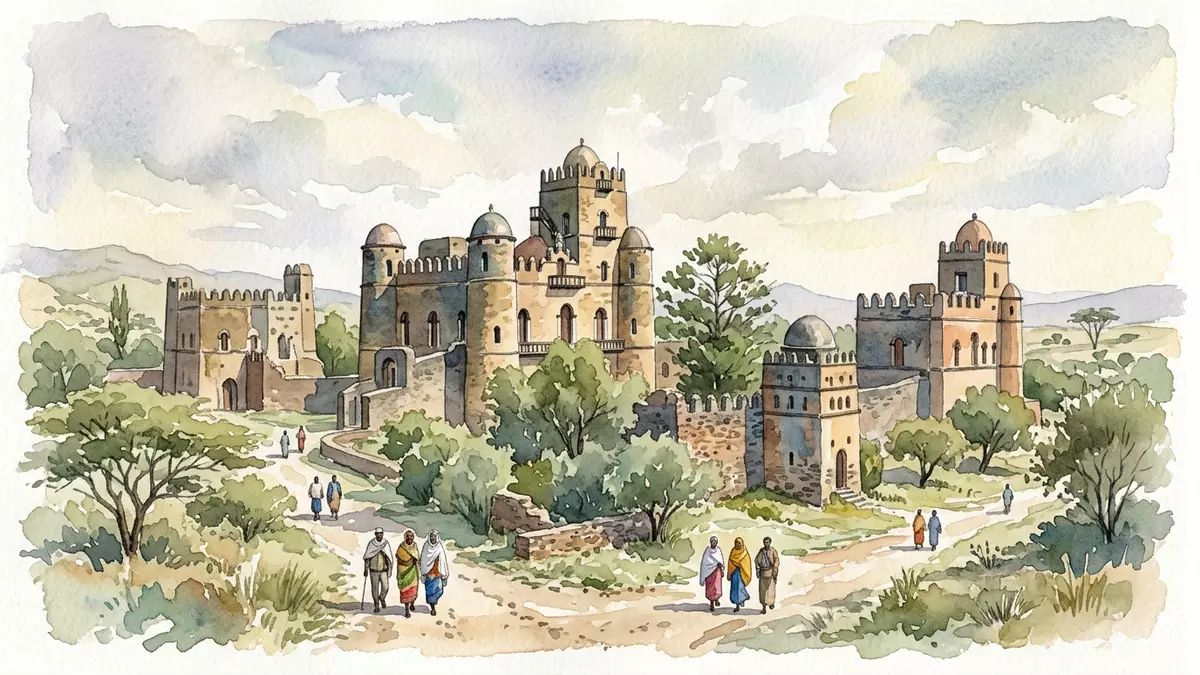
Fasil Ghebbi in Gondar is a walled royal city that gathered Ethiopia’s emperors, churches and courtiers inside a single stone enclosure in the seventeenth century. Within its walls, multiple castles, churches and service buildings stand in the open, giving Gondar a highland “court city” that can be walked like an architectural chronicle of imperial Ethiopia.
Stone castles inside the royal enclosure
At the heart of Fasil Ghebbi stands the main palace of Emperor Fasilides, the ruler who established Gondar as a permanent capital in 1636 and began the fortress-city that visitors see in Athiopien’s northern highlands.King Fasilides settled in Gondar and built his fortress The palace rises in solid masonry, with towers and parapets that give it a fortified, almost citadel-like outline against the highland sky.
The main castle is surrounded by further palaces built by Fasilides’ successors, forming a compact cluster of stone residences and halls inside the enclosure. Among them are the castle of Emperor Iyasu, Dawit III’s hall, the Bakaffa castle, a royal library and a chancellery building, each reflecting a phase of Gondar’s imperial story.The documented monuments include Iyasu’s castle, a Royal Library and a Chancellery The palaces stand separated by lawns and paths rather than crowded streets, so their massed towers and walls read almost like individual sculptures set within an open court.
A fortress-city shaped by global influences
Fasil Ghebbi is not only a royal residence; it is a fortress-city surrounded by a stone wall that runs for about 900 m (2,953 ft) around the compound.The enclosure is described as a 900?m?long wall Inside the wall lie palaces, churches, monasteries and public buildings that together formed the political and religious centre of Gondar’s imperial era.
The architecture within Fasil Ghebbi fuses highland Ethiopian traditions with forms and details drawn from abroad. Sources describe Hindu and Arab influences in the buildings, later overlaid by Baroque elements introduced by Jesuit missionaries to Gondar.Hindu and Arab influences were transformed by Baroque style brought by Jesuit missionariesThe site’s architecture was inspired by Baroque style introduced by Jesuit missionaries Strong walls, towers and elevated walkways mix with arched openings and European-style volumes, so the compound reads as a rare architectural dialogue between Ethiopian highland building and imported courtly styles.
UNESCO recognition and Gondar’s wider royal landscape
Because of its concentration of palaces and its role as the seat of Ethiopia’s Christian emperors, Fasil Ghebbi was inscribed as a UNESCO World Heritage Site in 1979 as a cultural property.The fortress was inscribed as a UNESCO World Heritage Site in 1979Fasil Ghebbi, Gondar Region, is recorded as inscribed in 1979 The serial World Heritage listing extends beyond the main enclosure to a wider royal landscape around Gondar, incorporating several churches, palaces and ritual sites linked to the emperors.
Alongside the castles within the walls, the World Heritage property includes the Bath of Fasilidas, the Debre Berhan Selassie monastery and church, Qusquam, the palace of Guzara and other sites in and around Gondar.The serial property lists the Bath of Fasilidas, Debre Berhan Selassie, Qusquam and the Palace of Guzara among its components Together they form a royal landscape of stone castles, ceremonial baths and richly decorated churches that anchor Gondar’s reputation as an Athiopien court city shaped in the seventeenth and eighteenth centuries.
Visiting Fasil Ghebbi: what travellers from Western Europe should know
- Fasil Ghebbi stands in central Gondar in the Amhara Region of northern Ethiopia, within the Piassa area of the town’s built-up core.
- Inside the enclosure, movement between the castles involves walking on uneven ground and using stairways within the stone structures.
- Gondar lies north of Lake Tana on the Ethiopian highlands, and Fasil Ghebbi forms part of a wider landscape of royal sites around the town.
- The official language is Amharic and the currency is the Ethiopian birr.
- Entry requirements depend on your nationality; UK travellers can check the FCDO travel advice at gov.uk/foreign-travel-advice, Irish travellers the Department of Foreign Affairs at ireland.ie.
Searching for Fasil Ghebbi on social platforms
These links open searches for Fasil Ghebbi on each platform.
Frequently asked questions about Fasil Ghebbi
Where is Fasil Ghebbi?
Fasil Ghebbi is a fortress-city in Gondar in the Amhara Region of northern Ethiopia, north of Lake Tana in the country’s highlands.
What can visitors expect inside the enclosure?
Visitors encounter a walled compound with multiple stone castles, churches and service buildings standing in open ground, all linked by paths and stairways.
What makes Fasil Ghebbi distinctive among Ethiopian sites?
Fasil Ghebbi concentrates seventeenth-century imperial castles and churches within a single walled city, blending Ethiopian highland building with Hindu, Arab and Baroque influences.


