
Fasil Ghebbi: castles and churches of Gondar’s royal enclosure
Published on 09/15/2026 at 13:42 | Editorial responsibility: Rafael Müller, Editor-in-Chief AD HOC NEWS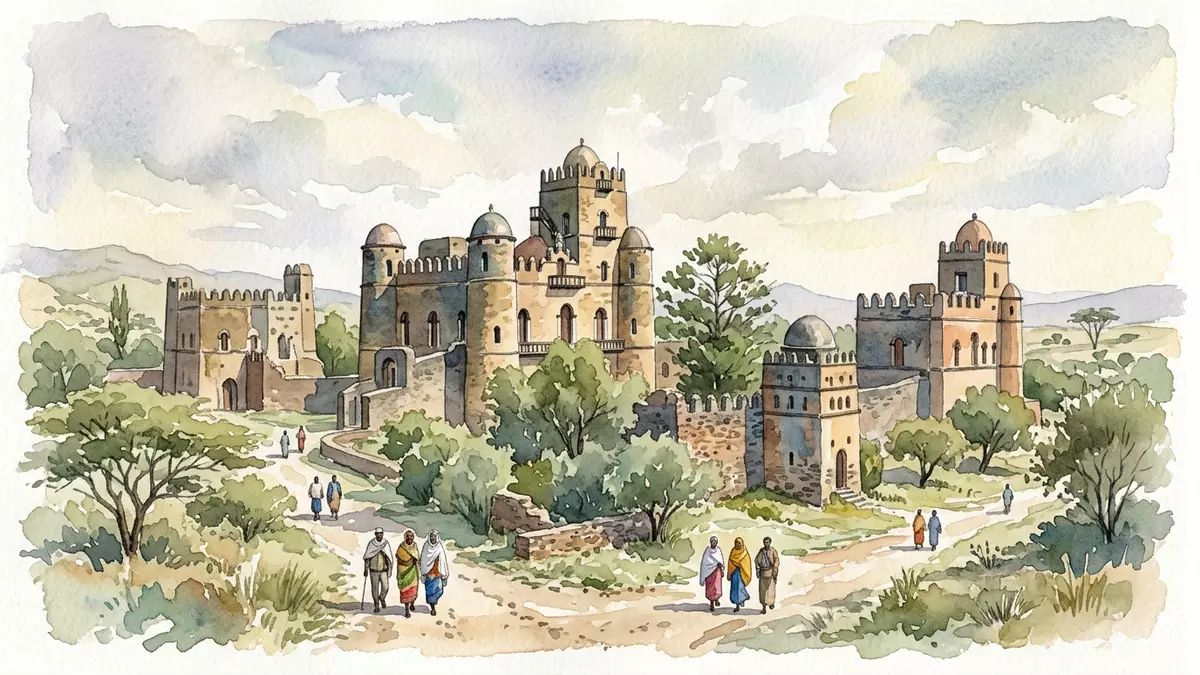
In the centre of Gondar in northern Ethiopia, Fasil Ghebbi forms a compact fortress-city of stone castles, churches and courtyards enclosed by high walls. Founded in the seventeenth century as the residence of Emperor Fasilides, it became the seat of Ethiopian rulers for generations and is recognised as a UNESCO World Heritage Site for its architecture and historical role.
A walled royal enclosure on the Gondar plateau
Fasil Ghebbi occupies a roughly rectangular compound on the highlands of the Amhara Region, where Gondar looks towards the hills that rise between Lake Tana and the country’s northern ranges. Within the enclosure, tall masonry walls define a royal precinct that once set the imperial court apart from the surrounding town, with gates and bridges marking the formal entrances to the ruling centre.The fortified royal enclosure was built soon after Fasilides relocated his capital to Gondar in 1636, turning a mobile court into a settled city.
The compound, measuring around 70,000 square metres, is surrounded by a wall recorded as about 900 m (2,953 ft) in length, punctuated by multiple entrances and overseen by towers, which frame views towards the internal buildings.Descriptions of the enclosure emphasise the way palaces, churches, monasteries and public structures cluster within this walled city, reflecting the organisation of power, worship and ceremony in Gondar’s imperial era.
Castles, palaces and churches within the enclosure
Within Fasil Ghebbi, several major castles and palaces rise above the grassed interior, each associated with a different emperor or royal figure of the Gondarine period. The Castle of Emperor Fasilides, often regarded as the principal attraction, stands as a multi-storey stone residence with ramparts and external stairways, combining the qualities of a palace and a fortified stronghold.UNESCO’s listing for Fasil Ghebbi notes further components, including the Castle of Emperor Iyasu, the Castle of Emperor Dawit, and the Palace of Empress Mentewab, together forming a dense ensemble of royal architecture.
Around these principal residences, additional buildings recall the administrative and religious life of the Gondarine court. A library, a chancery and banqueting halls speak to governance and ceremony, while churches and monasteries reflect the longstanding role of the Ethiopian Orthodox faith in the imperial city.Accounts of the Royal Enclosure describe stables, smaller service buildings and richly decorated church interiors, giving visitors a sense of how palace life, religious observance and military organisation once shared the same enclosed space.
Seventeenth?century architecture shaped by many influences
Fasil Ghebbi belongs to the architectural world of seventeenth? and eighteenth?century Ethiopia, yet its buildings do not follow a single stylistic model. The masonry castles are built largely of stone, with robust walls and battlements that recall elements of European medieval strongholds, while decorative forms and structural details show the imprint of Nubian, Arab, Indian and Baroque influences.Material from UNESCO on Gondar’s palaces links the Baroque strand to Jesuit missionaries who brought new architectural ideas to Gondar during the era of Fasilides and his successors.
These borrowed motifs are woven into local building traditions rather than replacing them. Stone towers rise beside Ethiopian church compounds, arches frame halls used for imperial receptions, and walkways connect castle levels, giving the complex a distinctive profile among the highland cities of the Horn of Africa.Studies of Fasil Ghebbi’s architecture highlight how successive emperors left their trace on the enclosure, adding new structures and embellishments while maintaining the overall fortified form.
Visiting Fasil Ghebbi: what travellers from Western Europe should know
- Fasil Ghebbi stands in central Gondar in the Amhara Region of northern Ethiopia, on a plateau not far from Lake Tana, and is reached by road connections from regional airports and other towns.
- Within the royal enclosure, visitors move across open grassy areas and stone paths, and access to castle upper levels involves staircases that can be narrow and steep.
- The historic compound lies amid the urban fabric of Gondar, with Ethiopian Orthodox churches and additional palace sites located in the surrounding districts beyond the main enclosure walls.
- The official language is Amharic and the currency is the Ethiopian birr.
- Entry requirements depend on your nationality; UK travellers can check the FCDO travel advice at gov.uk/foreign-travel-advice, Irish travellers the Department of Foreign Affairs at ireland.ie.
Searching for Fasil Ghebbi on social platforms
These links open searches for Fasil Ghebbi on each platform.
Frequently asked questions about Fasil Ghebbi
Where is Fasil Ghebbi located?
Fasil Ghebbi is in Gondar in the Amhara Region of northern Ethiopia, on the high plateau north of Lake Tana.
What can visitors expect inside the enclosure?
Visitors encounter stone castles, palaces, churches and administrative buildings set within a walled compound of open lawns, paths and towers.
What makes Fasil Ghebbi distinctive among historic sites?
It combines a seventeenth?century royal residence and fortress with architectural influences from Ethiopian, European, Nubian, Arab and Indian traditions within one compact highland city.


