
Fasil Ghebbi and the royal stone city of Gondar
Published on 09/18/2026 at 22:52 | Editorial responsibility: Rafael Müller, Editor-in-Chief AD HOC NEWS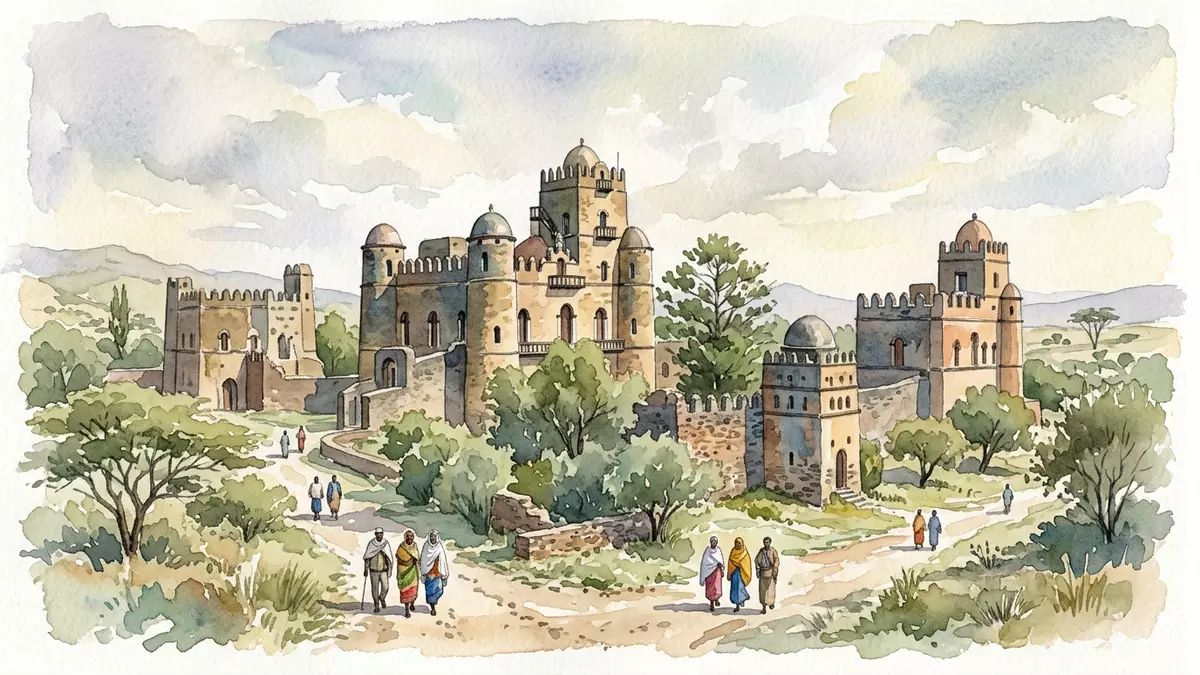
Fasil Ghebbi in Gondar is a walled imperial compound, not a single palace. The site is linked to Emperor Fasilides and to the seventeenth-century court that made Gondar a capital.
A walled imperial compound in Gondar
The core image is simple: walls, castles, churches and monasteries inside one enclosure. UNESCO describes Fasil Ghebbi as the residence of Fasilides and his successors in the sixteenth and seventeenth centuries, and the compound still reads as a royal city rather than a detached monument.
The enclosing wall runs for 900 m (2,953 ft). That scale matters because it gives the place its form: a bounded complex with palaces, churches, monasteries and public and private buildings inside the same defensive outline.
Fasilides, Gondar and the Gondarian period
Fasil Ghebbi belongs to the period when Ethiopian rulers settled more permanently in Gondar. The compound is tied to Fasilides, and the UNESCO record places its main imperial use in the sixteenth and seventeenth centuries.
The site also reflects the Gondarian style associated with imperial Gondar. The palaces and churches are marked by Hindu and Arab influences and later Baroque elements brought to Gondar by Jesuit missionaries.
Castles, churches and a layered layout
Inside the enclosure stand the Castle of Emperor Fasilidas, the Castle of Emperor Iyasu, the Library of Tzadich Yohannes, the Chancellery of Tzadich Yohannes, the Castle of Emperor David, the Palace of Mentuab and the Banqueting Hall of Emperor Bekaffa. The official site list also names churches and monasteries in and around Gondar as part of the wider heritage ensemble.
That mixture gives Fasil Ghebbi a layered character. It is both a royal residence and a civic-religious landscape, with the fortified enclosure holding different kinds of buildings in one place.
Visiting Fasil Ghebbi: what travellers from Western Europe should know
- Fasil Ghebbi lies in Gondar, in the Amhara National Regional State of Ethiopia. The compound is reached through the city rather than as a separate hill site.
- The 900 m (2,953 ft) wall defines the main experience on foot. The site contains several buildings within one enclosure, so a visit means moving between distinct structures.
- The place is part of a wider UNESCO property around Gondar. The listed components include palaces, churches, monasteries and related historic buildings.
- English is not an official language in Ethiopia, so practical matters in Gondar may involve Amharic. The currency is the Ethiopian birr.
- Conditions on the site depend on the historic fabric of the compound. Stone walls, enclosed courtyards and older masonry shape the visit more than open parkland would.
Searching for Fasil Ghebbi on social platforms
These links open searches for Fasil Ghebbi on each platform.
Frequently asked questions about Fasil Ghebbi
Where is Fasil Ghebbi?
Fasil Ghebbi is in Gondar, in northern Ethiopia’s Amhara region. It forms part of the historic city fabric around the old imperial centre.
What does a visit involve?
A visit means moving through a fortified compound with multiple buildings inside one wall. The experience is architectural rather than scenic in the landscape sense.
What makes Fasil Ghebbi distinctive?
Its distinction lies in the mix of imperial buildings, religious structures and a 900 m (2,953 ft) enclosure tied to Fasilides and the Gondarian court. The result is a royal compound with several historical layers in one place.


