
Faneuil Hall, Boston’s brick hall of markets and debate
Published on 09/16/2026 at 15:00 | Editorial responsibility: Rafael Müller, Editor-in-Chief AD HOC NEWS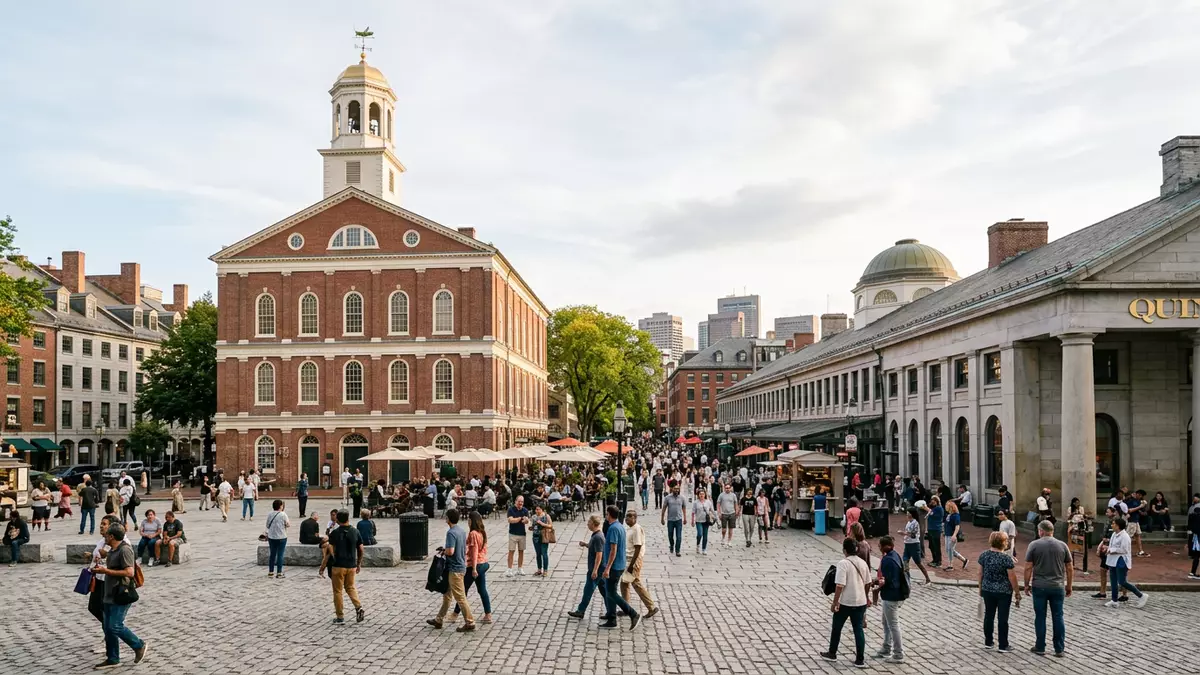
Faneuil Hall in Boston is a brick marketplace and meeting hall completed in 1742, where a ground-floor market and an upper assembly room have long shared the same roof. Peter Faneuil, a wealthy merchant of the eighteenth century, funded the building as a gift to the town, and its combination of trade and debate has made it a fixture of the city’s story ever since.
A Georgian hall built for markets and meetings
Faneuil Hall stands at Dock Square in central Boston, close to the waterfront in Massachusetts, on land that once formed part of the town’s early harbour front.Dock Square in Boston It was constructed in brick in the early 1740s and completed in 1742, taking the form of a Georgian-style public building facing what is now Congress Street.a two-storey Georgian brick building The project was commissioned and paid for by Peter Faneuil, whose name the hall still bears, and he presented it to Boston as a combined town meeting hall and covered market.a gift to the town by merchant Peter Faneuil
The hall originally rose two storeys above the market arcades, with the ground floor given over to stalls for meat, produce and other goods, and the upper level laid out as a meeting room for the town’s assemblies.a marketplace below and a meeting hall above That arrangement of commerce below and debate above remained central to the building’s character, even as the structure changed shape in later centuries. The Georgian hall that visitors see today still keeps the broad brick walls and pitched roof of the eighteenth-century design, yet its internal layout reflects later enlargements that increased its capacity for public gatherings.
Fire, enlargement and a growing city
In January 1761 a fire swept through Faneuil Hall, destroying much of the interior and leaving only the brick shell standing.destroyed by fire on 13 January 1761 The town chose to rebuild the hall on its original lines, and it reopened in 1763 as a repaired marketplace and meeting space.reopened in 1763 At the turn of the nineteenth century the architect Charles Bulfinch substantially enlarged the building, doubling its width and adding a third floor to accommodate a growing population and more expansive town meetings.Bulfinch doubled the building's width and added a third floor in 1806
The surrounding market district expanded along with the hall. In 1826 a new granite market building known as Quincy Market was added to extend the trading space, followed in 1827 by the South Market and North Market ranges.Quincy Market, South Market and North Market buildings Later nineteenth-century work included further renovations and fireproofing, and by the end of that century the hall had been structurally strengthened with more modern materials while keeping its historic outline. The building’s place in Boston’s civic life was reinforced in the twentieth century when it was recognised as a National Historic Landmark and incorporated into Boston National Historical Park.National Historic Landmark and Boston National Historical Park site
“Cradle of Liberty”: a hall of speeches and protest
Alongside its trading role, Faneuil Hall gained lasting significance as a venue for political speech. In the years before the American Revolution, Boston’s town meetings convened here to debate imperial taxation and colonial rights, and the hall’s upper chamber became associated with speeches by figures such as Samuel Adams and James Otis Jr.incendiary speeches by Samuel Adams and James Otis Jr. The intensity of those eighteenth-century debates earned the building the enduring nickname “The Cradle of Liberty”, underlining its reputation as a place where ideas about American independence were argued in public.“The Cradle of Liberty”
Political gatherings continued through the nineteenth century and beyond. Abolitionists met in Faneuil Hall to organise against slavery and the enforcement of fugitive slave laws, forming committees and planning responses to cases such as those of George Latimer in 1842 and Anthony Burns in 1854.a designated Network to Freedom site Later movements, including campaigns for women’s suffrage and labour rights, also used the hall as a forum for speeches and protest. Through these successive eras, the same brick shell that housed food stalls on the ground floor has also framed debates about liberty and citizenship in the meeting spaces above.
Visiting Faneuil Hall: what travellers from Western Europe should know
- Faneuil Hall stands in central Boston at Dock Square, close to the waterfront and within the historic district linked by the Freedom Trail foot route.
- The upper meeting hall is reached by internal staircases, and visits involve climbing steps within an eighteenth- and nineteenth-century structure.
- English is the official language and the currency is the United States dollar.
- Entry requirements depend on your nationality; UK travellers can check the FCDO travel advice at gov.uk/foreign-travel-advice, Irish travellers the Department of Foreign Affairs at ireland.ie.
Searching for Faneuil Hall on social platforms
These links open searches for Faneuil Hall on each platform.
Frequently asked questions about Faneuil Hall
Where is Faneuil Hall in Boston?
Faneuil Hall stands at Dock Square in central Boston, close to the waterfront and within the area served by Boston National Historical Park.
What can visitors expect inside Faneuil Hall?
Visitors encounter a historic market level and an upper meeting hall, housed within an eighteenth- and nineteenth-century brick structure that has hosted civic gatherings for generations.
What makes Faneuil Hall distinctive among Boston landmarks?
The hall combines an eighteenth-century marketplace with spaces long used for political speeches, giving it a dual identity as a centre of trade and a symbol of American civic debate.


