
Faneuil Hall, Boston’s brick hall of markets and debate
Published on 08/26/2026 at 20:24 | Editorial responsibility: Rafael Müller, Editor-in-Chief AD HOC NEWS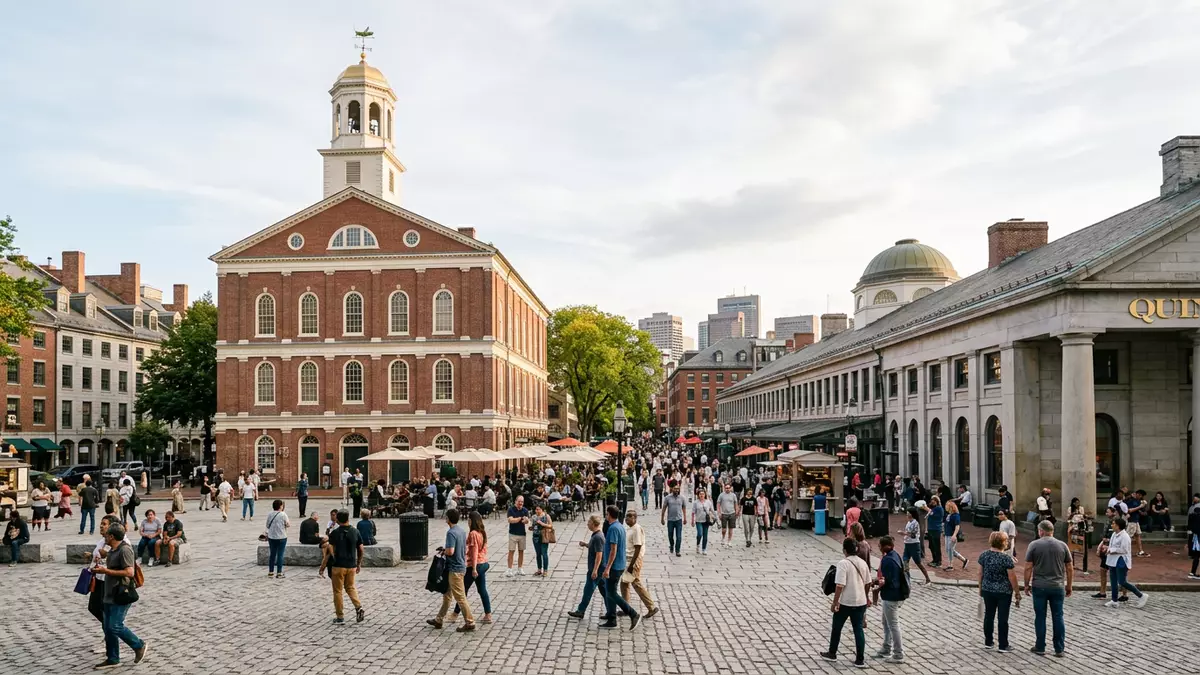
In the middle of Boston’s old waterfront district stands Faneuil Hall, a red-brick market building with a long upper hall that has hosted public debate since the eighteenth century. Built as a gift to the town by merchant Peter Faneuil and completed in 1742, it brought together a covered marketplace on the ground floor and a meeting space above under one roof.
A market hall that became a civic stage
Faneuil Hall was constructed in the early 1740s on reclaimed land at the head of Boston’s historic Town Dock, at the eastern edge of Dock Square in the town centre.eastern edge of Dock Square The building was financed by Peter Faneuil, one of the city’s wealthiest merchants, who offered to fund a combined market house and meeting hall for Boston’s growing trade.funded its construction Designed by Scottish-born artist and architect John Smibert, the original hall was a relatively compact brick structure with an open market at street level and an assembly room above.originally designed by artist John Smibert
The marketplace quickly became a centre of commerce, with stalls for meat, produce and other goods, while the upstairs hall took over the role of Boston’s town meeting venue.central point of commerce In the years leading up to the American Revolution, local debates about imperial taxation and colonial rights were held in this upper chamber, giving the building a reputation as “The Cradle of Liberty” that has stayed with it ever since.
Fire, expansion and a nineteenth-century makeover
Only two decades after its completion, Faneuil Hall was heavily damaged by a fire in January 1761 that left its brick walls standing but destroyed much of the interior.damaged by fire in 1761 The town chose to rebuild it, reopening the hall in 1763 with its dual role as market and meeting space preserved.reopened in 1763 Through the later eighteenth century the upper hall hosted gatherings that responded to events such as the Boston Massacre and the protests against tea taxation, with figures including Samuel Adams and James Otis delivering speeches beneath its timber roof.speeches by Samuel Adams and James Otis
In the early nineteenth century the building was substantially enlarged and altered. In 1806, Boston architect Charles Bulfinch oversaw a redesign that extended Faneuil Hall and raised its roofline, giving it the taller, more elongated proportions seen today.remodelled and expanded by Charles Bulfinch in 1806 A few decades later, the construction of Quincy Market in 1826 and the adjacent North and South Market buildings broadened the commercial precinct around the hall, creating a row of granite and brick market structures that framed its position in the city’s trading district.expanded to include Quincy Market in 1826
The hall as a platform for American reform movements
Faneuil Hall’s long upper chamber continued to serve as a venue for public meetings into the nineteenth century and beyond, moving from colonial grievances to wider national questions. During the decades before the Civil War, abolitionists held gatherings here to protest the capture and return of fugitive slaves under federal law, including meetings responding to the cases of George Latimer in 1842 and Anthony Burns in 1854.meetings in response to fugitive slave arrests Campaigners for women’s suffrage, labour rights and temperance also used the hall as a forum to argue for social and political reforms in front of large audiences.forum for humanitarian, political and social reforms
The building’s role as a civic symbol is reflected in its preservation status. Faneuil Hall is recognised as a National Historic Landmark and forms part of Boston National Historical Park and the city’s Freedom Trail, linking it to other sites significant in the story of American independence and reform.National Historic Landmark operated by the National Park Service Its exterior keeps the brick walls, pitched roof and distinctive weather vane that date back to the Bulfinch expansion, while the interior upper hall retains a long, rectangular meeting space lined with windows and historical portraits.
Visiting Faneuil Hall: what travellers from Western Europe should know
- Faneuil Hall stands in central Boston at the eastern side of Dock Square, close to the historic waterfront and within the cluster of buildings around Quincy Market.
- The ground floor and surrounding streets form a market precinct with paved surfaces and indoor spaces; the historic meeting hall is reached by staircases inside the building.
- The building lies within Boston National Historical Park on the Freedom Trail, so it sits among other eighteenth- and nineteenth-century landmarks that can be reached on foot.
- Boston is in the United States of America; the official language is English and the currency is the US dollar.
- Entry requirements depend on your nationality; UK travellers can check the FCDO travel advice at gov.uk/foreign-travel-advice, Irish travellers the Department of Foreign Affairs at ireland.ie.
Searching for Faneuil Hall on social platforms
These links open searches for Faneuil Hall on each platform.
Frequently asked questions about Faneuil Hall
Where in Boston is Faneuil Hall located?
Faneuil Hall stands at the eastern edge of Dock Square in downtown Boston, close to the historic Town Dock area and the waterfront.
What can visitors expect inside the building?
The ground floor contains enclosed market space, while the upper floor is a long meeting hall used for talks, ceremonies and other public gatherings.
What makes Faneuil Hall distinctive as a landmark?
It combines an eighteenth-century brick market building with a long history as a venue for political debate, reform meetings and commemorative events.


