
Faneuil Hall and the marketplace of liberty in Boston
Published on 08/22/2026 at 09:50 | Editorial responsibility: Rafael Müller, Editor-in-Chief AD HOC NEWS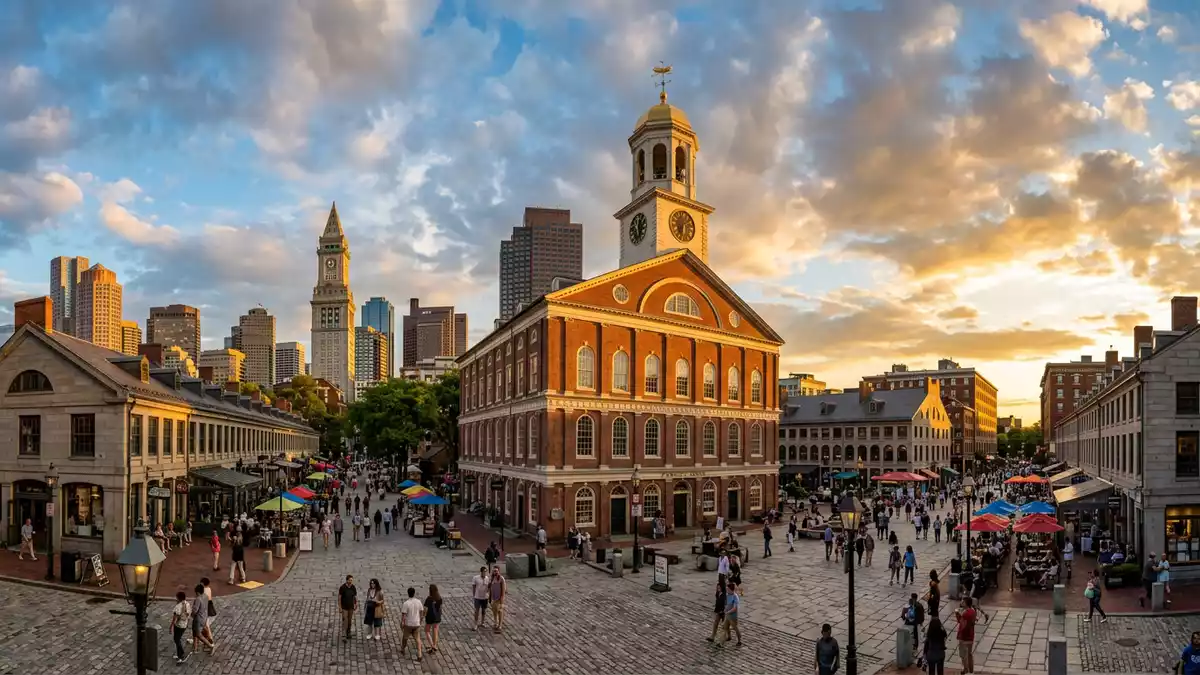
Faneuil Hall in Boston is a red?brick market and meeting hall dating to the early eighteenth century, where commercial stalls and a large assembly room share the same building and have done so for generations.
An eighteenth?century market hall at the edge of Dock Square
Faneuil Hall stands at the eastern side of Dock Square in central Boston, close to the historic waterfront and the harbour basins that once defined the town’s trading life.eastern edge of Dock Square The hall was completed in 1742 and named for Peter Faneuil, a wealthy merchant who funded the building as a gift to the town.finished in 1742 It rose on newly created land beside the old Town Dock, in a district that had already been formalised as an outdoor market space in the 1730s.formal outdoor market space in 1733
The original design of Faneuil Hall is generally attributed to John Smibert, a Scottish?born artist whose work brought Palladian?influenced Georgian architecture to Boston.Palladian Georgian buildings In its early form the building combined a ground?floor market with a meeting hall above, a layout that made it both a centre of commerce and the town’s main indoor gathering place.market-house and public meeting house Brick walls and a pitched roof give the exterior a plain, robust character, while rows of windows on the upper level signal the large enclosed hall inside.
Fire, rebuilding and nineteenth?century expansion
Only two decades after its completion, Faneuil Hall suffered a major fire on 13 January 1761 that left little more than its brick envelope standing.destroyed by fire in 1761 The hall was rebuilt and reopened in 1763, restoring both the covered market and the meeting space above at a time when Boston’s political tensions with Britain were intensifying.rebuilt and reopened in 1763 The reconstructed structure kept the essential arrangement of stalls beneath and assembly room above, reinforcing its dual role in daily life.
In the early nineteenth century architect Charles Bulfinch oversaw a substantial enlargement of Faneuil Hall that added storeys and extended the building’s footprint.expanded in 1805-1806 Around the same period the city authorised the construction of Quincy Market immediately to the west, completed in 1826 to ease pressure on the existing market hall.expanded to include Quincy Market in 1826 Together, Faneuil Hall, Quincy Market and the flanking North and South Market buildings formed a coherent marketplace complex that anchored trade in meat, produce and other goods throughout the nineteenth century.
The “Cradle of Liberty”: speeches and civic gatherings
For centuries the upstairs hall at Faneuil Hall has been a stage for town meetings, political speeches and public ceremonies, a role that earned it the nickname “The Cradle of Liberty”.“The Cradle of Liberty” In the years leading up to the American Revolution, figures such as Samuel Adams and James Otis addressed the assembled townspeople here on taxation and representation, and gatherings at the hall protested measures like the Sugar Act, Stamp Act and Townshend duties.protests against the Sugar Act and Stamp Act
The hall’s role as a civic forum extended well beyond the eighteenth century. Nineteenth?century meetings here marked occasions such as George Washington’s New England tour and the eulogies for John Adams and Thomas Jefferson in 1826, while abolitionists later used the space to organise against slavery and the enforcement of fugitive slave laws.designated site on the Network to Freedom Into the twentieth century the hall continued to host debates, rallies and commemorations, making the combination of market below and meeting hall above a distinctive feature of central Boston rather than a relic of the colonial era.central to Boston’s civic life
Visiting Faneuil Hall: what travellers from Western Europe should know
- Faneuil Hall stands in downtown Boston at Faneuil Hall Square, close to the junction of Congress and North Streets and a short walk from State Street subway stations on the Orange and Blue lines.
- The interior includes staircases between the market level and the upper meeting hall, and visitors should expect steps when moving between the floors.
- The official language is English and the currency is the United States dollar.
- Entry requirements depend on your nationality; UK travellers can check the FCDO travel advice at gov.uk/foreign-travel-advice, Irish travellers the Department of Foreign Affairs at ireland.ie.
Searching for Faneuil Hall on social platforms
These links open searches for Faneuil Hall on each platform.
Frequently asked questions about Faneuil Hall
Where is Faneuil Hall located in Boston?
Faneuil Hall stands at Faneuil Hall Square beside Dock Square in downtown Boston, close to Congress Street and within walking distance of State Street stations.
What can visitors expect when they enter Faneuil Hall?
Visitors encounter a ground?floor marketplace inside the brick shell and, above it, an historic meeting hall reached by staircases that continues to host civic events.
What makes Faneuil Hall distinctive among Boston’s historic sites?
The combination of an eighteenth?century market and a long?standing civic assembly hall in one Palladian?influenced building gives Faneuil Hall a character closely tied to both trade and political debate.


