
Faisal Masjid and its tent-like silhouette above Islamabad
Published on 09/15/2026 at 20:43 | Editorial responsibility: Rafael Müller, Editor-in-Chief AD HOC NEWS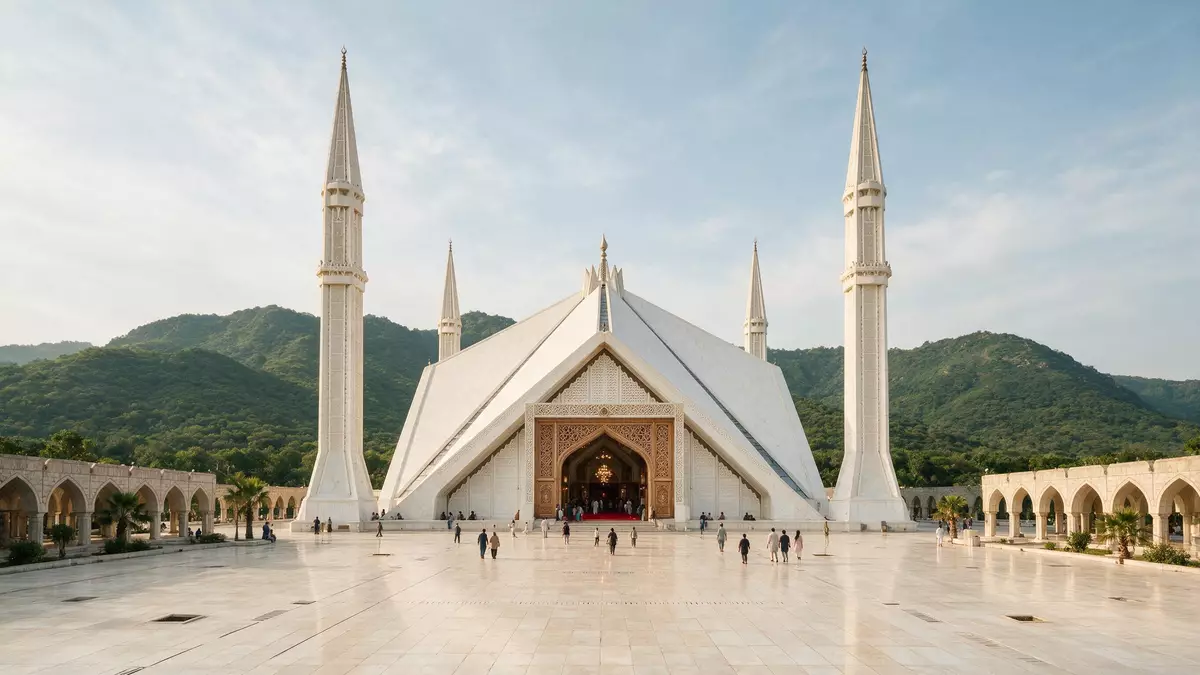
Faisal Masjid in Islamabad stands where the planned avenues of Pakistan’s capital meet the rising ground of the Margalla Hills, its white, tent-like form giving the city a monumental modern mosque completed in the mid-1980s. Named after Saudi Arabia’s King Faisal bin Abdulaziz, whose support in 1966 set the project in motion, it became the national mosque of Pakistan and a defining landmark of the later twentieth century.
A modern mosque shaped like a vast tent
The most striking feature of Faisal Masjid is its departure from the familiar dome-centred profile of many grand mosques, adopting instead a steeply pitched, tent-like main hall framed by tall concrete ribs and clad in pale marble.tent-like main prayer hall This form, conceived by Turkish architect Vedat Dalokay, traces clear geometric lines up from the broad base of the complex to high ridges, creating a single rising volume rather than a composition of separate domes and wings.Turkish architect Vedat Dalokay
Four slender minarets stand at the corners of the main platform, accenting the symmetry of the mosque and marking it clearly on Islamabad’s skyline above the city’s northern edge.Faisal Mosque, Pakistan - Islamabad The exterior surfaces use white and light-coloured marble panels, so the structure reads as a single, bright volume against the darker slopes of the Margalla Hills and the plains of the Potohar plateau. From a distance, the main hall and its minarets form a crisp, angular silhouette, making Faisal Masjid instantly recognisable even from the broad avenues and government precincts below.
From royal patronage to a national mosque
The idea of building a national mosque for Islamabad dates back to the mid-1960s, when Pakistan planned a new, purpose-built capital and sought major civic and religious institutions for it.national mosque in the new capital During an official visit in 1966, King Faisal bin Abdulaziz of Saudi Arabia supported the initiative for a grand mosque and committed substantial funding, and the project later took his name in recognition of that patronage.named after King Faisal bin Abdul Aziz
An international architectural competition in 1969 brought proposals from architects across numerous countries, reflecting the global interest in shaping a major religious building for Pakistan’s new capital.international competition in 1969 Vedat Dalokay’s unconventional design, with its modern tent-like form in place of traditional domes, won the commission and set the course for a mosque that would stand as an emblem of late twentieth-century Islamic architecture in Pakistan’s political centre.modern architecture crowned by a white marble tent
A vast worship complex above Islamabad
Construction of Faisal Masjid began in 1976 under National Construction Limited of Pakistan, working to Dalokay’s design on a prominent site at the city’s northern edge, and the complex was completed and inaugurated in 1986.construction began in 1976 and completed in 1986 In its finished form it became the national mosque of Pakistan and, for several years after its opening, it ranked among the largest mosque complexes in the world by capacity.largest mosque in Pakistan and South Asia
The main prayer hall rises from a broad plinth that includes extensive courtyard spaces, ancillary buildings and circulation areas, all aligned with the geometry of the primary structure.Faisal Mosque, Islamabad, Pakistan This scale allows Faisal Masjid to serve large congregations, while its position on slightly elevated terrain places it within sight of many parts of Islamabad, tying the mosque visually to the city’s grid of boulevards, administrative buildings and green spaces.
Visiting Faisal Masjid: what travellers from Western Europe should know
- Faisal Masjid stands on rising ground at the northern edge of Islamabad, below the Margalla Hills, and is reached by city roads that run out from the central government districts.
- The complex is expansive, with broad paved areas and stairways around the main platform; visiting involves walking across large open spaces and using steps between levels.
- The mosque lies close to the base of the Margalla Hills, so views from the approaches combine the angular white structure with the green slopes and the planned avenues of the capital below.
- The official language is Urdu and the currency is the Pakistani rupee.
- Entry requirements depend on your nationality; UK travellers can check the FCDO travel advice at gov.uk/foreign-travel-advice, Irish travellers the Department of Foreign Affairs at ireland.ie.
Searching for Faisal Masjid on social platforms
These links open searches for Faisal Masjid on each platform.
Frequently asked questions about Faisal Masjid
Where is Faisal Masjid and what is its role in Pakistan?
Faisal Masjid stands at the northern edge of Islamabad, below the Margalla Hills, and serves as the national mosque of Pakistan, named for King Faisal bin Abdulaziz.
What should visitors expect when they arrive at Faisal Masjid?
Visitors encounter a vast complex of white marble and concrete, with a tent-like main prayer hall, four tall minarets and broad open terraces overlooking the planned capital below.
What makes Faisal Masjid distinctive among major mosques?
Its later twentieth-century design replaces traditional domes with a single steeply pitched, tent-like structure, created by Turkish architect Vedat Dalokay and completed in 1986 on a prominent site above Islamabad.


