
Faisal Masjid and Islamabad’s tent-like skyline
Published on 09/17/2026 at 13:59 | Editorial responsibility: Rafael Müller, Editor-in-Chief AD HOC NEWS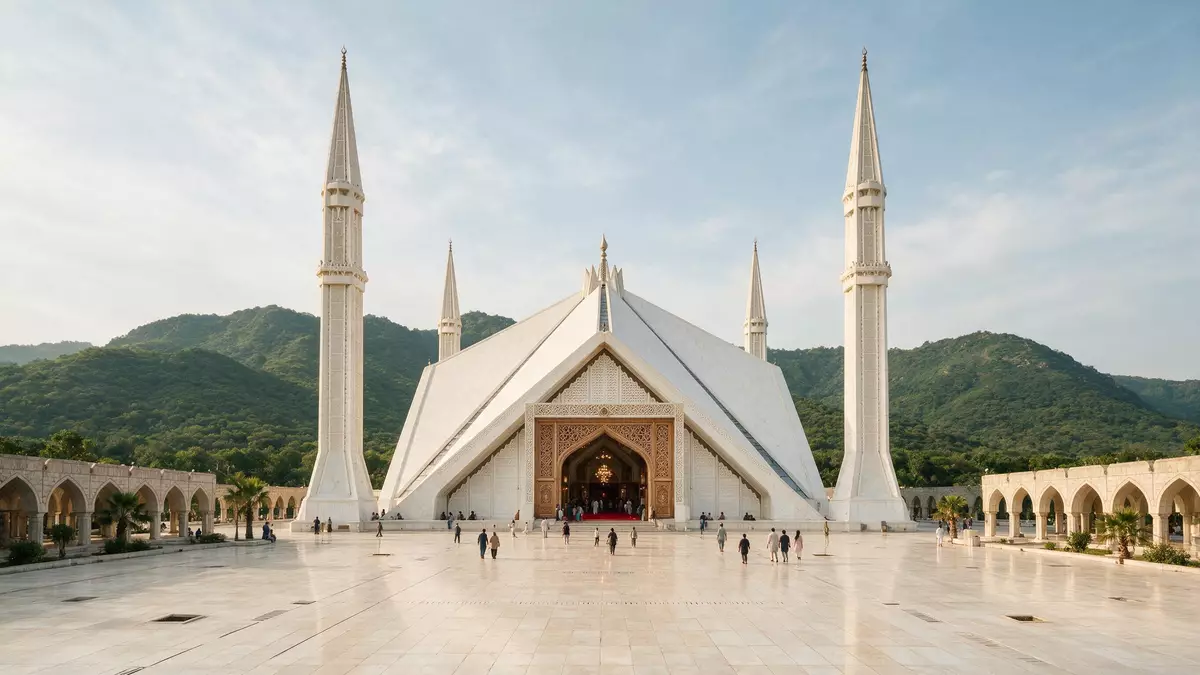
Faisal Masjid is Islamabad’s national mosque, and its broad, tent-like roof makes the building read as a single geometric form from a distance. Designed by Vedat Dalokay and completed in 1986, it combines a modern concrete shell with white marble and four tall minarets.
Dalokay’s modern mosque in Islamabad
The mosque stands in Islamabad, Pakistan, on the city’s northern side near the Margalla Hills. Its identity is tied to Vedat Dalokay, the Turkish architect whose winning scheme for the national mosque took an unusual direction for a mosque of this scale.
The main prayer hall is an eight-sided concrete shell, and the building avoids a central dome. Completed in 1986, it became one of Islamabad’s most recognisable modern landmarks through that clear silhouette and its pale cladding.
White marble, concrete and corner minarets
The mosque’s surfaces are faced in white marble, which sharpens the outline of the roof and minarets. Four minarets rise from the corners of the platform, giving the complex a strong vertical frame against the horizontal sweep of the city.
Inside, the prayer hall uses mosaics, calligraphy and a Turkish-style chandelier. The composition is spare rather than crowded, and the geometry of the shell remains the dominant feature in the interior space. Vedat Dalokay’s design keeps the building’s form legible from the approach, the courtyard and the terraces.
Margalla Hills as a backdrop
Faisal Masjid sits against the foothills of the Margalla Hills, with open ground in front and rising terrain behind. The setting gives the mosque a strong profile in the city, especially because the white surfaces sit against darker mountain slopes.
The site includes a main courtyard, porticoes and elevated terraces, so the complex reads as more than a single hall. The main courtyard and the prayer hall are part of one composition, with the minarets marking the corners and the platform lifting the mosque above its surroundings.
Visiting Faisal Masjid: what travellers from Western Europe should know
- The mosque is in northern Islamabad, and Shah Faisal Avenue leads towards it from the city grid. The Margalla Hills rise close behind the complex.
- The approach includes exterior steps, paved terraces and a raised platform. Movement within the precinct takes place over open ground rather than through enclosed corridors.
- The country’s official language is Urdu and the currency is the Pakistani rupee.
- Entry requirements depend on your nationality; UK travellers can check the FCDO travel advice at gov.uk/foreign-travel-advice, Irish travellers the Department of Foreign Affairs at ireland.ie.
Searching for Faisal Masjid on social platforms
These links open searches for Faisal Masjid on each platform.
Frequently asked questions about Faisal Masjid
Where is Faisal Masjid?
Faisal Masjid stands in Islamabad, on the city’s northern side near the Margalla Hills. Shah Faisal Avenue provides the main approach.
What does Faisal Masjid look like?
It has an eight-sided concrete prayer hall, a white marble exterior and four corner minarets. The form recalls a tent rather than a domed mosque.
What makes Faisal Masjid distinctive?
Its combination of Dalokay’s modern geometry, the marble cladding and its position against the Margalla Hills gives it a clear identity in Islamabad.


