
Everglades National Park’s river of grass around Homestead
Published on 08/29/2026 at 07:26 | Editorial responsibility: Rafael Müller, Editor-in-Chief AD HOC NEWS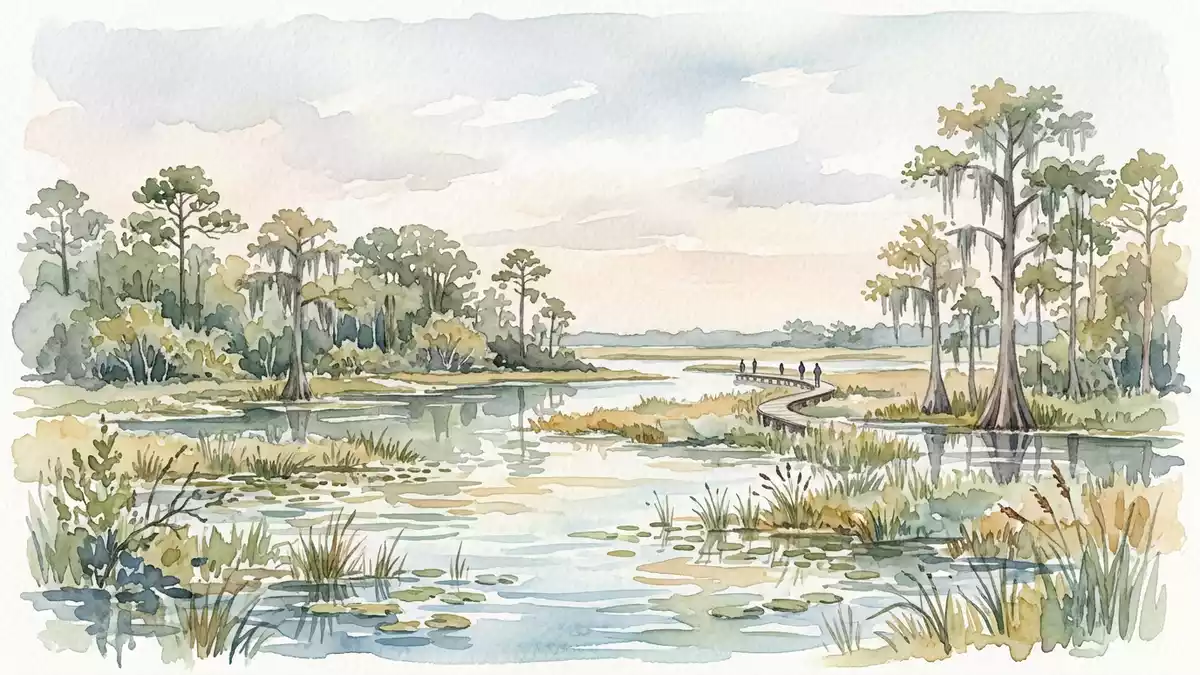
Everglades National Park, reached from Homestead in southern Florida, protects a sweeping subtropical wetland shaped by a famously slow “river of grass”. The park was formally established as a national park on 6 December 1947 and now anchors a wider network of protected areas on the southern Florida peninsula, making the interaction between water, rock and vegetation its defining experience.
A subtropical wilderness on the edge of Florida Bay
Everglades National Park lies across parts of Miami-Dade, Monroe and Collier counties at the southern tip of Florida, extending over roughly 1.5 million acres (about 6,100 km²) of low-lying land and coastal waters.Everglades National Park (EVER) Much of this expanse sits only a few metres above sea level, with flat limestone bedrock underlying the marshes, prairies and mangrove channels. The park includes large portions of Florida Bay, the broad, shallow lagoon between mainland Florida and the Florida Keys, where seagrass meadows and mangrove-fringed islands form an intricate coastal landscape.Florida Bay is considered part of the Everglades
The Everglades themselves developed roughly 5,000 years ago as water flowing south from Lake Okeechobee spread across the peninsula in a wide, shallow sheet.The Everglades formed atop porous limestone Before large-scale drainage works, this mosaic of marshes and wet prairie covered thousands of square miles; the national park now protects the southern portion of that historic watershed, including extensive sawgrass sloughs and estuaries. The terrain is generally flat, but subtle differences in elevation and salinity separate freshwater prairies from mangrove forests and coastal glades, so walking or boating through the park means passing gradually from inland wetlands towards brackish creeks and open bay.
The “river of grass” and its ecosystems
The phrase “river of grass”, popularised in 1947 by writer Marjory Stoneman Douglas, captures the character of the Everglades as a broad, slow-moving flow of water through sawgrass marshes.The Everglades are dominated by sawgrass in water In the park, freshwater sloughs appear as open prairies dotted with low tree islands, their grasses standing in shallow water that moves imperceptibly from north to south. Hardwood hammocks rise just slightly above the surrounding marshes, forming dense stands of trees on small, elevated ground; pinelands occupy other slightly higher zones, where thin soils over limestone support South Florida pine forests.Sawgrass prairies, hammocks and pinelands
Towards the Gulf of Mexico and Florida Bay, mangrove forests fringe the coast, their roots forming intricate networks along tidal channels and sheltered bays.The Everglades mangrove system These mangroves, along with coastal marshes and marine seagrass beds, make Everglades National Park one of the most extensive protected coastal environments in the United States.Everglades National Park at 610,670 hectares The combination of tropical and temperate influences means that plant communities include species associated with Caribbean climates alongside those more typical of the south-eastern United States. Fire, water levels and subtle variations in salinity together shape where each community is found, so the boundary between prairie, hammock and mangrove is often gradual rather than sharply defined.
Wildlife and international recognition
The park’s wetlands, forests and coastal shallows support a wide variety of animals, including several threatened or endangered species. Among the most noted are the American alligator and American crocodile, which share parts of the brackish estuaries; the West Indian manatee, found in warm coastal waters; and the Florida panther, a rare big cat associated with South Florida’s forests and swamps.More than 400 species of birds and rare mammals Wading birds such as herons, egrets and ibises use the marshes and mangroves for feeding and nesting, while migratory species pass through on seasonal routes.
Everglades National Park was authorised by the United States Congress in 1934 and later dedicated in 1947, reflecting a decades-long effort to protect this distinctive wetland system.The park was authorised in 1934 In 1976 it became part of an International Biosphere Reserve recognised under UNESCO’s Man and the Biosphere Programme, and in 1979 the park was inscribed as a World Heritage Site.Biosphere Reserve and World Heritage inscription It was also added to the Ramsar list of Wetlands of International Importance in 1987.Wetland of International Importance These overlapping designations underline the park’s role within a larger protected landscape that includes Big Cypress National Preserve, Biscayne National Park, Dry Tortugas National Park and several wildlife refuges.
Visiting Everglades National Park: what travellers from Western Europe should know
- Everglades National Park lies south-west of Miami, with a principal road entrance reached from Homestead; park access points include areas such as Shark Valley and the Gulf Coast near Everglades City.
- The landscape is low, flat wetland over limestone, and many areas are explored along boardwalks, on designated trails or by boat through shallow channels and open sloughs.
- The park’s climate reflects its position between tropical and temperate zones, with a marked wet season and dry season influencing water levels and the character of the marshes.
- English is the official language and the currency is the United States dollar.
- Entry requirements depend on your nationality; UK travellers can check the FCDO travel advice at gov.uk/foreign-travel-advice, Irish travellers the Department of Foreign Affairs at ireland.ie.
Searching for Everglades National Park on social platforms
These links open searches for Everglades National Park on each platform.
Frequently asked questions about Everglades National Park
Where is Everglades National Park located?
Everglades National Park is in southern Florida, spanning parts of Miami-Dade, Monroe and Collier counties and including much of Florida Bay between the mainland and the Florida Keys.
What should visitors expect on a first visit?
Visitors encounter extensive wetlands, sawgrass prairies, tree islands, mangrove estuaries and shallow bays, explored via roads, boardwalks, trails and guided or independent boat trips.
What makes Everglades National Park distinctive among national parks?
The park protects the southern portion of the Everglades “river of grass”, combining subtropical wetlands with coastal and marine environments recognised as a Biosphere Reserve, World Heritage Site and Ramsar wetland.


