
Everglades National Park’s river of grass and wilderness
Published on 09/08/2026 at 21:02 | Editorial responsibility: Rafael Müller, Editor-in-Chief AD HOC NEWS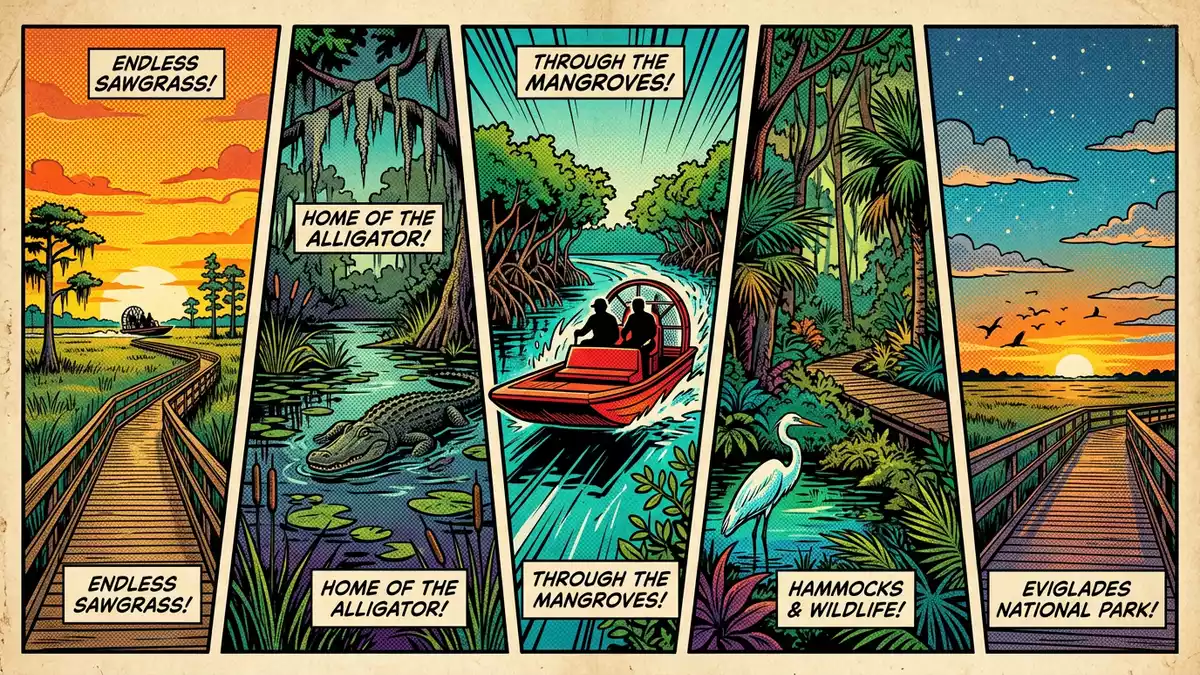
Everglades National Park lies at the southern tip of Florida, near Homestead, and stretches across a broad subtropical wilderness of water, grass and limestone. It was formally dedicated by President Harry S Truman on 6 December 1947, a date that anchors its modern identity.
Wetlands, sawgrass and mangroves
The park is known for its wide, low landscape rather than for peaks or buildings. UNESCO describes it as the largest designated subtropical wilderness reserve on the North American continent, and the site combines sawgrass prairie, mangrove forest and shallow coastal waters.
That mix of habitats gives the park its visual character. The UNESCO listing also identifies it as a World Heritage Site, while the National Park Service classifies it as a biosphere reserve and a wetland of international significance.
A park shaped by water and rock
Everglades National Park sits on a limestone base and occupies a landscape that is almost level. Its water habitats include freshwater marshes, estuaries and coastal mangroves, and the site is also linked to the Florida Bay edge of the system.
The park is closely associated with Ernest F. Coe, a landscape architect who helped drive the early campaign for protection. That effort gathered force in the 1920s and led to federal authorisation in 1934, before the dedication in 1947.
Heritage status and ecological range
The park’s formal recognition adds another layer to its identity. UNESCO inscribed Everglades National Park on the World Heritage List in 1979, citing its limestone substrate and its mixture of temperate and subtropical species and habitats.
Its wildlife reputation rests on breadth rather than spectacle. The park is linked with large numbers of birds and reptiles, along with species such as the manatee, the American alligator and the Florida panther.
Visiting Everglades National Park: what travellers from Western Europe should know
- Everglades National Park lies near Homestead in south Florida. US 41, also known as the Tamiami Trail, reaches the Shark Valley area, and park headquarters is in Homestead.
- The terrain is flat, wet and exposed. Many areas sit at very low elevation, and the landscape is built from water, marsh and limestone rather than steep ground.
- The park spans several counties, including Miami-Dade, Monroe and Collier. Its scale is best understood as a wide protected wetland system rather than a compact urban park.
- The official language is English and the currency is the United States dollar.
- Entry requirements depend on your nationality; UK travellers can check the FCDO travel advice at gov.uk/foreign-travel-advice, Irish travellers the Department of Foreign Affairs at ireland.ie.
Searching for Everglades National Park on social platforms
These links open searches for Everglades National Park on each platform.
Frequently asked questions about Everglades National Park
Where is Everglades National Park?
It lies at the southern tip of Florida, with Homestead as the nearest city named in the park’s basic information. The protected area extends across parts of Miami-Dade, Monroe and Collier counties.
What does a visit involve?
The park is a wetland landscape of marsh, mangrove and shallow water. Its ground is low and flat, and much of its character comes from scale rather than built structures.
What makes Everglades National Park distinctive?
Its identity rests on the meeting of subtropical wilderness, limestone terrain and a wide range of habitats. UNESCO links it with sawgrass prairie, mangroves and a large number of birds, reptiles and threatened species.


