
Everglades National Park as Florida’s vast river of grass
Published on 09/12/2026 at 11:09 | Editorial responsibility: Rafael Müller, Editor-in-Chief AD HOC NEWS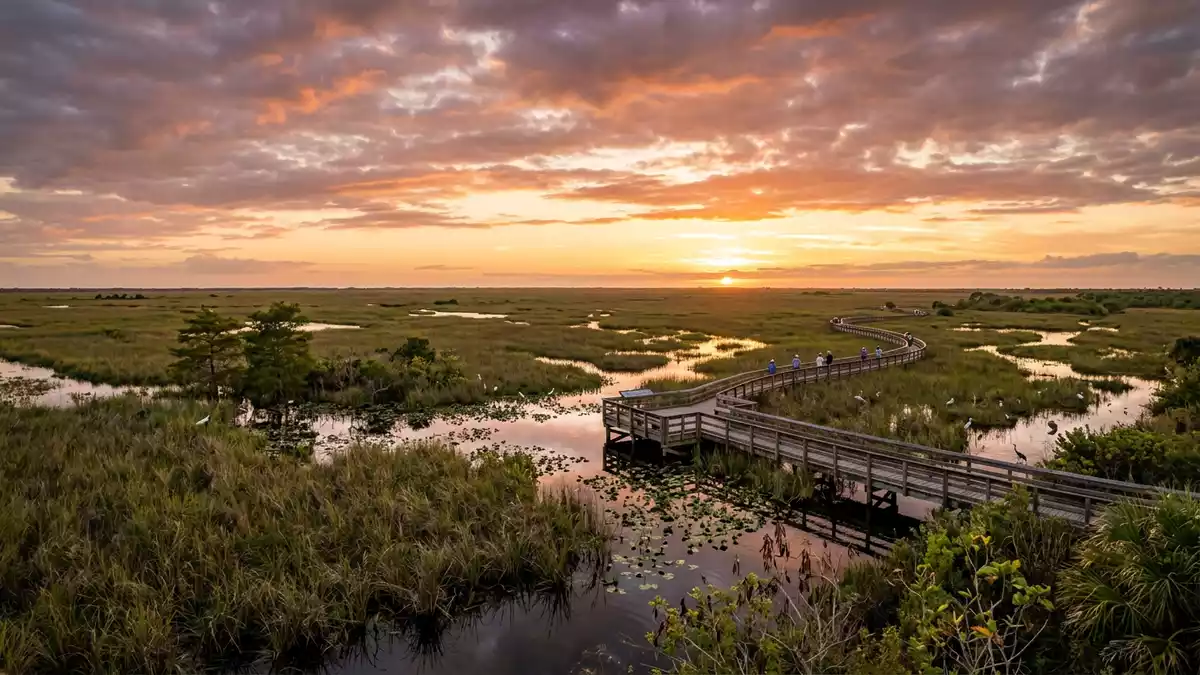
Everglades National Park near Homestead in southern Florida stretches across the south-western portion of the Everglades region as a vast subtropical wilderness of wetlands, estuaries and shallow coastal waters. Established as a national park in 1947 after authorisation by the United States Congress in 1934, it protects a broad, shallow basin where freshwater moves slowly over limestone towards Florida Bay and the Gulf of Mexico, creating what became known in the mid twentieth century as a “river of grass”.
A subtropical wilderness shaped by slow-moving water
Everglades National Park lies at the southern tip of the Florida peninsula, occupying a large area of Miami-Dade, Monroe and Collier counties and forming the south-western part of the wider Everglades watershed that extends from Lake Okeechobee towards Florida Bay.the southwestern portion of the region The landscape is extraordinarily flat, with elevations only a few feet above sea level, so water spreads out rather than cutting deep channels, covering the limestone bedrock in a slow, shallow sheet.extraordinary flatness
This shallow flow of freshwater gives Everglades National Park its distinctive “river of grass” character, a phrase popularised in 1947 to describe long views across sawgrass marshes where tall blades rise from standing water dotted by tree islands and open sloughs.the River of Grass The park encompasses extensive freshwater marl prairies and sloughs, tropical hardwood hammocks on slightly higher ground, and pine rocklands where shallow soils over limestone support different vegetation, all tied together by the seasonal movement of water.
Sawgrass prairies, tree islands and coastal mangroves
The core landscape of Everglades National Park is made up of broad sawgrass prairies, where the sedge known as sawgrass dominates marshes that remain flooded for much of the year and give wide areas a distinctive appearance.sawgrass prairies Within this “river of grass”, slightly raised areas form tree islands that support hardwood species and palms, standing as patches of forest above the surrounding wetland. Open sloughs provide broader water channels, adding variety to the largely level terrain.
Towards the coasts, freshwater habitats grade into mangrove forests and shallow marine environments, so the character of the park changes as the water approaches Florida Bay and the Gulf of Mexico.freshwater and saltwater environments Along Florida Bay, extensive mangrove shorelines and estuaries form interfaces between land and sea, while on the Gulf side labyrinths of mangrove-fringed channels lead towards the Ten Thousand Islands region. The mangrove system within Everglades National Park is documented as one of the largest continuous areas of mangroves in the world, with red, black and white mangrove species forming dense forests over hundreds of square kilometres.largest continuous system of mangroves
Wildlife, protection status and Homestead as a gateway
Everglades National Park preserves wetland, forest and marine habitats that support an array of wildlife adapted to shallow, fluctuating waters, including American alligators, American crocodiles, West Indian manatees, wading birds such as herons and egrets, and endangered species like the Florida panther and wood stork.rare or threatened species The park was recognised under the UNESCO Man and the Biosphere Programme in 1976 and inscribed on the World Heritage List in 1979, placing it within an international network of protected areas that also includes other sites in southern Florida and the Florida Keys.UNESCO Biosphere Reserve and World Heritage site
Homestead and nearby Florida City function as gateway communities for travellers approaching Everglades National Park from the Atlantic side of the peninsula, with a main road entrance reached by following State Road 9336 towards the Ernest F. Coe Visitor Center.State Road 9336 towards the Ernest F. Coe Visitor Center Within the protected area, roads and waterways connect different sectors of the park’s landscape, from sawgrass and tree islands to mangrove estuaries and Florida Bay, giving a physical sense of the transition from freshwater wetlands to marine shallows.
Visiting Everglades National Park: what travellers from Western Europe should know
- Everglades National Park lies in southern Florida, with a main eastern road entrance reached from Homestead and Florida City by following State Road 9336 towards the Ernest F. Coe Visitor Center.
- The landscape is low, flat and wet, with extensive marshes and mangroves; paths and boardwalks may include sections over standing water and raised areas on tree islands.
- Everglades National Park includes coastal zones along Florida Bay and the Gulf of Mexico, where shallow marine waters, mangrove shorelines and estuaries form part of the protected area.
- The official language is English and the currency is the United States dollar.
- Entry requirements depend on your nationality; UK travellers can check the FCDO travel advice at gov.uk/foreign-travel-advice, Irish travellers the Department of Foreign Affairs at ireland.ie.
Searching for Everglades National Park on social platforms
These links open searches for Everglades National Park on each platform.
Frequently asked questions about Everglades National Park
Where is Everglades National Park?
Everglades National Park is in southern Florida in the United States, occupying a large subtropical wetland landscape near Homestead and extending towards Florida Bay and the Gulf of Mexico.
What kind of landscape should visitors expect?
Visitors encounter an unusually flat wetland basin where freshwater moves slowly over limestone, creating sawgrass prairies, tree islands, mangrove estuaries and shallow coastal waters.
What makes Everglades National Park distinctive?
The park’s scale as a subtropical wilderness, its “river of grass” marshes, extensive mangrove system and combination of freshwater and marine habitats give it a distinctive character among protected areas in the United States.


