
Everglades National Park as a living subtropical wilderness
Published on 09/04/2026 at 21:59 | Editorial responsibility: Rafael Müller, Editor-in-Chief AD HOC NEWS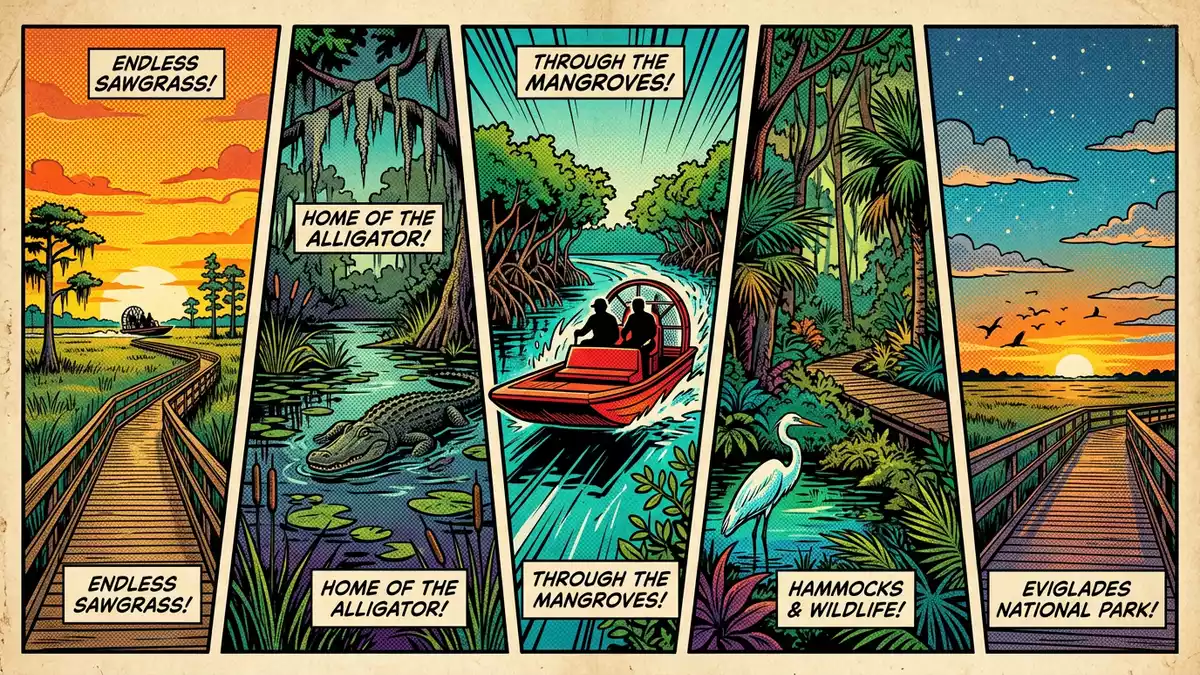
Everglades National Park stretches across the southern tip of Florida as a vast subtropical wilderness of wetlands and mangrove estuaries, reached by road from Homestead on the Atlantic side of the peninsula. Established as a national park in 1947, it protects a long, shallow basin where fresh water moves slowly across limestone towards the Gulf of Mexico and Florida Bay.
A river of grass shaped by water and limestone
The core landscape of Everglades National Park is a broad, shallow sheet of water flowing south and south-west over porous limestone bedrock, creating what is often described as a “river of grass” dotted with tree islands and open sloughs. Sawgrass marshes give wide areas of the park a distinctive appearance, their tall blades emerging from standing water that can extend for many kilometres. Within this wetland, slightly higher points of ground carry hardwood hammocks and pinelands, forming patches of woodland that rise just enough above the surrounding marsh to remain comparatively dry.
Towards the coasts, the character of the park changes as freshwater wetlands grade into mangrove forests and marine shallows. On the Gulf of Mexico side, labyrinths of mangrove-fringed channels lead into the Ten Thousand Islands, while along Florida Bay extensive mangrove shorelines and estuaries form feeding grounds for fish and wading birds. The park lies at the meeting point between temperate and subtropical America, and its wetlands, forests and coastal waters sit within a larger biosphere reserve recognised by UNESCO.biosphere reserve recognised by UNESCO
Protection history and international status
Everglades National Park was authorised by the United States Congress in 1934, after local advocates had spent years arguing for the protection of the region’s wetlands. Land acquisition took more than a decade, and the park was formally dedicated on 6 December 1947 by President Harry S. Truman in a ceremony in Everglades City.dedicated on 6 December 1947 At the time of establishment, the protected area covered around 1.3 to 1.5 million acres of marshes, mangroves and open water.
The park forms part of a wider network of protected areas in southern Florida, including Big Cypress National Preserve, Biscayne National Park and Dry Tortugas National Park, as well as a number of wildlife refuges and marine sanctuaries.wider network of protected areas In 1976, Everglades National Park together with Dry Tortugas National Park was designated a biosphere reserve, and in 1979 much of the park was inscribed on the UNESCO World Heritage List.inscribed on the UNESCO World Heritage List These international recognitions underline the ecological importance of its wetlands and its role in protecting habitats for a wide range of plants and animals.
Wildlife, habitats and visiting on foot and by boat
Everglades National Park protects wetland, forest and marine habitats that support a varied community of wildlife, including alligators, crocodiles, wading birds and fish adapted to shallow waters. The sawgrass prairies and open sloughs provide feeding areas for herons and egrets, while mangrove forests shelter fish nurseries and coastal birds. Pine rocklands and hardwood hammocks on slightly raised ground add further habitat types within the park, creating a mosaic of environments within the protected area.wetland, forest and marine habitats
Visitors encounter this landscape through boardwalks, short walking trails and longer backcountry routes, as well as by canoe, kayak or motor boat in designated areas. Established visitor centres, including the Ernest F. Coe Visitor Center near Homestead and facilities at Flamingo, serve as gateways to different parts of the park’s road-accessible zones.Ernest F. Coe Visitor Center near Homestead Away from the roads and boardwalks, large tracts of wetland and mangrove remain without constructed paths, reachable only on water.
Visiting Everglades National Park: what travellers from Western Europe should know
- Everglades National Park lies in southern Florida, with a main eastern road entrance reached from Homestead and Florida City by following State Road 9336 towards the Ernest F. Coe Visitor Center.
- Large areas of the park consist of wetlands and mangrove channels, so exploring beyond the road-accessible boardwalks and trails generally involves travel by boat along marked waterways.
- The terrain on many walking routes is flat but can include exposed sections with little shade, while boardwalks and viewing platforms provide raised vantage points over the surrounding marshes.
- Everglades National Park is in the United States; the official language is English and the currency is the United States dollar.
- Entry requirements depend on your nationality; UK travellers can check the FCDO travel advice at gov.uk/foreign-travel-advice, Irish travellers the Department of Foreign Affairs at ireland.ie.
Searching for Everglades National Park on social platforms
These links open searches for Everglades National Park on each platform.Frequently asked questions about Everglades National Park
Where is Everglades National Park located?
Everglades National Park occupies the south-western portion of the Everglades region in southern Florida, with an eastern entrance reached from Homestead and Florida City.
What can visitors expect during a visit?
Visitors encounter extensive sawgrass wetlands, tree islands, mangrove shores and coastal shallows, explored via boardwalks, short trails and boat routes that reveal different parts of the subtropical ecosystem.
What makes Everglades National Park distinctive among national parks?
Everglades National Park was established to protect a fragile wetland ecosystem rather than mountain scenery, and its recognition as a biosphere reserve and World Heritage site reflects its ecological significance.


