
Everglades National Park, a subtropical wilderness of water and grass
Published on 08/28/2026 at 15:21 | Editorial responsibility: Rafael Müller, Editor-in-Chief AD HOC NEWS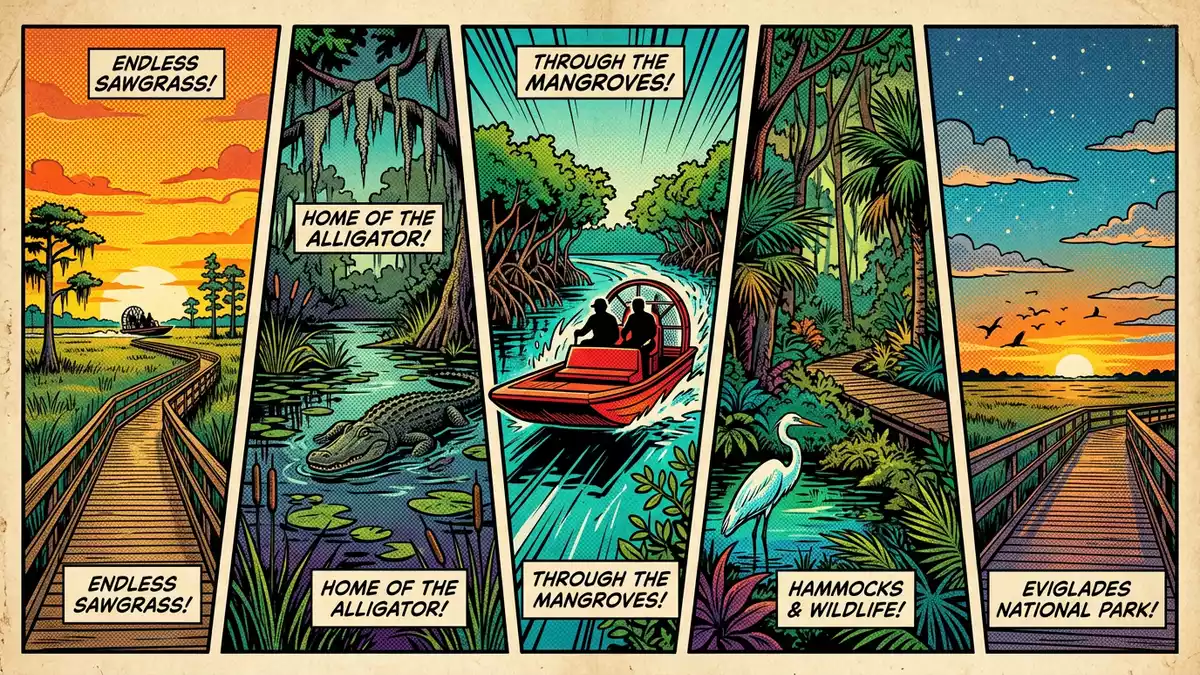
Everglades National Park, south of Homestead in southern Florida, protects a vast subtropical wetland where shallow water, sawgrass and mangroves form a broad, slow-moving river of grass across a limestone plain.subtropical wetland Established in 1947 as a national park, it preserves the southwestern portion of the wider Everglades ecosystem at the tip of the Florida peninsula.established in 1947 The landscape’s defining character is this shallow basin of water flowing south-west towards Florida Bay, carrying visitors through a mosaic of marshes, tree islands and coastal estuaries.
A river of grass over limestone
The wider Everglades watershed formed several thousand years ago on a broad, low-lying limestone platform, and Everglades National Park protects its lower, coastal reach.Everglades watershed Fresh water historically overflowed from Lake Okeechobee, spreading as a shallow sheet across the peninsula and creating a river of grass up to around 160 km from lake to bay.river of grass Within the park, the Shark River Slough and the smaller Taylor Slough carry much of this flow, draining the marshes into estuaries and the Gulf of Mexico.
Across much of the interior, the dominant plant is sawgrass, a sedge forming extensive prairies standing in shallow water and giving the Everglades its “river of grass” image.sawgrass prairies Above the marsh level rise hardwood hammocks and pinelands on slightly higher ground, creating tree islands with different soils and plant communities.hardwood hammock and pinelands Visitors moving through the park encounter this contrast between open, waterlogged prairies and scattered wooded islands, all resting on the same limestone foundation.
From sloughs to mangroves and Florida Bay
As the fresh water of the Everglades approaches the coast, it meets salt water from the Gulf of Mexico and the Atlantic, and mangrove forests occupy this transitional zone.mangrove forests Red, black and white mangroves form dense stands along creeks and estuaries, building up low islands and protecting channels that lead out towards Florida Bay.mangrove ecosystem Much of Florida Bay itself, including extensive seagrass beds, lies within the park boundary and is considered part of the Everglades’ marine environment.Florida Bay seagrass
More than 800 square miles (about 2,100 km²) of Florida Bay are protected inside Everglades National Park, making this shallow bay the largest continuous body of water within the park.largest body of water Here, turtle grass and other seagrasses create underwater meadows that support fish, invertebrates and birds, linking the freshwater sloughs with marine habitats visited by wading birds and coastal species.seagrass ecosystems For travellers, the relationship between inland marsh, mangrove fringe and open bay can be seen by moving from the park’s interior out towards its coastal areas along marked roads and waterways.
A protected subtropical wilderness of global importance
Everglades National Park covers more than 1.5 million acres (over 6,400 km²) of land and water in Miami-Dade, Monroe and Collier counties, making it the largest subtropical wilderness reserve in North America.park acreagelargest subtropical wilderness It contains the largest continuous stand of sawgrass prairie in the United States and one of the largest mangrove ecosystems in the Western Hemisphere.largest mangrove ecosystem Within this space, a diversity of habitats ranges from freshwater sloughs and marl prairies to coastal saltmarshes and marine seagrass beds.
Beyond its national park status, Everglades National Park holds several international conservation designations reflecting its ecological significance. It was inscribed on the UNESCO World Heritage List in 1979 under natural criteria, recognising its geological processes, biological complexity and threatened species.World Heritage inscription 1979 It also forms part of the Everglades and Dry Tortugas Biosphere Reserve under UNESCO’s Man and the Biosphere Programme and is designated as a Ramsar Wetland of International Importance.biosphere reserve and Ramsar site These overlapping protections underscore the park’s role as habitat for rare species such as the Florida panther, American crocodile and West Indian manatee, alongside extensive breeding grounds for wading birds.
Visiting Everglades National Park: what travellers from Western Europe should know
- Everglades National Park lies at the southern tip of Florida, with major road access from Homestead and Miami; the main eastern entrance is reached via State Road 9336 from Homestead.
- The terrain includes long, flat boardwalks over wetlands, unpaved trails through pinelands and hammocks, and boat routes on shallow coastal waters, so sturdy footwear and weather-appropriate clothing are important.
- Within the wider protected complex, the park’s coastal boundary reaches Florida Bay and the Gulf of Mexico, and some viewpoints bring open water, mangrove channels and sawgrass prairies into the same panorama.
- The official language is English and the currency is the US dollar.
- Entry requirements depend on your nationality; UK travellers can check the FCDO travel advice at gov.uk/foreign-travel-advice, Irish travellers the Department of Foreign Affairs at ireland.ie.
Searching for Everglades National Park on social platforms
These links open searches for Everglades National Park on each platform.
Frequently asked questions about Everglades National Park
Where is Everglades National Park?
Everglades National Park lies in southern Florida in the United States, with its main eastern access near Homestead and its western boundary reaching towards the Gulf of Mexico.
What should travellers expect on a visit?
Travellers encounter extensive wetlands of shallow water and sawgrass, scattered tree islands, boardwalks over marshes and access points to mangrove channels and Florida Bay, rather than a single central viewpoint.
What makes Everglades National Park distinctive?
The park is distinctive as a large subtropical wilderness where a slow river of grass, extensive mangrove forests and protected seagrass bays are combined under overlapping national and international conservation designations.


