
Everest Base Camp on the Khumbu Glacier
Published on 09/23/2026 at 08:31 | Editorial responsibility: Rafael Müller, Editor-in-Chief AD HOC NEWS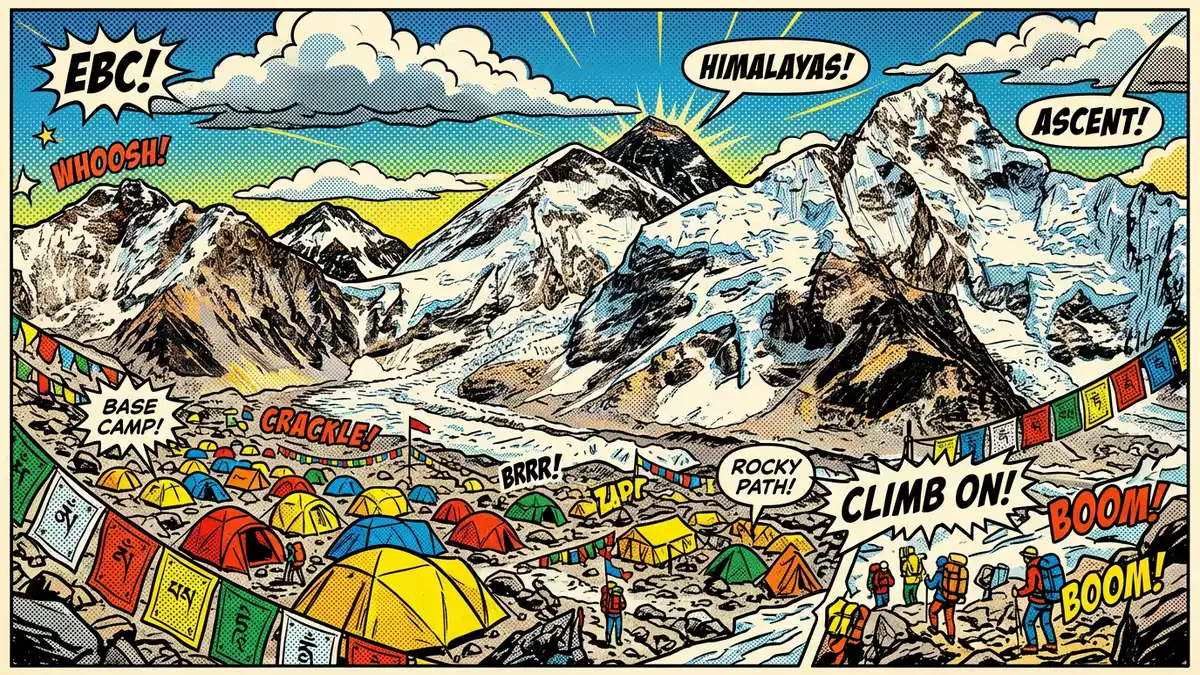
Everest Base Camp is a high-altitude camp on the Khumbu Glacier beneath the southern side of Mount Everest. At 5,364 m (17,598 ft), it is a place of ice, moraine, tents and expedition history in Nepal’s Khumbu region.
Everest Base Camp on moving ice
The camp lies within Sagarmatha National Park in Solukhumbu district. The park contains deep valleys, glaciers and high Himalayan peaks, with Mount Everest dominating the landscape. Its natural and cultural importance led to UNESCO World Heritage inscription in 1979.
The ground beneath the camp is glacial terrain rather than a permanent urban site. The Khumbu Glacier descends from the Everest massif, carrying rock and ice through a landscape marked by crevasses, moraine ridges and the Khumbu Icefall. The camp’s Khumbu location places it on the southern approach to Everest, close to the mountain’s lower glacier system.
The southern approach to Mount Everest
Everest Base Camp is reached through the Khumbu Valley. The recognised trekking route begins at Lukla and passes through settlements including Namche Bazaar, Tengboche, Dingboche, Lobuche and Gorak Shep before reaching the glacier.
The route links inhabited mountain villages with an increasingly severe alpine environment. Terraced fields and forested slopes give way to exposed rock, high passes, glacial valleys and sparse vegetation. Gorak Shep, at about 5,164 m (16,942 ft), is the final settlement on the usual approach.
The camp itself is not the summit of Everest, nor is it the highest point on the standard trekking route. It is the southern staging area for expeditions and the destination associated with the walk from Lukla. The route through Khumbu follows the Dudh Koshi valley before reaching the upper glacier landscape.
A place tied to the 1953 ascent
The camp is closely connected with the British Everest expedition of 1953, led by Colonel John Hunt. On 29 May 1953, Edmund Hillary of New Zealand and Tenzing Norgay reached the summit of Mount Everest from the southern side.
The ascent gave Everest Base Camp a permanent place in mountaineering history. Hillary and Tenzing approached the summit through the Khumbu Icefall, the Western Cwm and the South Col. Their achievement remains the defining historical association of the Nepalese base camp.
Mount Everest reaches 8,849 m (29,032 ft) on the border between Nepal and Tibet. The mountain is known as Sagarmatha in Nepali and Chomolungma in Tibetan. The 1953 summit ascent placed Hillary and Tenzing at the centre of the mountain’s modern history.
The surrounding region is also a Sherpa homeland, with villages, monasteries and trading routes spread through the valleys below the glacier. Tengboche Monastery and Namche Bazaar form important cultural points on the approach, while Sagarmatha National Park protects the wider mountain environment. Sagarmatha National Park combines Himalayan scenery with a living high-altitude cultural landscape.
Visiting Everest Base Camp: what travellers from Western Europe should know
- The camp lies in northeastern Nepal’s Khumbu region, within Sagarmatha National Park. The approach runs from Lukla through the Khumbu Valley and ends near the glacier.
- The route is reached on foot after arrival in Lukla. It crosses steep mountain paths, suspension bridges, rocky ground and high-altitude terrain.
- At 5,364 m (17,598 ft), the camp is above the tree line. The final approach from Gorak Shep crosses exposed moraine and glacial ground.
- The official language is Nepali and the currency is the Nepalese rupee.
- Entry requirements depend on your nationality; UK travellers can check the FCDO travel advice at gov.uk/foreign-travel-advice, Irish travellers the Department of Foreign Affairs at ireland.ie.
- Conditions on the mountain change with the seasons; the local cable-car operators and alpine clubs provide information.
Searching for Everest Base Camp on social platforms
These links open searches for Everest Base Camp on each platform.Frequently asked questions about Everest Base Camp
Where is Everest Base Camp?
Everest Base Camp is in Nepal’s Khumbu region, within Sagarmatha National Park in Solukhumbu district. It lies on the southern side of Mount Everest, on the Khumbu Glacier.
What is a visit to Everest Base Camp like?
The approach is a high-altitude trek through villages, forests, rocky valleys and glacial terrain. The camp itself is a seasonal expedition site surrounded by moraine and ice.
What makes Everest Base Camp distinctive?
Its identity combines a precise glacial setting with the history of the 1953 ascent by Edmund Hillary and Tenzing Norgay. The camp also sits within a Sherpa cultural landscape protected by Sagarmatha National Park.


