
Everest Base Camp and the high trail through Khumbu
Published on 09/01/2026 at 16:11 | Editorial responsibility: Rafael Müller, Editor-in-Chief AD HOC NEWS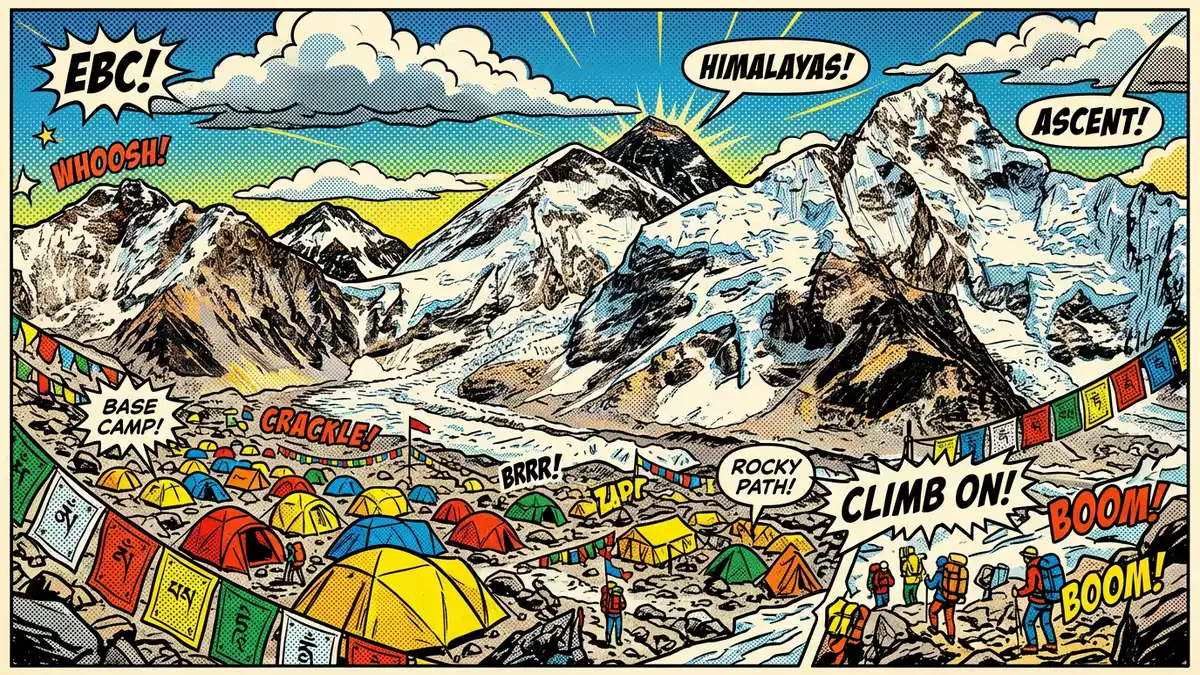
Everest Base Camp in Khumbu, Nepal, is the high-altitude campsite on the southern side of Mount Everest that anchors one of the Himalaya’s most travelled trekking routes. Rising to 5,364 m (17,598 ft) on the Khumbu Glacier within Sagarmatha National Park, it sits among ridges of ice and rock that frame the upper reaches of the Dudh Koshi river valley.
The southern base on the Khumbu Glacier
The Everest Base Camp reached from Khumbu is the South Base Camp in Nepal, positioned on the Khumbu Glacier below the Khumbu Icefall at about 5,364 m (17,598 ft) above sea level.South Base Camp in Nepal The campsite lies in northeastern Nepal, in the Solukhumbu District, inside the protected landscape of Sagarmatha National Park, a UNESCO World Heritage Site recognised for its high mountain ecosystems and Sherpa settlements.Sagarmatha National Park
The glacier surface at Base Camp is a rough mix of boulders, gravel and ice, with seasonal tents for expedition teams and support staff spread across the lateral moraine beside the icefall.lateral moraine beside the icefall Above, the seracs and crevasses of the Khumbu Icefall rise towards the Western Cwm, while to the south and west, trekking paths continue towards Gorak Shep and the ridge of Kala Patthar, a viewpoint that reaches about 5,545 m (18,192 ft) and gives wide views over the summit pyramid of Everest and surrounding peaks.Kala Patthar viewpoint
The trekking route through Khumbu to Base Camp
The approach to Everest Base Camp on the Nepal side follows a long-established trail through the Khumbu valley, beginning at the airstrip town of Lukla in the Solukhumbu District at around 2,860 m (9,383 ft).trail begins in Lukla From Lukla, the path descends towards Phakding beside the Dudh Koshi river, then climbs to Namche Bazaar, the principal Sherpa town and trading centre in the valley at about 3,440 m (11,286 ft).Namche Bazaar at 3,440 m
Beyond Namche Bazaar, the route continues through forested slopes and high pastures to Tengboche, Dingboche and Lobuche, gradually leaving trees behind and entering an alpine landscape of rock, scrub and glacial debris.route through Tengboche and Dingboche The final settlement on the main trail is Gorak Shep, a small cluster of lodges on a sandy plateau above the glacier at around 5,140–5,164 m, from which a path along the lateral moraine leads towards the Base Camp area.Gorak Shep plateau The full trekking route from Lukla to Everest Base Camp and back covers roughly 130 km (81 miles), with a cumulative ascent of more than 2,500 m (8,202 ft) from the airstrip to the glacier.approximately 130 km round-trip
Everest Base Camp, mountaineering and Sherpa culture
Everest Base Camp in Khumbu functions as the staging ground for expeditions using the South Col route to the summit of Mount Everest, which reaches 8,848.86 m (29,031.7 ft) at the highest point of the mountain.South Col route Climbers and support teams spend extended periods at the campsite preparing equipment, establishing higher camps and moving loads through the Khumbu Icefall, while trekking groups usually visit the area from Gorak Shep before returning to lower altitudes.
The wider Khumbu region around the Base Camp trail is the heartland of Sherpa communities, with long-standing villages such as Namche Bazaar and monasteries including Tengboche forming part of the cultural landscape along the route.Sherpa settlements along the route Within Sagarmatha National Park, trekkers and climbers move through zones of changing vegetation, from pine and rhododendron forest at lower levels to open tundra and glacial terrain near Base Camp, with views of peaks such as Ama Dablam, Lhotse and Nuptse forming a backdrop to the approach towards Everest.views of Everest and Ama Dablam
Visiting Everest Base Camp: what travellers from Western Europe should know
- Everest Base Camp lies in northeastern Nepal within the Khumbu region of Solukhumbu District, reached by trekking routes that start from the town of Lukla, which is served by domestic flights from Kathmandu.
- The approach to Base Camp involves sustained walking at high altitude, with sections of steep gradients, stone steps and paths over glacial moraine; the final stretch from Gorak Shep towards the campsite crosses uneven rock and ice debris.
- The wider route passes through Sherpa settlements such as Namche Bazaar and high villages including Dingboche and Lobuche, where stone-built lodges and teahouses line the trail.
- The official language is Nepali and the currency is the Nepalese rupee.
- Entry requirements depend on your nationality; UK travellers can check the FCDO travel advice at gov.uk/foreign-travel-advice, Irish travellers the Department of Foreign Affairs at ireland.ie.
Searching for Everest Base Camp on social platforms
These links open searches for Everest Base Camp on each platform.
Frequently asked questions about Everest Base Camp
Where is Everest Base Camp in Khumbu?
Everest Base Camp is the South Base Camp on Mount Everest, located on the Khumbu Glacier in northeastern Nepal within Sagarmatha National Park in the Solukhumbu District.
What should travellers expect on a visit to Everest Base Camp?
Travellers encounter high-altitude trekking conditions, stone-built Sherpa villages and glacial terrain, culminating in a rough campsite area on the Khumbu Glacier beside the Khumbu Icefall.
What makes Everest Base Camp distinctive among Himalayan trekking destinations?
Everest Base Camp combines a demanding route through the Khumbu valley with a location directly beneath the world’s highest peak, linking long-distance trekking with expedition mountaineering culture.


