
Etosha National Park’s great white pan and waterholes around Okaukuejo
Published on 09/05/2026 at 11:48 | Editorial responsibility: Rafael Müller, Editor-in-Chief AD HOC NEWS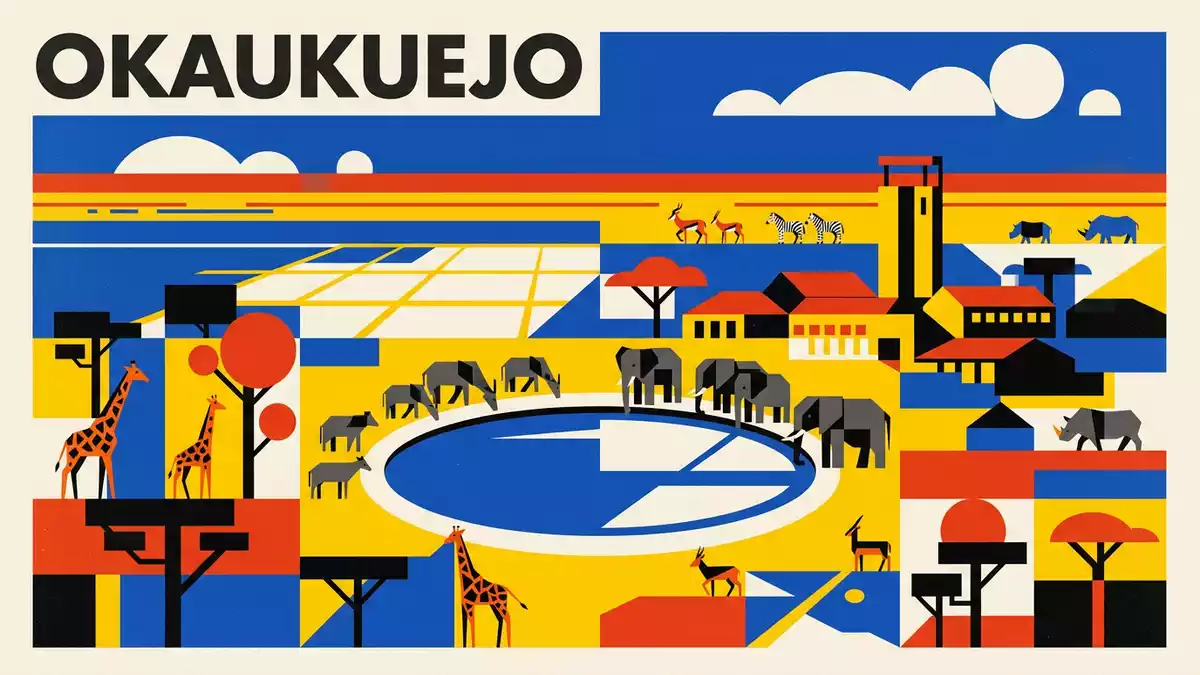
Etosha National Park in northern Namibia centres on a broad salt pan and a chain of waterholes that make the area around Okaukuejo one of southern Africa’s most distinctive wildlife landscapes. Open savanna, thorn scrub and pale mineral flats meet at the edge of the Etosha Pan, where animals congregate and the park’s long conservation history is written in tracks rather than words.
The great white pan that defines Etosha
The single feature that shapes Etosha National Park is the Etosha Pan, a mineral-encrusted salt flat that occupies a substantial part of the park’s interior and is visible from space in satellite imagery.Etosha Pan, the mineral-encrusted salt pan Stretching in a long, shallow basin, the pan presents a surface of pale, powdery crust that contrasts sharply with the darker bushveld around Okaukuejo.
Geologically, the Etosha Pan is a remnant of an ancient inland lake system associated with rivers such as the Kunene, cut off when tectonic movements redirected their courses and left a closed basin that only intermittently holds water.formation of the Etosha Pan from an ancient lake During dry periods the surface forms a broad expanse of calcrete and salt, but in exceptionally wet years shallow water can collect across parts of the pan and turn sections into temporary wetlands, drawing flocks of flamingos and other waterbirds to the newly formed lagoon.
A century of protection around Okaukuejo
Etosha’s status as a protected area dates back to March 1907, when Governor Friedrich von Lindequist of German South-West Africa proclaimed the Etosha Game Reserve, establishing formal conservation over a swathe of territory that originally extended far beyond the present park boundaries.proclaimed in March 1907 as Wildschutzgebiet Nr. 2 Over the following decades, particularly under South African administration in the mid-twentieth century, these boundaries were progressively reduced and redefined, concentrating the park around the Etosha Pan and the surrounding wildlife-rich plains.
Okaukuejo developed as an administrative centre within this protected landscape and became one of Etosha’s key rest camps in the twentieth century, providing accommodation and a focal point for travellers while also serving as a base for park operations.Okaukuejo camp established as a tourism facility The protected status, later consolidated when Etosha was formally proclaimed a national park in 1967, has given wildlife in the area around Okaukuejo more than a century of legal shelter, even as political authority over Namibia changed.
Waterholes and wildlife around Okaukuejo
Where the edge of the Etosha Pan meets the surrounding grassland, a network of waterholes turns an austere landscape into a busy wildlife stage, especially around Okaukuejo. The park contains both natural springs and fountains and others fed by boreholes drilled to reach groundwater, creating reliable drinking points across an otherwise dry environment.numerous natural and borehole-fed waterholes These waterholes form focal nodes, with animals moving between them along faint tracks that criss-cross the plains.
Okaukuejo’s own waterhole lies directly beside the rest camp and is floodlit after dark, making it one of Etosha National Park’s most recognisable viewing points.Okaukuejo camp near the Andersson Gate with a floodlit waterhole In the dry season particularly, elephants, giraffes, zebras, springbok and other antelope line up at the margin of the pool, while black rhinos are frequently recorded approaching the water after dusk, their silhouettes standing out against the lit surface.
Wildlife communities on the plains
Beyond the individual waterholes, Etosha National Park’s broader wildlife community reflects its mix of habitats, from mopane woodland to open grassland and the margins of the pan. Large mammals in the park include elephants, both black and white rhinos, giraffes, Burchell’s zebras, lions, leopards, cheetahs and a range of antelope such as springbok, blue wildebeest, oryx (gemsbok), eland and black-faced impala.elephants, rhinos, big cats and antelope species Smaller mammals and birds occupy the scrub and pans, with raptors scanning from roadside trees and flocks of seed-eaters moving between patches of grass.
Historically, hunting and ivory trading in the nineteenth century led to sharp declines in large mammals such as elephants, rhinoceroses and lions in the wider region, but the establishment and maintenance of Etosha as a designated reserve helped many of these species recover within its boundaries.heavy hunting and later recovery within the reserve Over time, the park has also become an important refuge for black rhinos, which are now one of its most closely monitored and conservation-sensitive residents, often seen at waterholes such as the one at Okaukuejo.
Visiting Etosha National Park: what travellers from Western Europe should know
- Etosha National Park lies in northern Namibia, with Okaukuejo situated in the south-western sector of the park near the Andersson Gate, reached by road from towns such as Outjo.
- The terrain around Okaukuejo is largely flat but at times uneven, with gravel tracks, patches of calcrete and occasional low rises; walking areas near the camp and main waterhole involve short distances on firm surfaces.
- Within the park, designated roads link Okaukuejo to other camps such as Halali and Namutoni, giving access to multiple waterholes on the edge of the pan and across the surrounding plains.
- The official language of Namibia is English and the currency is the Namibian dollar.
- Entry requirements depend on your nationality; UK travellers can check the FCDO travel advice at gov.uk/foreign-travel-advice, Irish travellers the Department of Foreign Affairs at ireland.ie.
Searching for Etosha National Park on social platforms
These links open searches for Etosha National Park on each platform.
Frequently asked questions about Etosha National Park
Where is Etosha National Park and Okaukuejo located?
Etosha National Park lies in northern Namibia, and Okaukuejo is a camp and administrative centre in the south-western part of the park near the Andersson Gate.
What can visitors expect when staying near the Okaukuejo waterhole?
Visitors staying at Okaukuejo encounter a floodlit waterhole beside the camp, where a succession of animals, including black rhinos and elephants, often come to drink after dark in the dry season.
What makes the Etosha Pan and its surroundings distinctive?
The Etosha Pan forms a vast mineral salt flat that dominates the park’s centre, and its edge around Okaukuejo combines open plains, waterholes and long-protected wildlife in a single, easily observed landscape.


