
Etna, the towering stratovolcano above Catania
Published on 09/12/2026 at 17:45 | Editorial responsibility: Rafael Müller, Editor-in-Chief AD HOC NEWS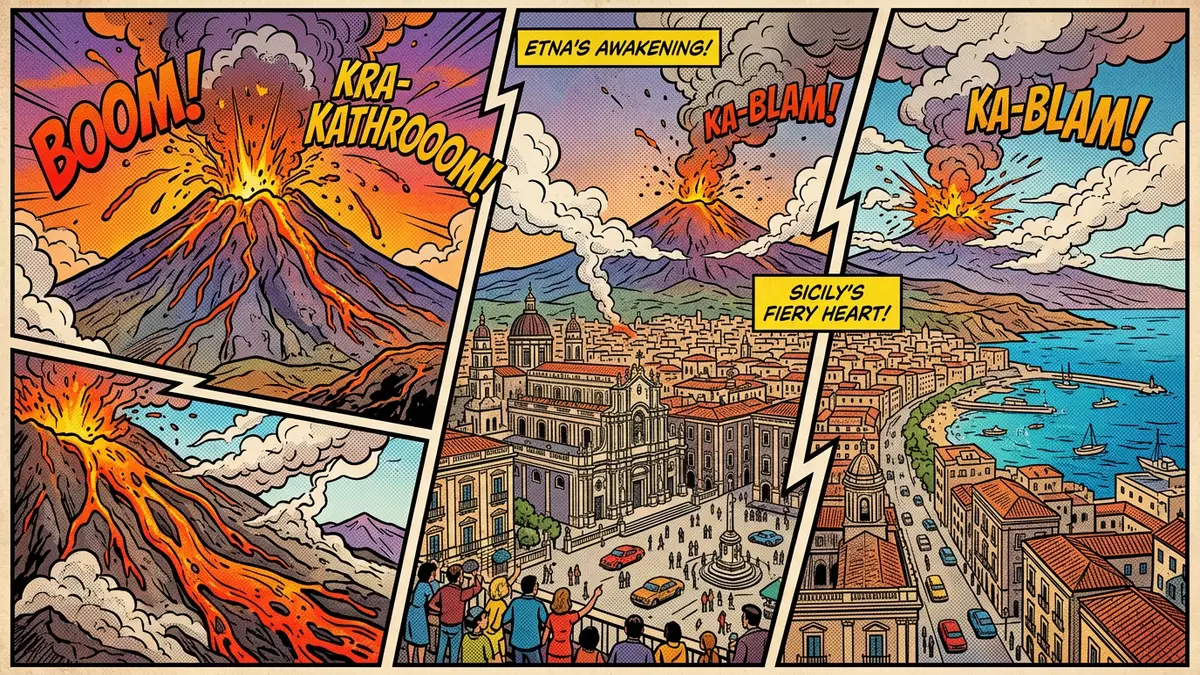
Etna dominates the landscape above Catania on the eastern coast of Sicily, a vast active stratovolcano whose bulk and height define this part of Italy. Rising more than 3,300 m (around 10,900 ft) above sea level, it is the highest mountain on any Mediterranean island and the highest active volcano in Europe, with a conical form built up by repeated eruptions over hundreds of thousands of years.the highest Mediterranean island mountain
Etna’s scale, shape and volcanic character
Etna is a classic stratovolcano, sometimes called a composite volcano, formed by layers of solidified lava, tephra and ash that have created its broad, sloping flanks and high central cone.stratovolcano or composite volcano The mountain covers an area measured in the hundreds of square kilometres, its base spreading inland from the Ionian Sea and wrapping around Catania and neighbouring communities.
The summit region is a cluster of craters and vents where fresh lava and dark ash frequently reshape the rim, so its exact elevation has varied in recent measurements between a little over 3,320 m and around 3,357 m (approximately 10,900 ft to 11,014 ft).about 10,900 feet (3,320 metres) Below this high zone, the mountain’s flanks form a series of broad terraces and older cones, scarred by eruption fissures and cooled lava flows that have solidified into black and rust-coloured rock.
Lava landscapes, fertile belts and human history
Etna’s slopes show a distinct banding of landscapes, from the cultivated lower zone through forest belts to the stark summit region. The lower slopes around Catania and neighbouring towns are covered by orchards and vineyards that make use of soils derived from weathered lava and ash, a pattern described for Etna’s fertile belt for generations.fertile lower slopes with vineyards and orchards Here, stone walls and terraces are built from dark volcanic blocks, and roads and settlements thread between ancient lava fields.
Higher up, patches of forest cloak parts of the middle slopes, giving way to more open terrain where shrubby vegetation and bare rock dominate. The upper areas are marked by extensive ash deposits and younger lava streams, producing a grey and black surface broken by occasional hardy plants and small volcanic cones.growing for about 500,000 years The volcano has an eruptive history traced back around 500,000 years and written records of eruptions for at least 2,700 years, including a major event in 1669 that sent lava towards Catania and reshaped parts of the surrounding countryside.Catania itself was hit by an eruption in 1669
UNESCO recognition and Etna Park
Etna’s scientific and natural importance led to its inscription as a UNESCO World Heritage Site in 2013, recognising its long documented volcanic activity and the variety of features concentrated on the mountain.inscribed on the World Heritage List The designated World Heritage property encompasses a core area of 19,237 ha on the upper part of the volcano, forming part of the Parco dell’Etna regional nature park that protects the mountain’s higher slopes and summit zone.Mount Etna World Heritage Site (19,237 ha)
Within this protected area, visitors encounter lava fields from different eras, eruption craters, and long ridges where flows solidified into sharp-edged formations. From many points on the upper slopes there are broad views over Catania, the coastal plain and the Ionian Sea, underlining how closely the city and its neighbouring settlements are tied to the volcano’s presence.
Visiting Etna: what travellers from Western Europe should know
- Etna rises inland from the Ionian coast, north of Catania in Sicily, and is reached by mountain roads that climb from the city and neighbouring towns towards the volcano’s flanks.
- Approaches to the higher slopes involve steep gradients on paved roads and sections of uneven volcanic ground, with ash, loose stones and older lava underfoot on many walking routes.
- The terrain at altitude is exposed and rocky, with cooled lava fields and ash surfaces, so footwear suitable for rough ground is important for any walk beyond the immediate roadside viewpoints.
- Etna lies in Italy, where the official language is Italian and the currency is the euro.
Searching for Etna on social platforms
These links open searches for Etna on each platform.
Frequently asked questions about Etna
Where is Etna?
Etna stands above the city of Catania on the eastern coast of Sicily, in southern Italy, forming a dominant mountain between Catania and Messina.
What should visitors expect on a visit to Etna?
Visitors encounter broad lava fields, ash-covered slopes, older volcanic cones and, at higher levels, views over Catania and the Ionian Sea from exposed, rocky terrain shaped by repeated eruptions.
What makes Etna distinctive among European mountains?
Etna is both the highest active volcano in Europe and the highest mountain on any Mediterranean island, with a long documented eruptive history and recognised UNESCO World Heritage status.


