

Etna’s lava slopes and crater country
Published on 08/26/2026 at 14:34 | Editorial responsibility: Rafael Müller, Editor-in-Chief AD HOC NEWS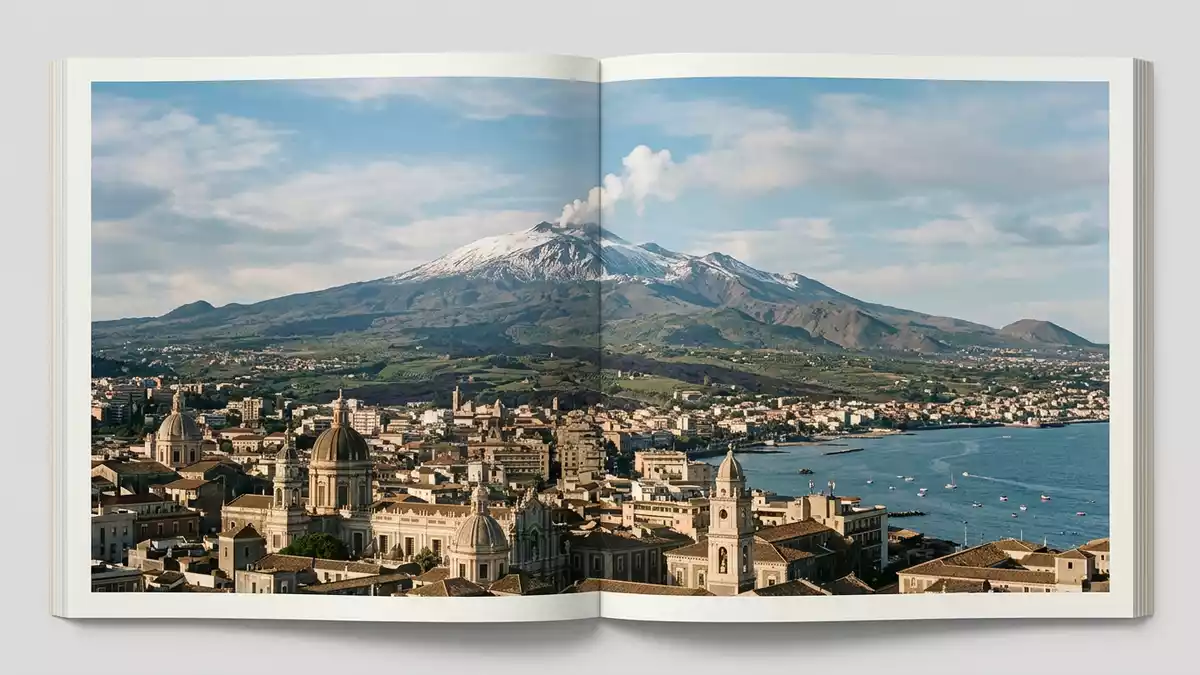
Etna rises above Catania as a volcanic landscape of lava, ash and summit craters. It is a UNESCO World Heritage site on Sicily’s eastern coast, and one of the Mediterranean’s most distinctive mountain settings.
Etna’s cratered upper slopes
The volcano’s upper reaches are shaped by repeated eruptions, with craters, cones and dark lava fields visible across the slopes. The core World Heritage area covers 19,237 ha and sits within the Parco dell’Etna Regional Nature Park.19,237 ha core area
Etna is a stratovolcano, a steep cone built by layers of lava and volcanic fragments. Its volcanic history reaches back hundreds of thousands of years, and human documentation of its activity extends for at least 2,700 years.2,700 years of record
Etna in the volcanic landscape of Sicily
The mountain stands on the eastern side of Sicily in the district of Catania. Its slopes are crossed by fissures, lava flows and caves, and the surrounding land includes forests, volcanic debris and open ground formed by eruption deposits.
The UNESCO dossier describes Etna as the highest Mediterranean island mountain and the most active stratovolcano in the world. Its summit region reaches around 3,340 m (10,958 ft), though the exact height changes as material accumulates and collapses.around 3,340 m high
Etna as a place of rock, ash and study
Etna is not a single smooth cone but a volcanic complex with overlapping eruptions and multiple vents. Its surface includes summit craters, cinder cones, lava caves and the Valle de Bove depression, all part of the mountain’s layered physical character.Valle de Bove depression
The volcano’s composition includes lava, slag, ash, sand and tuff, with older eruptive layers buried beneath newer ones. Geologists use Etna as a field site because the mountain preserves a long sequence of volcanic forms and deposits.lava, ash and tuff
Visiting Etna: what travellers from Western Europe should know
- The mountain rises above Catania on Sicily’s eastern coast. Roads and cable cars serve different parts of the volcano, and the summit area lies far above the plain.
- The ground changes quickly from paved access roads to lava stone, loose ash and rough volcanic slopes. The upper mountain includes crater rims, fissures and uneven terrain.
- Etna contains lava caves and the Valle de Bove depression. Both are part of the mountain’s volcanic landscape.
- The official language is Italian and the currency is the euro.
Searching for Etna on social platforms
These links open searches for Etna on each platform.
Frequently asked questions about Etna
Where is Etna?
Etna stands on Sicily’s eastern coast in the district of Catania. It rises inland from the plain and dominates the mountain skyline of south-eastern Sicily.
What does a visit involve?
Visitors encounter a volcanic mountain with road access to some areas, then rougher ground higher up. The surface includes lava fields, cones, caves and cratered slopes.
What makes Etna distinctive?
Etna combines great scale with a dense volcanic landscape. Its long documented eruptive history, summit craters and lava formations make it one of Europe’s most studied volcanoes.


