
Etna above Catania: Sicily’s restless volcano
Published on 09/07/2026 at 20:27 | Editorial responsibility: Rafael Müller, Editor-in-Chief AD HOC NEWS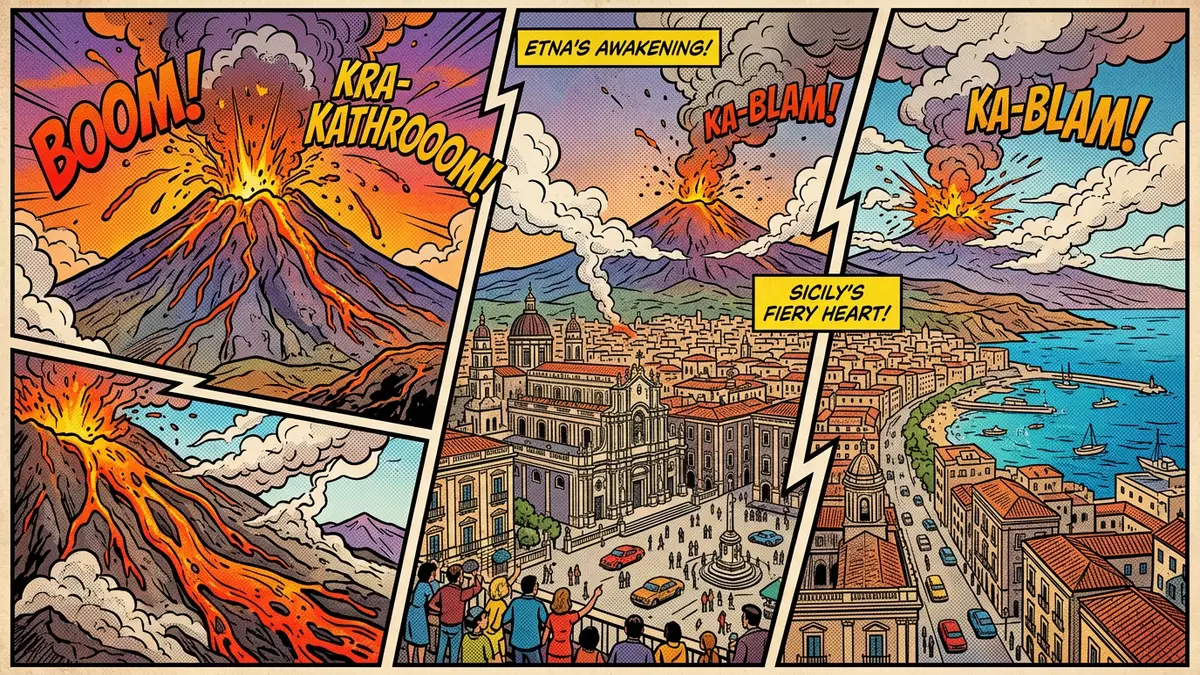
Etna is an active stratovolcano rising above Catania on the eastern coast of Sicily, Italy, its broad bulk dominating the surrounding landscape and the city below.active volcano on the east coast of Sicily It is the highest mountain in Italy south of the Alps and the highest Mediterranean island mountain, a long-lived volcanic giant that has shaped this corner of the island.highest mountain in Italy south of the Alps
Etna’s scale, summit and volcanic character
Etna rises to over 3,300 m (around 10,800 ft) above sea level, giving it a snow-dusted summit in colder months and a skyline presence that is visible from far along Sicily’s eastern shore.Etna peaks at 3,300 meters The mountain’s flanks spread across more than 1,000 km² (386 sq mi), with a wide basal circumference that encircles towns, farmland and forests.Etna covers an area of 1,190 km² Near the top, the broad summit region holds several craters, including the Northeast Crater, Bocca Nuova, Voragine and the Southeast Crater, all linked to the volcano’s continuing activity.several active summit craters
Etna is classified as a stratovolcano, or composite volcano, built from layers of lava flows, ash deposits and other erupted material that have accumulated over many thousands of years.highest and most active volcano in Europe Its eruptive history can be traced back about 500,000 years, and written records of its eruptions extend for at least 2,700 years, making it one of the longest-documented volcanoes on Earth.activity documented for over 2,700 years Historic eruptions have included violent explosive events and extensive lava flows, among them a major eruption in 1669 that damaged parts of Catania and surrounding villages.
UNESCO recognition and Etna Park
In 2013, Mount Etna was inscribed on the UNESCO World Heritage List as a natural site, recognised under criterion (viii) for its outstanding geological and geomorphological features and its long-recorded volcanic activity.Mount Etna is an iconic site The World Heritage property encompasses 19,237 hectares on the upper part of the mountain, forming the most strictly protected area within the wider Parco dell’Etna regional nature park.Mount Etna World Heritage Site (19,237 ha) This core zone sits above a larger buffer within the park, together framing Etna as a landscape of scientific interest as well as a prominent feature of Sicily’s geography.
The recognition highlights Etna’s summit craters, lava fields, and volcanic landforms as a natural record of how stratovolcanoes grow and change. Within the park boundary, the terrain shifts from cultivated lower slopes into forest belts and then into higher ash-covered areas with sparse vegetation.fertile lower slopes with vineyards and orchards The protected status supports scientific observatories and monitoring efforts on the mountain, with long-term measurements of eruptions, gas emissions and ground deformation helping researchers understand Etna’s behaviour.
Layers of landscape: from vineyards to ash fields
Etna’s lower slopes are known for fertile volcanic soils that support vineyards, orchards and fields, a belt where agriculture takes advantage of the minerals deposited by eruptive activity.vineyards and orchards on lower slopes Above this cultivated zone, forests of oak, chestnut and other trees occupy the middle elevations, forming a green ring around the mountain during the growing season.largest volcano in Europe located along the east coast of Sicily Higher still, the landscape turns to older lava flows, loose ash and cinder fields, where vegetation becomes sparse and the forms of the volcano’s cones and ridges stand out more clearly.
On the eastern side, Etna rises above the coastal plain where Catania spreads between the mountain and the Ionian Sea, placing urban streets and harbour installations within sight of the volcano’s upper slopes.stands near Catania, Sicily's second city To the north, the Nebrodi and Peloritani ranges form a separate chain of mountains, while to the south the plain of the Simeto River marks a transition into lower-lying terrain.bordered to the north by Nebrodi and Peloritani The contrast between volcanic heights and this coastal setting is one of the most distinctive visual aspects of Etna’s surroundings.
Visiting Etna: what travellers from Western Europe should know
- Etna rises on the eastern side of Sicily above Catania, which is served by an international airport and lies along major road and rail routes across the island.
- The mountain’s slopes include rough lava fields, ash-covered paths and higher sections at significant altitude, so approaches involve uneven ground and, on foot, substantial climbs.
- On clear days, the summit area and upper slopes are exposed, with wide open views and limited shelter from wind and weather across the ash and rock fields.
- The official language is Italian and the currency is the euro.
Searching for Etna on social platforms
These links open searches for Etna on each platform.
Frequently asked questions about Etna
Where is Etna and what kind of place is it?
Etna is an active stratovolcano on the east coast of Sicily in southern Italy, rising above the city of Catania and the nearby coastal plain.
What should visitors expect when exploring Etna?
The mountain offers a broad volcanic landscape of lava flows, ash-covered ground and higher-altitude terrain, with cultivated slopes and forest belts lower down.
What makes Etna distinctive compared with other mountains?
Etna combines considerable height with long-documented volcanic activity and a recognised UNESCO World Heritage core zone, giving it both geological and cultural significance.


