

Etna above Catania, a living volcano shaped by time
Published on 09/16/2026 at 06:50 | Editorial responsibility: Rafael Müller, Editor-in-Chief AD HOC NEWS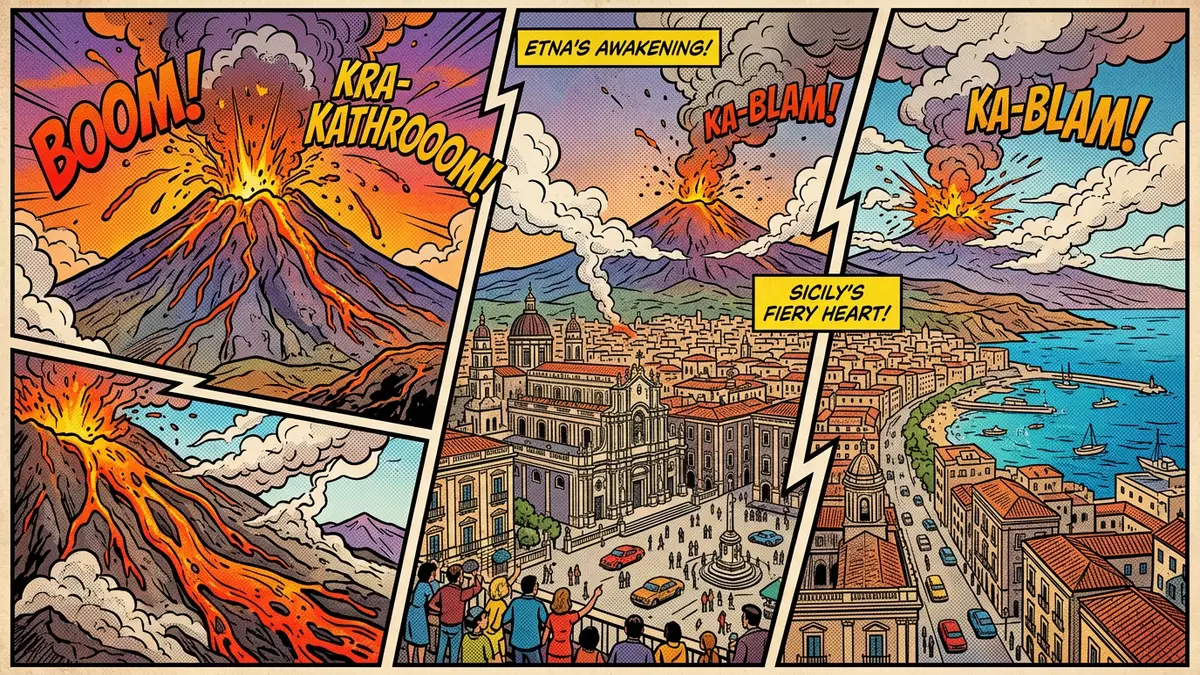
Etna is an active stratovolcano rising above Catania on the eastern coast of Sicily, a mountain of lava fields and cultivated slopes that dominates the region’s skyline.
The scale and shape of Etna’s volcanic massif
Seen from Catania and the neighbouring coastal plain, Etna forms a broad volcanic massif rather than a single sharp peak, its upper cone resting on wide shoulders of older lava flows and pyroclastic deposits.Mount Etna, active volcano on the east coast of Sicily The mountain reaches over 3,300 m (around 10,800 ft) above sea level, making it the highest summit in Italy south of the Alps and the highest mountain on any Mediterranean island.Reaching 3,335 m above sea level Its flanks spread over a large area, with lava-built terraces stepping down towards the Simeto river plain and the coastal strip between Catania and Messina.Etna, with its 3350m above sea level and 35 km in diameter at the base
The volcano’s bulk is matched by the complexity of its summit area, which carries several active craters surrounded by layers of ash, scoria and welded spatter from historic eruptions.Etna contains several active summit craters On the higher slopes, recent lava flows form dark ribbons across older, weathered surfaces, creating sharp boundaries between fresh basalt and lighter, more eroded ground. Lower down, the lava fields soften into undulating ground where terraces, stone walls and tracks mark the interface between volcanic rock and long-established human use.
A long eruptive history and UNESCO recognition
Etna’s eruptive history extends back hundreds of thousands of years, with the volcano taking its present conical form over roughly the past hundred thousand years as successive eruptions built up the stratovolcano above the Sicilian crust.Etna has more than 500,000 years of eruptive history Written records of its activity reach deep into classical antiquity, with eruptions documented for at least 2,700 years and specific events noted in Greek and Roman sources.Mount Etna’s activity documented for over 2,700 years This long record of observation, combined with continuing activity, has made Etna a key site for volcanology, with summit craters and flank vents offering varied eruption styles.
On 21 June 2013, Mount Etna was inscribed on the UNESCO World Heritage List as a natural site under criterion (viii), recognising its outstanding geological significance and its role in the study of volcanic processes.Mount Etna World Heritage Site The World Heritage property encompasses 19,237 ha on the upper third of the mountain, forming the most strictly protected area within the Parco dell’Etna regional nature park that surrounds it.Mount Etna World Heritage Site (19,237 ha) Within this zone, summit craters, lateral vents, lava flows and volcanic cones stand alongside ravines cut into older deposits, offering a concentrated view of how a large stratovolcano develops and reshapes its own slopes over time.
Etna in the landscape of Catania and Sicily
Etna rises immediately inland of Catania, Sicily’s second-largest city, its slopes forming a backdrop to the Baroque streets rebuilt after the seventeenth-century eruption and earthquake that affected the area.Etna stands near Catania, Sicily’s second city The mountain covers an area measured in the order of a thousand square kilometres, stretching north towards the Nebrodi and Peloritani ranges and south towards the alluvial plain of the Simeto river.Etna located along the east coast of Sicily with an area of 1250km2 From the coast, the transition from urban fabric through citrus groves and vineyards into the bare, dark lava near the summit gives a clear sense of how volcanic terrain and human settlement interlock.
The volcanic soils on Etna’s lower and middle slopes are fertile, supporting orchards, vineyards and fields that follow the contours of old lava flows, while higher up scrub, pine and other hardy vegetation occupy ground shaped by more recent eruptions.Etna as the main source of income for the island Scattered villages and small towns sit on terraces above older flows, connected by roads that climb towards the regional nature park and the high-altitude stations serving the upper slopes. The contrast between cultivated ground, built-up areas and raw volcanic land is visible in many directions, particularly where black lava fields abut pale agricultural terraces or dense settlement.
Visiting Etna: what travellers from Western Europe should know
- Etna stands on the eastern side of Sicily in southern Italy, rising inland of Catania; road routes from the city climb towards stations and viewpoints on its flanks.
- Approaches to higher viewpoints involve steep gradients and sections of rough volcanic ground, with paths and tracks crossing hardened lava and ash rather than smooth pavements.
- The terrain near the summit consists of loose cinders, uneven lava blocks and exposed slopes; sturdy footwear and care with footing are important on these upper sections.
- Etna’s slopes lie within the Parco dell’Etna regional nature park, where marked routes cross a mix of forest, scrub and open lava fields at varying altitudes.
- The official language is Italian and the currency is the euro.
Searching for Etna on social platforms
These links open searches for Etna on each platform.
Frequently asked questions about Etna
Where is Etna?
Etna is on the eastern side of Sicily in southern Italy, rising inland of the coastal city of Catania and extending towards the Nebrodi and Peloritani ranges.
What can visitors expect when exploring Etna?
Visitors encounter a large volcanic mountain with lava fields, ash slopes, summit craters and fertile lower terraces, together forming a landscape where active volcanism and long-term settlement meet.
What makes Etna distinctive among European mountains?
Etna combines status as one of Europe’s tallest active volcanoes with a long, well-documented eruptive history and formal recognition as a UNESCO World Heritage Site focused on its geological significance.


