
Erg Chebbi in Merzouga, Morocco’s towering dune sea
Published on 09/07/2026 at 07:33 | Editorial responsibility: Rafael Müller, Editor-in-Chief AD HOC NEWS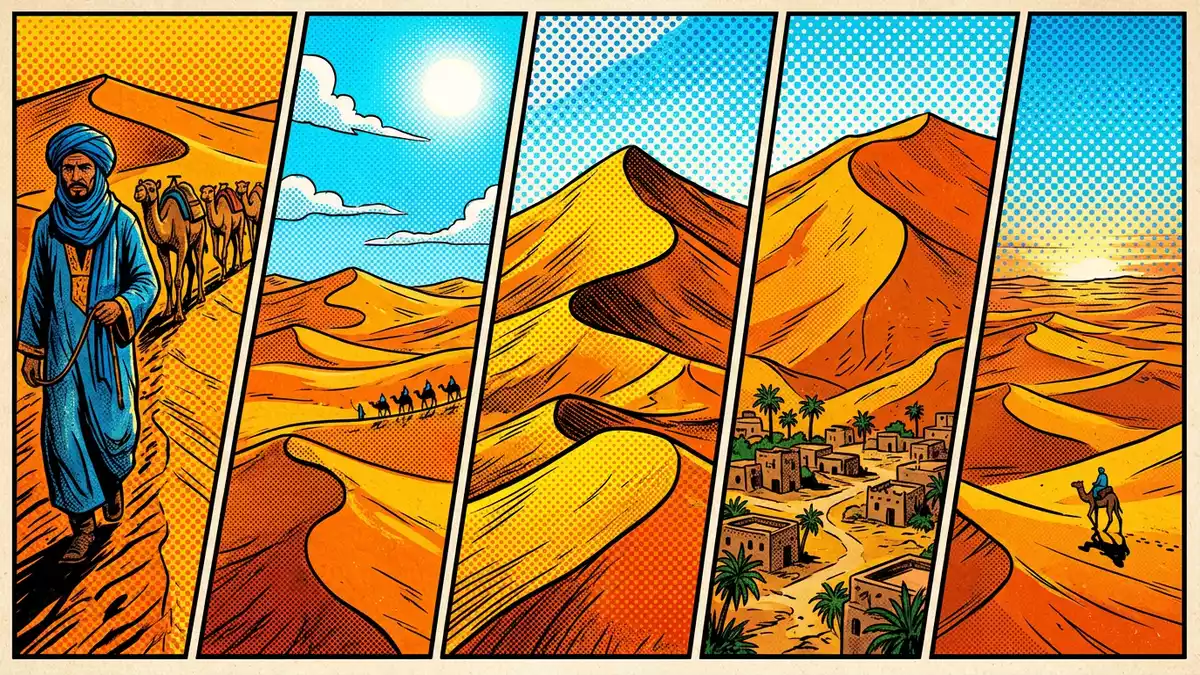
Erg Chebbi is the great field of Saharan sand dunes that rises directly beside Merzouga in south-eastern Morocco, close to the Algerian border. It is an erg in the strict geographical sense, a broad “sea” of wind-formed dunes that stands out against the surrounding rocky hamada and has become one of the country’s most recognisable desert landscapes, with dunes reaching around 150 m (492 ft) above the plain in places.
Sand, height and the shape of an erg
In geographical terms, Erg Chebbi is a concentrated mass of sand dunes bounded by more barren stony desert, known locally as hamada. The dunes form a distinct sand body that extends for tens of kilometres, with the sandy area running roughly north–south along the frontier zone between Morocco and Algeria.The dunes of Erg Chebbi rise sharply from the hamada so that the edge of the sand feels abrupt, a clear line between two types of desert terrain.
Measurements given for the size of Erg Chebbi vary slightly between sources, but they consistently describe a dune field extending on the order of several tens of kilometres in length and several kilometres in width. Figures around 28 km from north to south and between 5 km and 7 km from east to west appear repeatedly in descriptions of the area.Erg Chebbi is described as 28 km long with a breadth in the mid single-digit kilometres, while other guides express similar dimensions in different rounding. The tallest individual dunes reach around 150 m above the surrounding plain, giving the sand hills a steep profile when viewed from the foot.Summit-focused descriptions emphasise this height as a defining feature.
Merzouga and the human edge of the dunes
Merzouga is the settlement that sits on the western edge of Erg Chebbi and acts as the human point of contact with the dune field. The village and its surrounding cluster of lodgings and small hotels lie immediately beyond the sand, so that built structures and palm-lined compounds give way quite quickly to the first dunes.Merzouga is described as the local tourist centre aligned along the western lee of the dunes, its accommodation arranged roughly north–south where sand meets firmer ground.
Road access reaches Merzouga from other parts of Morocco, crossing large areas of rocky desert before arriving at the sand edge. Travellers approaching from places such as Erfoud or Rissani experience a marked visual change as low-lying hamada plains give way to the rising colours of Erg Chebbi.German-language guides emphasise that after many kilometres of stony desert, the dunes appear as a contrasting band of pink and golden sand. Merzouga functions as a base for organised excursions into the dunes, many of which use traditional camel caravans to reach viewpoints and overnight encampments positioned within the erg.
Colour, contours and desert light
The visual character of Erg Chebbi is shaped by its fine sand and the way the dunes are sculpted by prevailing winds. The sand grains form smooth, flowing ridges and concave slopes, creating a pattern of repeating crests and hollows that continues across the dune field. Under direct sunlight the dunes tend towards bright yellow and pale gold, while lower-angle light at the margins of the day reveals deeper orange and hints of pink in the sand.Travel accounts highlight these shifts in colour as a central part of the experience.
From higher dune crests, the view takes in waves of sand that run away in multiple directions, interrupted only occasionally by small clusters of vegetation anchored where moisture reaches the surface. The absence of large built structures within the core of the dune field leaves the sand forms themselves dominant. Looking back towards Merzouga from within the erg, the contrast between the curving dunes and the lines of the village’s buildings illustrates how closely the settlement and the sand lie to one another.
Visiting Erg Chebbi: what travellers from Western Europe should know
- Erg Chebbi lies in south-eastern Morocco, near the frontier with Algeria, and is reached by road from towns such as Erfoud and Rissani, with Merzouga immediately beside the dunes.
- The terrain within the erg consists of loose sand and steep slopes; walking on the dunes involves climbing soft surfaces, and gaining the higher crests requires sustained effort on shifting ground.
- Merzouga provides accommodation and organised excursions into the dunes, including camel rides and guided walks, and functions as the main base for visiting the Erg Chebbi sand field.
- The official language is Arabic and the currency is the Moroccan dirham.
- Entry requirements depend on your nationality; UK travellers can check the FCDO travel advice at gov.uk/foreign-travel-advice, Irish travellers the Department of Foreign Affairs at ireland.ie.
Searching for Erg Chebbi on social platforms
These links open searches for Erg Chebbi on each platform.
Frequently asked questions about Erg Chebbi
Where is Erg Chebbi located?
Erg Chebbi lies in south-eastern Morocco, close to the border with Algeria, with the village of Merzouga on its western edge providing the main access point.
What should travellers expect on a visit to Erg Chebbi?
Travellers encounter a large field of high sand dunes rising from stony desert, with soft sand underfoot, steep dune slopes and views over waves of wind-shaped sand.
What makes Erg Chebbi distinctive among Moroccan deserts?
Erg Chebbi is known for its concentrated dune field of around 28 km by several kilometres, dunes reaching about 150 m (492 ft) above the plain, and its immediate proximity to Merzouga.


