
Erg Chebbi in Merzouga: Morocco’s rolling sea of dunes
Published on 08/25/2026 at 18:56 | Editorial responsibility: Rafael Müller, Editor-in-Chief AD HOC NEWS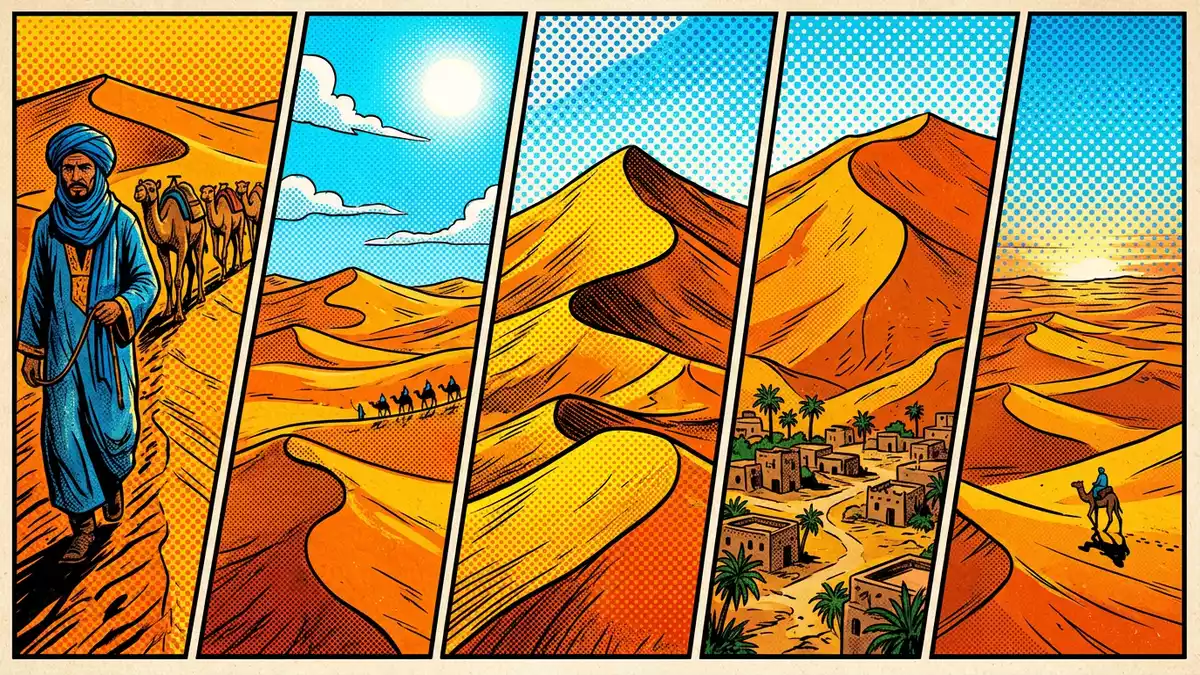
Erg Chebbi is the great belt of sand dunes that rises directly beside Merzouga in eastern Morocco, forming a long, wind-shaped ridge of Sahara sand that has become one of the country’s most recognisable desert landscapes.Erg Chebbi stretches across the borderlands near Algeria, and its dunes climb high enough to dominate the surrounding stone desert.
A Sahara dune sea shaped by wind and scale
In Arabic the word “erg” refers to a large field of wind-blown sand dunes, and Erg Chebbi is one of the few named ergs in Morocco’s Sahara.type of desert composed completely of sand dunes The sand mass runs roughly north–south for several tens of kilometres, presenting a continuous line of sculpted crests above the surrounding gravel plains.Erg Chebbi Camp, Merzouga Individual dunes rise to around 150 m (about 500 ft), with some sources describing slightly higher crests; the effect on the ground is a series of steep sandy slopes that demand careful, slow climbing on foot.Shape-shifting over 28km from north to south
The dunes themselves form a band several kilometres wide, standing out sharply against the flatter hamada, the stony desert that surrounds them.Erg Chebbi Sahara desert guide From the crest lines there are open views over the surrounding palm groves along the nearby Ziz valley and toward the low hills that mark the wider Sahara plateau.to the west of the Ziz River palm groves The sand surface is constantly reshaped by wind, which sharpens the ridges and pushes the dune fronts gradually onward, but the overall form of the erg remains a recognisable band of sand aligned with the Algerian frontier.
Merzouga and the human edge of Erg Chebbi
Merzouga is the small settlement that serves as the main human gateway to Erg Chebbi, lying immediately to the west of the dune belt.Merzouga, das lokale Touristenzentrum, liegt am Rand der Dünen A paved road reaches Merzouga from larger towns such as Erfoud, and a string of small hotels and auberges runs roughly north–south along the dune foot, marking the transition from stone to sand.Hotelort Merzouga From here, visitors step directly onto the first low dune ridges, with camel tracks and footpaths threading into the sand from various access points.
Desert camps are scattered within the erg, generally set among mid-height dunes where there is enough shelter from the surrounding crests to pitch tents.Erg Chebbi travel guide These camps range from simple bivouacs to more permanent tented arrangements with communal areas and defined paths across the sand. Outside the dune belt, low villages, palm groves and dry riverbeds mark the wider Tafilalet region, and the contrast between green plots and the sand wall of Erg Chebbi is one of the most striking spatial relationships in the area.
Landscape, light and the physical experience of the dunes
Erg Chebbi lies in Morocco’s eastern Sahara, in a region often grouped with the wider Tafilalet and near the frontier with Algeria.lining the Algerian border The underlying desert outside the erg is composed mainly of stone and compacted earth, with scattered vegetation surviving in drainage lines and oases fed by underground water. Within the erg, the sand is fine and light-coloured, formed into ripples at small scale and larger faces at dune level. Wind patterns carve sharp edges along the dune crests, while the lee sides form longer, gentler slopes that stretch down toward hollows between the dunes.
Walking into Erg Chebbi from Merzouga means leaving hard ground and stepping into loose sand that yields underfoot; progress up the steeper dune faces is slow because each step slides back slightly in the grains.dunes reaching 150 metres, running for 22 kilometres Light changes the appearance of the erg through the day, with long shadows accentuating the ridges at lower sun angles and more muted forms under high sun. The absence of solid rock within the dune belt gives the landscape a continuous, flowing quality, with no abrupt cliffs or outcrops breaking the sand surfaces.
Visiting Erg Chebbi: what travellers from Western Europe should know
- Erg Chebbi lies in eastern Morocco near the Algerian border, with Merzouga on its western side reached by road from towns such as Erfoud.
- The terrain inside the erg is composed of loose sand, with steep dune faces that require slow, steady climbing and easier progress along gentler slopes and hollows.
- The surrounding region includes palm groves along the Ziz valley and small villages on firmer ground, giving a clear contrast between cultivated land and the sand sea.
- The official language is Arabic and the currency is the Moroccan dirham.
- Entry requirements depend on your nationality; UK travellers can check the FCDO travel advice at gov.uk/foreign-travel-advice, Irish travellers the Department of Foreign Affairs at ireland.ie.
Searching for Erg Chebbi on social platforms
These links open searches for Erg Chebbi on each platform.
Frequently asked questions about Erg Chebbi
Where is Erg Chebbi located?
Erg Chebbi lies in eastern Morocco near the border with Algeria, immediately east of the village of Merzouga and within reach of towns such as Erfoud.
What should visitors expect on a visit to Erg Chebbi?
Visitors encounter a broad field of high sand dunes, with loose sandy slopes, desert camps among the crests and an abrupt change from stony desert to wind-sculpted sand.
What makes Erg Chebbi distinctive among Morocco’s deserts?
Erg Chebbi stands out as a continuous, high dune belt directly beside a village, combining a substantial Saharan sand mass with relatively easy access from an established settlement.


