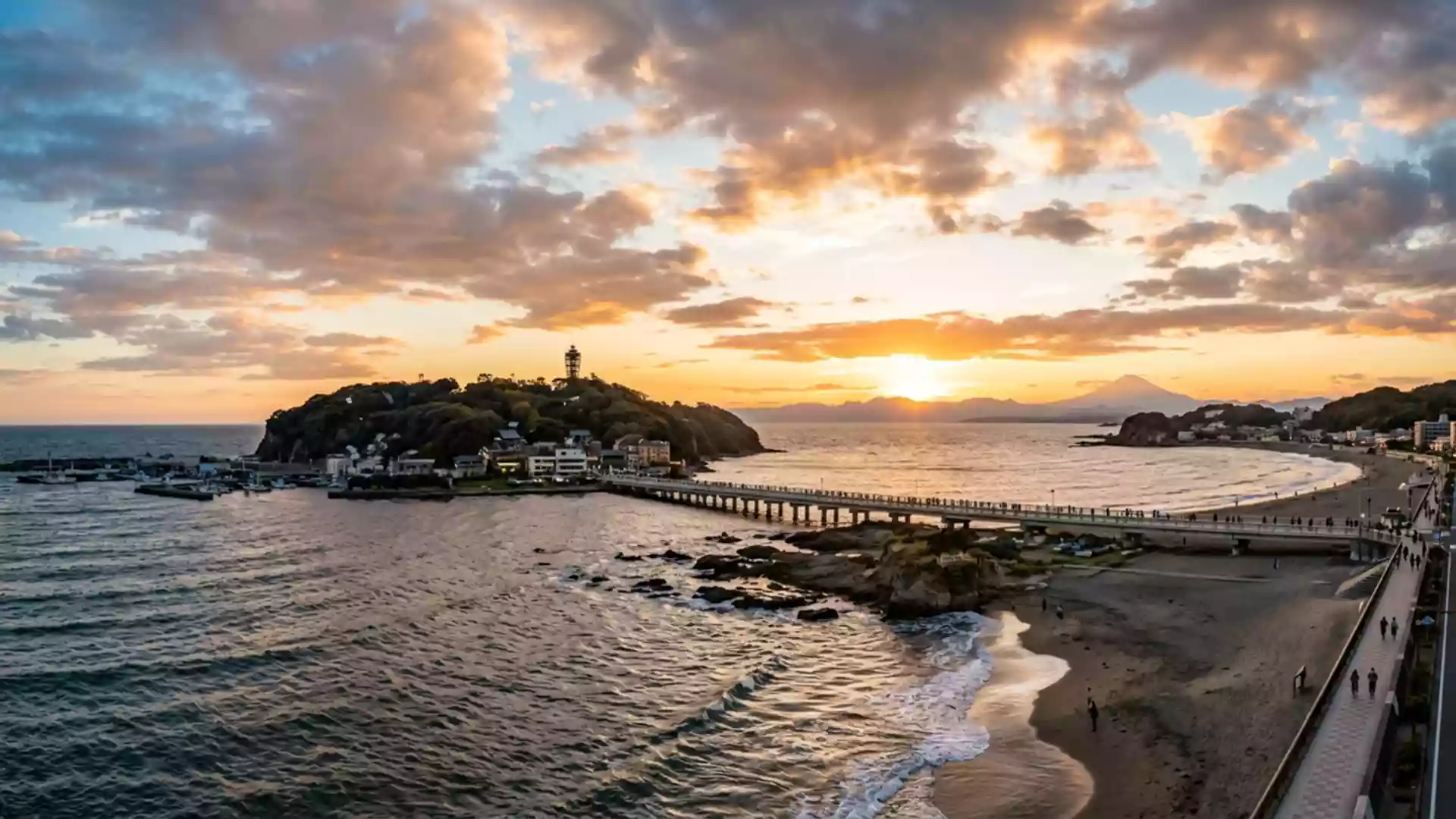
Enoshima’s shrine island and steep coastal ridge
Published on 09/11/2026 at 21:33 | Editorial responsibility: Rafael Müller, Editor-in-Chief AD HOC NEWS
Enoshima in Fujisawa is a small offshore island linked to the mainland by a bridge, with shrine buildings, a coastal ridge and a compact summit route. Its profile is shaped by Benzaiten worship, Samuel Cocking’s nineteenth-century additions and the island’s place in Sagami Bay.
Enoshima’s island form and shrine core
The island sits at the mouth of the Katase River in Sagami Bay, and it is part of Fujisawa in Kanagawa Prefecture. The bridge from Katase reaches a place where shrine precincts, paths and steps lead towards the upper part of the island.bridge from Katase
Benzaiten, the goddess of music and entertainment, is enshrined here, and the island is closely tied to the Enoshima Engi, written by K?kei in 1047. The shrine complex gives the island its religious centre, while the surrounding slopes keep the approach compact and layered.
Samuel Cocking’s gardens on the summit
The upper part of Enoshima includes the Samuel Cocking Garden, linked to Samuel Cocking, a British merchant who bought much of the uplands in 1880. The site also held a power plant and a large greenhouse, and the garden remains one of the island’s key landscaped spaces.Samuel Cocking
That summit zone mixes planted ground with shrine structures and open viewpoints over Sagami Bay. The contrast between garden beds, built precincts and sea-facing edges gives Enoshima a denser character than a simple beach island.
From pilgrimage island to coastal excursion
Enoshima has long been linked with pilgrimage and coastal travel, and its historical record reaches back to the eleventh century. The island appears in medieval shrine literature, and later visitors included figures from the Kamakura shogunate and the Edo period.medieval shrine literature
The island also entered modern sporting history as the sailing venue for the 1964 Tokyo Olympics. That association sits alongside the older religious landscape, giving the island a rare overlap of shrine culture, garden history and maritime recreation.1964 Tokyo Olympics
Visiting Enoshima: what travellers from Western Europe should know
- The island lies off the Fujisawa coast in Kanagawa Prefecture. Katase-Enoshima Station, Enoshima Station and Sh?nan-Enoshima Station serve the area.
- The route rises from the bridge and includes slopes and steps through the shrine precincts. The upper island is compact, but the climb is noticeable.
- Japan Standard Time applies on Enoshima. The local currency is the Japanese yen.
- Entry requirements depend on your nationality; UK travellers can check the FCDO travel advice at gov.uk/foreign-travel-advice, Irish travellers the Department of Foreign Affairs at ireland.ie.
Searching for Enoshima on social platforms
These links open searches for Enoshima on each platform.
Frequently asked questions about Enoshima
Where is Enoshima?
Enoshima is an island off the coast of Fujisawa in Kanagawa Prefecture, Japan. It stands at the mouth of the Katase River in Sagami Bay.
What does a visit involve?
The island combines shrine precincts, a summit garden and sea views, all within a compact coastal setting. Reaching the upper parts involves slopes and steps.
What makes Enoshima distinctive?
Its identity rests on the combination of Benzaiten worship, the 1047 Enoshima Engi and Samuel Cocking’s nineteenth-century garden landscape. The result is an island with religious, historical and coastal layers in one place.