

Enoshima island of shrines, cliffs and sea views
Published on 08/20/2026 at 18:36 | Editorial responsibility: Rafael Müller, Editor-in-Chief AD HOC NEWS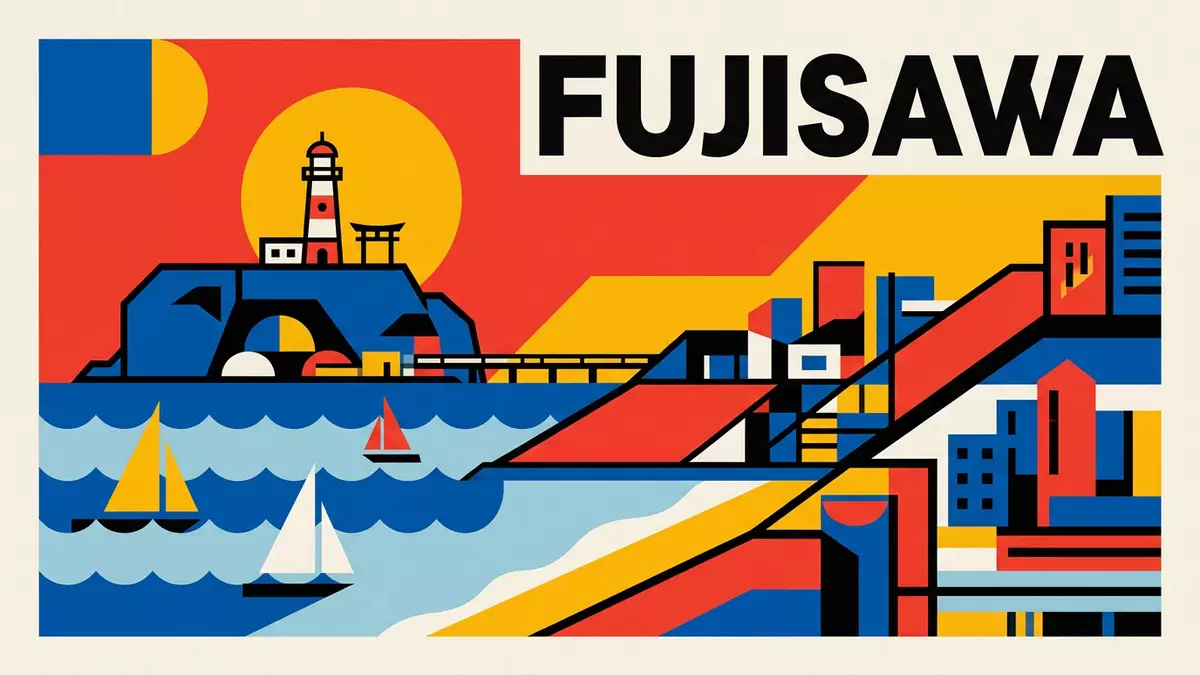
Enoshima is a small tidal island off the coast of Fujisawa in Kanagawa Prefecture, rising from Sagami Bay as a compact hill of forest, shrines and lookout points linked to the mainland by a bridge across the mouth of the Katase River.small offshore island Administratively part of Fujisawa, it combines coastal rock, narrow climbs and hilltop terraces in a single walkable circuit that has drawn visitors since the Edo period.
Island landscape above Sagami Bay
Enoshima stands at the southern edge of the Shonan coast, separated from the mainland by a narrow strip of water and a tombolo-like sandbar that is reinforced by a bridge carrying vehicles and pedestrians.connected by bridge The island’s perimeter path runs above and beside rugged shorelines where waves from Sagami Bay meet weathered rock, with views towards the wider bay and, on clear days, along the Kanagawa coastline.
The interior rises quickly from sea level through stepped paths into mixed woodland, where stone lanterns, small shrines and resting terraces sit between trees. The walk brings sudden openings towards the water, giving vantage points across the bay and back to the mainland districts of Fujisawa. On the western side, cliffs drop towards sea caves cut into the rock, reached through walkways at the base of the islandpleasantly touristy island that underline its character as a coastal landscape as much as a religious site.
Shrines to Benzaiten and island worship
Enoshima is closely associated with worship of Benzaiten, a deity linked to water, music and fortune, and its main shrine complex, Enoshima Shrine, brings together several buildings on the slopes and summit of the island.Enoshima Shrine Approaches climb past torii gates into precincts where honden and auxiliary halls sit among trees, with views framed between roofs and the bay beyond.
The island’s religious history reaches back to medieval times, with pilgrim routes focusing on the caves at the southern tip and the shrines above them.small island in Kanagawa Over generations, statues, tablets and votive plaques have accumulated across the island, shaping Enoshima as a compact example of coastal faith practice in eastern Japan, where the sea, cliffs and shrine precincts form a continuous setting.
Samuel Cocking Garden and the Enoshima Sea Candle
Near the summit lies Samuel Cocking Garden, named for the nineteenth-century British trader Samuel Cocking, whose greenhouse enterprise once stood on the site.Enoshima Samuel Cocking Garden The present garden is a park facility with lawns, paths and tropical planting arranged around the remains of his greenhouse and contemporary structures, creating a transition between historic foundations and modern leisure space near the top of the island.
Rising above the garden is the Enoshima Sea Candle, also known as the Shonan Observatory Lighthouse, an observation tower and lighthouse completed in the early twenty-first century.observation tower and lighthouse The tower stands on higher ground within the garden and carries both an enclosed deck and an outdoor platform, giving wide views over Sagami Bay, the Shonan coastline and, in suitable weather, towards distant mountains. Its slender structure and elevated setting have turned it into a visible symbol of Enoshima, lighting the bay as a lighthouse and marking the island skyline as an observation point.
Visiting Enoshima: what travellers from Western Europe should know
- Enoshima lies off the coast of Fujisawa in Kanagawa Prefecture, linked to the Katase area on the mainland by a bridge across the mouth of the Katase River.
- Approaching the shrines and Samuel Cocking Garden involves steep paths, stairways and, in places, outdoor escalators, with significant height gain from the shoreline to the island’s summit.
- Enoshima sits within Kanagawa Prefecture in Japan, where the official language is Japanese and the currency is the yen.
- From Tokyo and Yokohama, rail lines approach Fujisawa, with onward connections on local lines to stations such as Katase-Enoshima and Shonan-Enoshima close to the island.rail access details
- Entry requirements depend on your nationality; UK travellers can check the FCDO travel advice at gov.uk/foreign-travel-advice, Irish travellers the Department of Foreign Affairs at ireland.ie.
Searching for Enoshima on social platforms
These links open searches for Enoshima on each platform.
Frequently asked questions about Enoshima
Where is Enoshima located?
Enoshima is a small island in Sagami Bay, administratively part of Fujisawa in Kanagawa Prefecture, linked to the mainland by a bridge across the Katase River.
What can visitors expect on a visit to Enoshima?
Visitors encounter coastal cliffs, sea caves, wooded slopes with shrines dedicated to Benzaiten, and hilltop gardens with an observation lighthouse tower giving wide views over Sagami Bay.
What makes Enoshima distinctive among coastal destinations?
Enoshima combines a compact island landscape, longstanding shrine worship and the modern Samuel Cocking Garden with the Enoshima Sea Candle tower, bringing religious, historical and scenic elements together on a walkable hill.


