

Enoshima island and lighthouse above the Shonan coast
Published on 08/22/2026 at 09:27 | Editorial responsibility: Rafael Müller, Editor-in-Chief AD HOC NEWS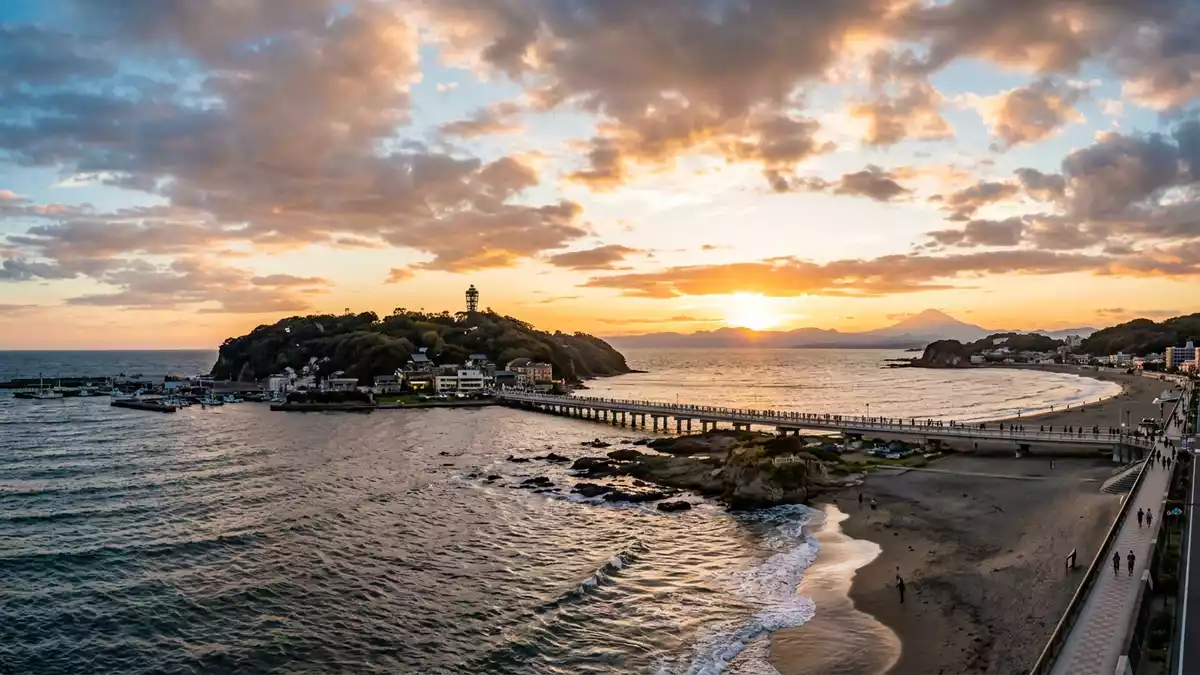
Enoshima is a small tidal island off the Shonan coast in Fujisawa, south of Tokyo, where rocky shoreline, shrine avenues and a modern lighthouse share the same compact hill.The island forms part of Fujisawa in Kanagawa Prefecture and is linked to the mainland by a bridge across the Katase River mouth.The causeway connects the island directly with the seaside district on the Sagami Bay shoreline.
Island of rock, shrines and sea views
The landform of Enoshima is compact enough to walk around yet rises steeply from the water, with steps and paths winding up from the harbour side towards the interior plateau.Its rocky base sits at the mouth of the Katase River, facing Sagami Bay, and the island’s circumference is given as around 4 km (2.5 mi). Traditional shrine buildings line the main approach route, and narrow streets between them hold shops that cluster around the ascent. Higher up, planted gardens and open terraces look out over the Shonan coastline, with the lighthouse structure rising above the treetops.
At the summit, the Samuel Cocking Garden occupies a significant part of the plateau, bringing together formal planting, lawns and the modern observation tower.The Enoshima Sea Candle stands within this garden as an observation tower and lighthouse, and from its decks the shoreline and hinterland unfold in all directions. The combination of a tidal island, shrine complex and contemporary tower gives Enoshima a layered character: fishing harbour and coastal resort at the base, religious and garden landscape in the middle, and wide open views from the uppermost structure.
Enoshima Sea Candle: lighthouse and lookout
The Enoshima Sea Candle is the most conspicuous built landmark on the island, a slender tower that functions both as lighthouse and viewing platform.It is also known as the Shonan Observatory Lighthouse and contains two observation decks, one enclosed and one open to the air. The enclosed primary deck can be reached by lift or by an internal spiral staircase, while a second staircase rises further to the outdoor deck above. The tower works as a navigational light and as a vantage point where the Shonan coast and, on clear days, distant mountain ranges come into view.The observation lighthouse is described as a familiar symbol of Enoshima, emphasising its role in local identity as well as in maritime guidance.
The current tower belongs to a lineage of beacons on the island.An earlier Enoshima observation lighthouse, recognised as Japan’s first private lighthouse, was built in 1951, and the present Sea Candle continues that dual purpose of safety and outlook.The structure with its observation platform was completed in 2002 in connection with the centenary of the Enoshima Electric Railway, tying the tower into the region’s transport history. Its height is given as 59.8 m from base to lightning rod, at an elevation of about 119.6 m above sea level, placing the upper deck roughly 120 m above the shoreline.The glass-walled observation floor and outdoor deck offer views towards Oshima, Mount Fuji and the Miura Peninsula, anchoring Enoshima visually within the wider geography of Kanagawa.
Paths, caves and coastal setting
Beyond the garden and tower, Enoshima’s slopes and shoreline provide varied terrain within a relatively small area.Guide descriptions emphasise the island’s status as a tourist destination connected by bridge, and walking routes radiate from the causeway entrance. Stone steps lead past shrine gates into wooded sections, and further paths continue down the far side towards sea caves and rock platforms at the water’s edge. The difference between the built-up harbour-facing side and the more exposed outer shore gives the island a distinct two-sided character that visitors can explore on foot.
Enoshima also sits within a broader coastal corridor, reached by rail lines that run parallel to Sagami Bay.Travel guides situate the island within Fujisawa city and describe connections from major stations in the Tokyo area to Katase-Enoshima and Shonan-Enoshima stations, placing it within day-trip range of the capital. From the island’s higher points, the sweep of the Shonan coast is visible in both directions, with beaches and urban districts lining the bay. Enoshima’s mixture of religious sites, gardens, tower and rock shore means that a circuit of the island combines built and natural features in close succession.
Visiting Enoshima: what travellers from Western Europe should know
- Enoshima lies just off the Shonan coastline of Kanagawa, linked to the Katase district of Fujisawa by a bridge across the mouth of the Katase River. It is reached on foot from Katase-Enoshima Station on the Odakyu Line or from nearby stations on the Enoshima Electric Railway and Shonan Monorail.
- The island rises steeply from the shore, and many routes involve stairways and slopes between the harbour, shrine approaches, Samuel Cocking Garden and the Sea Candle tower. Walking a full circuit includes sections over uneven rock along the outer coastline.
- The official language is Japanese and the currency is the yen. Entry requirements depend on your nationality; UK travellers can check the FCDO travel advice at gov.uk/foreign-travel-advice, Irish travellers the Department of Foreign Affairs at ireland.ie.
Searching for Enoshima on social platforms
These links open searches for Enoshima on each platform.Frequently asked questions about Enoshima
Where is Enoshima and how is it connected to Fujisawa?
Enoshima is a tidal island in Kanagawa Prefecture, forming part of Fujisawa city and linked to the Katase district on the mainland by a bridge over the Katase River.
What can visitors expect on a visit to Enoshima?
Visitors encounter a combination of harbour area, shrine-lined paths, gardens and the Enoshima Sea Candle lighthouse, with walking routes that lead up, across and around the island’s rocky slopes and shoreline.
What makes Enoshima distinctive among coastal destinations?
The island’s compact mix of religious architecture, gardens, sea caves and a modern lighthouse observatory, all set on a tidal rock connected by a single causeway, gives it a character that combines maritime, spiritual and recreational roles.


