
Englischer Garten, München’s long green river of parkland
Published on 09/03/2026 at 16:33 | Editorial responsibility: Rafael Müller, Editor-in-Chief AD HOC NEWS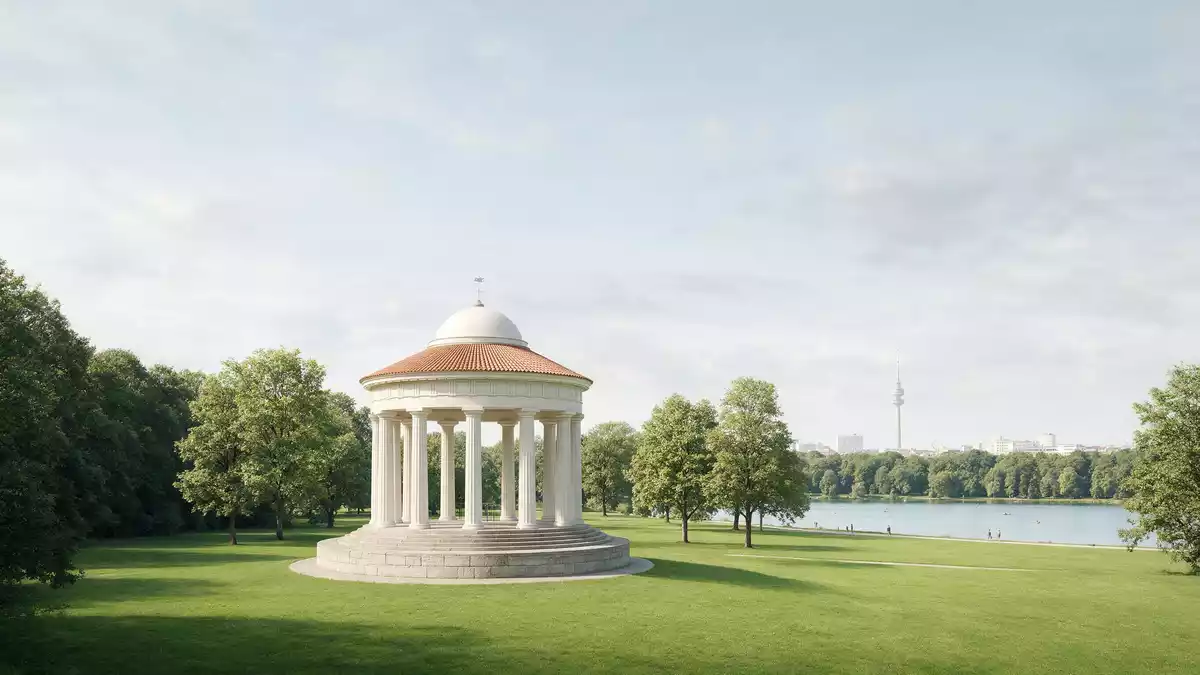
Englischer Garten in München is a broad sweep of parkland running from the edge of the historic centre along the River Isar towards the north-east, laid out as a public landscape garden in the late eighteenth century. Created in 1789 under Elector Karl Theodor with the involvement of Benjamin Thompson, later Count Rumford, it has grown into an inner-city parkland of several hundred hectares with meadows, woodland and water threaded into a continuous green corridor.
A city-length landscape garden beside the Isar
Englischer Garten stretches from near the old centre of München towards the city’s north-eastern limits, occupying the western bank of the River Isar as a long, narrow band of parkland that visitors can follow for kilometres. Its layout corresponds to the English landscape garden tradition, with curving paths, irregular planting and open lawns rather than rigid geometric avenues, a character already noted when the park’s plan was shaped by Friedrich Ludwig von Sckell in the nineteenth century.English landscape garden tradition Within its several hundred hectares, the park combines expansive meadows, substantial woodland and stretches of water; figures published by the Bavarian Palace Administration break this area down into distinct proportions of grassland, forest and water surfaces.area figures for meadows, woodland and water
The park’s length means that its character changes as one walks away from the centre. The southern section near the city is denser with paths and structures, while the northern areas stretch further along the river with a greater proportion of woodland and more extensive meadows.southern and northern sections Streams derived from the Isar cross the park, running in artificial channels that supply water to ponds and small lakes and add movement along the valley floor.streams connected to the River Isar
From military garden to public Volksgarten
The origins of Englischer Garten lie in late eighteenth-century reforms in Bavaria. In 1789, Elector Karl Theodor ordered the creation of gardens that would serve both military and civilian purposes, following ideas promoted by Benjamin Thompson, an American-born physicist and administrator who later became Count Rumford.construction started in 1789 The first phase created “military gardens” for soldiers, but the concept quickly shifted towards a public park open to the population, aligning with the contemporary notion of a Volksgarten on the European continent.founded in 1789 as a public garden
Construction began in 1789 and continued over several decades, as different sections and features were added.construction over several decades The Chinese Tower and Rumford House were among the early buildings, appearing around 1790 in the southern part of the park.Chinese Tower and Rumford House around 1790 In the early nineteenth century, the Hirschau section in the north was integrated, and work on Kleinhesseloher Lake began around 1804.Hirschau and Kleinhesseloher Lake Later, in the 1830s, the Monopteros, a small classical temple on an artificial hill, was added as a viewpoint within the southern park.Monopteros built in the 1830s
Structures, paths and water: how the park is experienced
Englischer Garten is not just open grass; its landscape is articulated by built structures and a dense network of paths. The Chinese Tower is a multi-level wooden tower rising above one of the clearings, modelled on East Asian precedents and surrounded by open space used as a gathering point.Chinese Tower in Englischer Garten Rumford House stands nearby as a more solid, house-like structure. Kleinhesseloher Lake forms a sizeable body of water within the northern part of the main park, linked to the surrounding paths and lawns, and animated by small islands and shorelines.
The park contains an extensive system of paths that together reach a total length of nearly 80 km, crossing meadows, woodland and watercourses.paths with a total length of nearly 80 km These paths vary from broad routes suitable for cycling to narrower tracks closer to the riverbanks and woodland areas. Streams derived from the Isar are channelled through the park, creating spots where fast-flowing water runs beneath bridges or alongside lawns, including the Eisbach, which is known for a standing wave that attracts river surfers.Eisbach wave in the park Beer gardens and kiosks are integrated at several points, especially near the Chinese Tower and at other clearings, linking the landscaped environment with traditional Bavarian outdoor hospitality.beer gardens and meadows in the park
Visiting Englischer Garten: what travellers from Western Europe should know
- Englischer Garten begins close to München’s historic centre and extends north-east along the western bank of the River Isar; central landmarks such as Odeonsplatz and Prinzregentenstrasse lie near its southern edge.
It can be reached on foot from central districts and via city public transport to stops bordering the park. - The terrain consists largely of level lawns, gently undulating ground and long, sometimes unpaved paths; exploring the park involves walking over natural surfaces for extended stretches.
Bridges cross streams at intervals, and some areas near the river have narrower paths. - Kleinhesseloher Lake provides a focal point in the mid-section of the park, while the Hirschau area stretches further north with long meadows and woodland, offering extensive walking routes.
- Englischer Garten lies in Germany, where the official language is German and the currency is the euro.
Searching for Englischer Garten on social platforms
These links open searches for Englischer Garten on each platform.Frequently asked questions about Englischer Garten
Where is Englischer Garten located within München?
Englischer Garten occupies a strip of parkland on the western bank of the River Isar, stretching from near the historic centre of München towards the city’s north-eastern districts.
What can visitors expect during a visit to Englischer Garten?
Visitors encounter wide meadows, woodland, streams, lakes and structures such as the Chinese Tower and Monopteros, linked by an extensive network of paths suitable for long walks or leisurely exploration.
What makes Englischer Garten distinctive compared with other city parks?
Its combination of eighteenth-century landscape design, several hundred hectares of continuous parkland and integration with the River Isar gives Englischer Garten the character of a city-length green corridor rather than a single enclosed garden.


