
Englischer Garten and the long green spine of München
Published on 08/30/2026 at 12:09 | Editorial responsibility: Rafael Müller, Editor-in-Chief AD HOC NEWS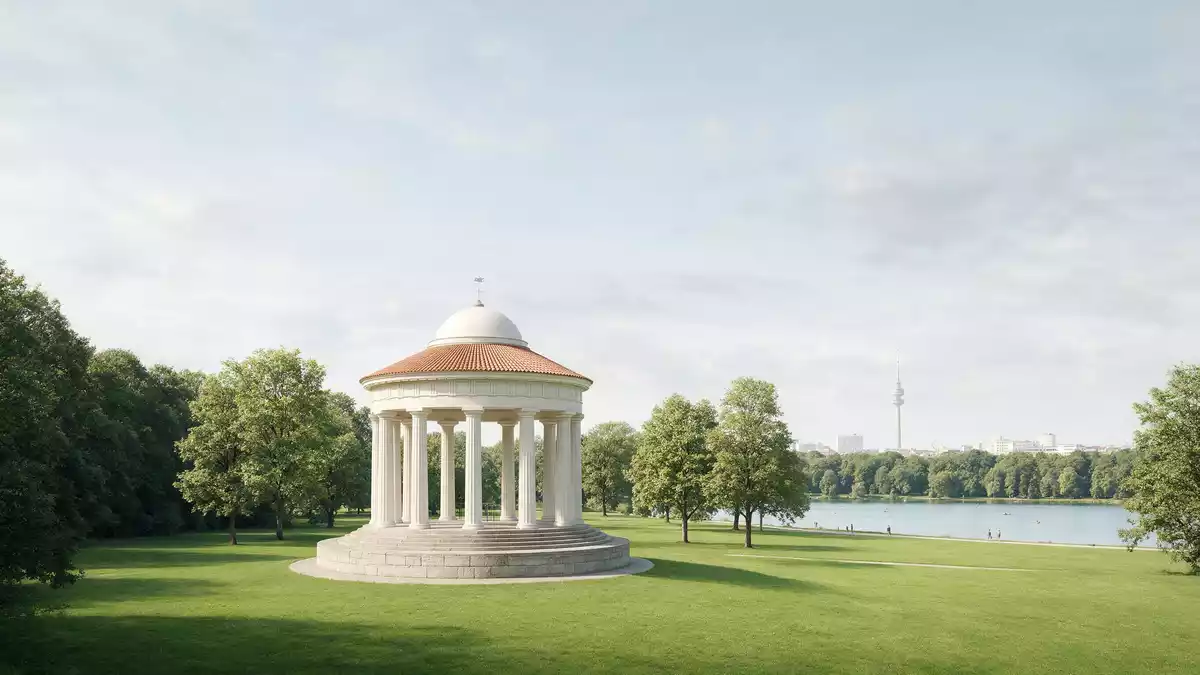
Englischer Garten runs like a long strip of landscape through München, following the western bank of the Isar from the city’s edge towards its historic centre. Conceived in the late eighteenth century as a public park and landscape garden, it still links formal city streets with open meadows, tree-lined streams and scattered pavilions in a single continuous band of green.
A river meadow turned English landscape
The name Englischer Garten comes from the fashion for English landscape gardens, whose informal lawns, clumps of trees and curving paths contrasted with baroque symmetry. Along the Isar, this style translated into long meadows, groves and watercourses that blend with the river’s floodplain, giving München a park that feels like a countryside strip running into the city.
The project began in 1789 under the direction of Benjamin Thompson, later known as Count Rumford, working for Elector Karl Theodor of Bavaria.The park was laid out as a public garden from 1789 and was one of the earliest large-scale city parks intended for all residents rather than as a private court garden.Friedrich Ludwig von Sckell, a leading landscape architect, later shaped much of its design and extended it northwards along the river.
Scale, layout and landscape features
Englischer Garten covers an area of around 3.7 km² of parkland, placing it among the largest urban parks in the world.The green strip stretches for several kilometres parallel to the Isar and creates a continuous recreational landscape from the edge of the Altstadt into the city’s north-eastern districts.The southern section near the centre contains a dense network of paths, lawns and water features while the northern areas become more expansive and less built up.
The park’s structure combines broad meadows where people gather on the grass with denser woodland sections and a system of artificial streams derived from the Isar. Paths for walking and cycling weave through these landscapes, crossing small bridges and passing ponds and canals that reflect the planted trees. The overall impression is of a deliberately informal landscape that nonetheless follows a carefully planned composition typical of eighteenth and nineteenth century garden design.
Monopteros, Chinese Tower and the Eisbach wave
Scattered through the park are individual architectural set-pieces that give distinct focal points to different areas. On a small artificial hill stands the Monopteros, a neoclassical round temple with columns that dates from the nineteenth century and serves as a viewpoint over the meadows towards München’s skyline.The temple forms part of the landscape composition completed by Sckell and frames long views across the southern park.
Further to the north within the southern section rises the Chinesischer Turm, a multi-storey wooden pagoda first erected around 1789 and rebuilt in the mid-twentieth century after wartime destruction.The tower is closely associated with one of München’s major beer gardens that spreads around its base and anchors one of the park’s liveliest gathering places. At the southern edge of the park, where the Eisbach stream flows under Prinzregentenstrasse, a standing river wave has become a fixed feature of the park’s character, with surfers taking turns on the wave as part of the everyday scene in this part of the Englischer Garten.The Eisbach, Monopteros and Chinese Tower together illustrate the park’s blend of naturalistic scenery and designed attractions.
Visiting Englischer Garten: what travellers from Western Europe should know
- Englischer Garten stretches along the western bank of the Isar in München, running north-east from the edge of the historic centre towards the districts beyond the Mittlerer Ring.
- The park consists of long, mostly level paths across grass and through woods, with some slopes around the Monopteros hill and steps near bridges and embankments.
- Surfers can be watched at the Eisbach wave near the southern entrance on Prinzregentenstrasse, while the Chinesischer Turm area lies further inside the park among open lawns and trees.
- The official language is German and the currency is the euro.
Searching for Englischer Garten on social platforms
These links open searches for Englischer Garten on each platform.
Frequently asked questions about Englischer Garten
Where is Englischer Garten located?
Englischer Garten lies in München in southern Germany, running along the western bank of the Isar from near the historic centre towards the city’s north-east.
What can visitors expect inside Englischer Garten?
Visitors encounter meadows, wooded paths, canals and streams, garden buildings such as the Monopteros and Chinese Tower, and lively gathering spots including the area around the Eisbach wave.
What makes Englischer Garten distinctive among city parks?
Its great length, river-side setting and eighteenth-century landscape design create a continuous band of countryside-like scenery within a major European city.


