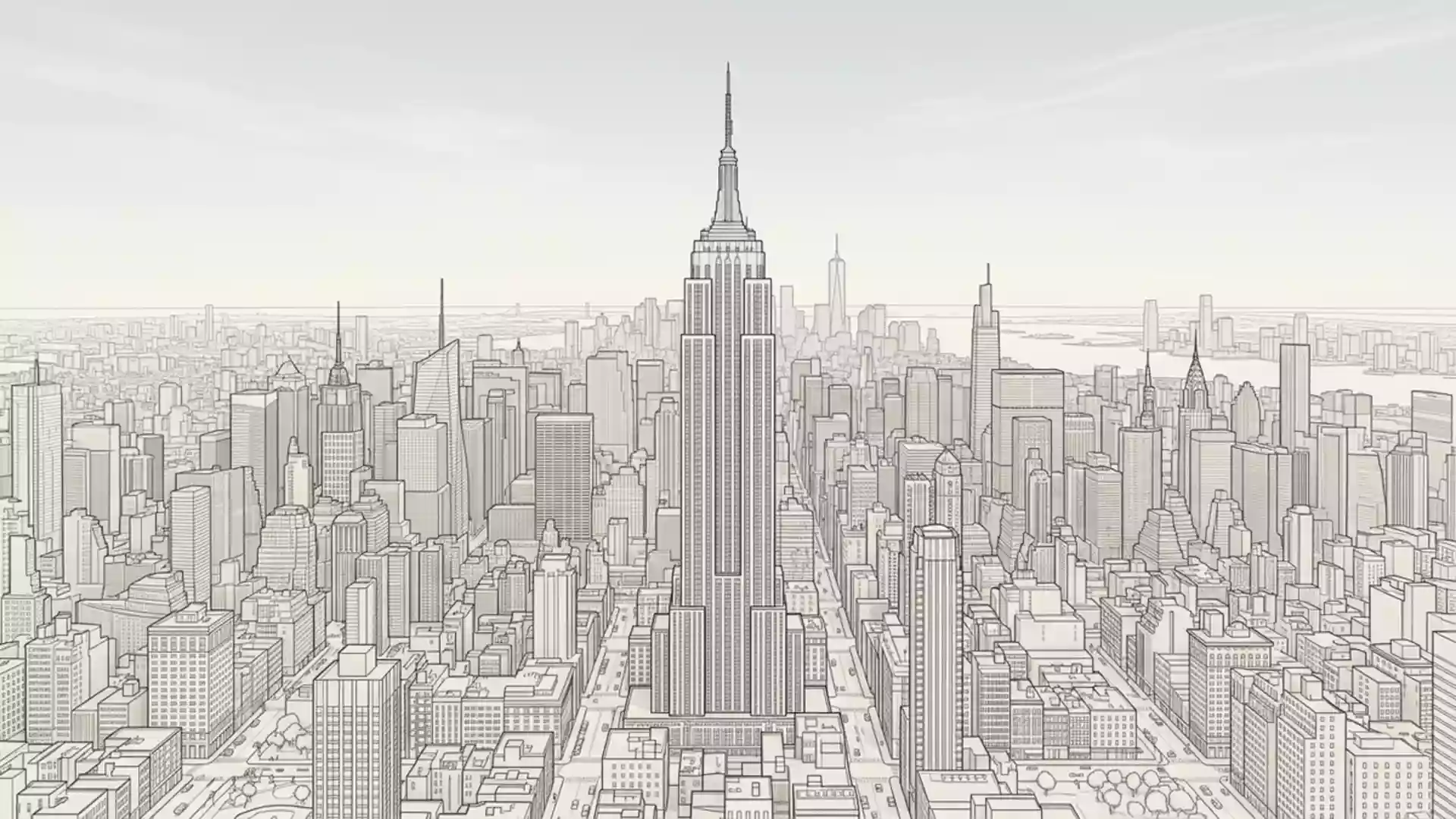
Empire State Building and its stacked Art Deco silhouette
Published on 09/03/2026 at 17:36 | Editorial responsibility: Rafael Müller, Editor-in-Chief AD HOC NEWS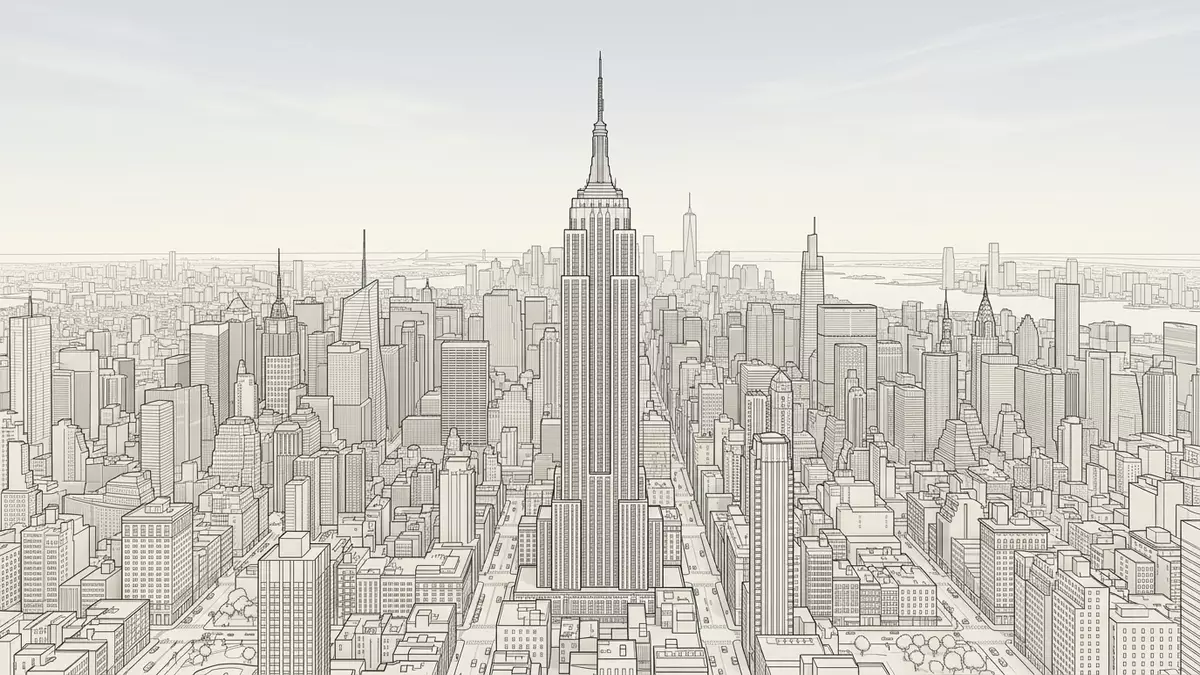
Empire State Building rises above Midtown Manhattan as a tiered Art Deco skyscraper whose stacked silhouette has become one of New York City’s clearest reference points. Completed in 1931 and standing 1,250 ft (381 m) to its roof, the tower climbs to about 1,454 ft (443 m) when its pinnacle and antenna are included, setting a vertical axis that is still easy to pick out from streets and riverfronts alike.
Art Deco height on Fifth Avenue
Empire State Building occupies a block on Fifth Avenue at the junction with West 34th Street, placing it firmly within Midtown Manhattan’s commercial grid of long avenues and cross streets.The skyscraper’s site at Fifth Avenue and West 34th Street gives it both a street-level presence and long axial views along the avenue. Designed by Shreve, Lamb and Harmon in the Art Deco style, the building was constructed in the early 1930s and formally opened in May 1931.Shreve, Lamb and Harmon’s design and the 1931 opening anchor it in the interwar period when New York’s skyline was gaining its stepped high-rises.
The tower is often described in terms of its height, and the figures are consistent across technical sources and the building’s own material. The roofline of the occupied floors reaches 381 m (1,250 ft), while the overall height including pinnacle and antenna is about 443 m (1,454 ft).Facts and figures published by the building’s operator confirm this dual measurement. When it opened, that height made Empire State Building the tallest building in the world, a record it held for roughly four decades until the completion of the World Trade Center’s North Tower in the early 1970s.Its status as the tallest building until 1971 gives it a clear place in skyscraper history.
A stacked limestone shaft and tower
Approached from Fifth Avenue, Empire State Building presents a broad base carrying a tall shaft of offices that step back as they rise, in keeping with both Art Deco taste and the zoning rules of its time.Descriptions of its limestone-clad shaft and setbacks underline how those recesses create the familiar profile. The exterior cladding combines limestone and other durable materials, giving the facade a pale, solid appearance that catches daylight differently on each tier. The tower above the main shaft carries the upper office floors and culminates in a narrower section that holds broadcasting equipment and the pinnacle.
Inside, the building is framed in steel, a typical approach for skyscrapers of the early twentieth century.Its description as a steel-framed skyscraper matches structural accounts. The Art Deco influence appears in decorative elements such as geometric motifs, polished materials and stylised patterns, particularly in the lobby and principal circulation spaces. Visitors who enter from Fifth Avenue pass through an entrance hall that carries these period details, framed by metal and stone surfaces that reflect the building’s era as clearly as its height does.
Observation decks over Manhattan
One of the clearest ways Empire State Building engages visitors is through its observation decks high above the streets. An outdoor terrace surrounds the building on the 86th floor, forming a viewing platform with open balustrades and vantage points aligned with each cardinal direction.The presence of observatories on the 86th and 102nd floors is consistently described. From this level, Midtown landmarks, river crossings and the more distant edges of the city come into view, framed by the building’s own masonry and the structural elements surrounding the deck.
Higher still, an enclosed observatory occupies the 102nd floor, close to the roof height that defines the building’s official figure of 381 m (1,250 ft).Height data for the 86th and 102nd floor observatories set these levels precisely. This upper deck is smaller, wrapped more tightly around the tower’s core, and gives a different perspective on Manhattan’s pattern of avenues and low-rise blocks below. The combination of an outdoor terrace and a higher enclosed lookout has helped fix Empire State Building in many visitors’ memory as a place where the vertical city can be read from more than one height.
Visiting Empire State Building: what travellers from Western Europe should know
- Empire State Building stands on Fifth Avenue at West 34th Street in Midtown Manhattan, reached by New York City’s subway network and by surface streets used by taxis and buses.
- Access to the observatory levels involves lifts followed by corridors and terraces; the outdoor deck on the 86th floor is surrounded by safety barriers with gaps suited to viewing and photography.
- The skyscraper sits within a dense grid of streets lined with shops and offices, so pavements around the base are busy and crossings require attention to traffic from several directions.
- USA uses English as an official language and the currency is the United States dollar.
- Entry requirements depend on your nationality; UK travellers can check the FCDO travel advice at gov.uk/foreign-travel-advice, Irish travellers the Department of Foreign Affairs at ireland.ie.
Searching for Empire State Building on social platforms
These links open searches for Empire State Building on each platform.
Frequently asked questions about Empire State Building
Where is Empire State Building located in New York City?
Empire State Building stands in Midtown Manhattan at Fifth Avenue and West 34th Street, within walking distance of several major subway stations and Penn Station.
What can visitors expect during a visit to Empire State Building?
Visitors pass through an Art Deco lobby before ascending by lift to observation decks on the 86th and 102nd floors, where city views unfold across Manhattan and beyond.
What makes Empire State Building distinctive among skyscrapers?
Its combination of a stacked Art Deco profile, steel frame, limestone-clad facade and dual high observatories, together with its 1931 height record, set it apart within New York’s skyline.