

Emei Shan’s layered pilgrimage from forest foot to golden summit
Published on 08/27/2026 at 12:47 | Editorial responsibility: Rafael Müller, Editor-in-Chief AD HOC NEWS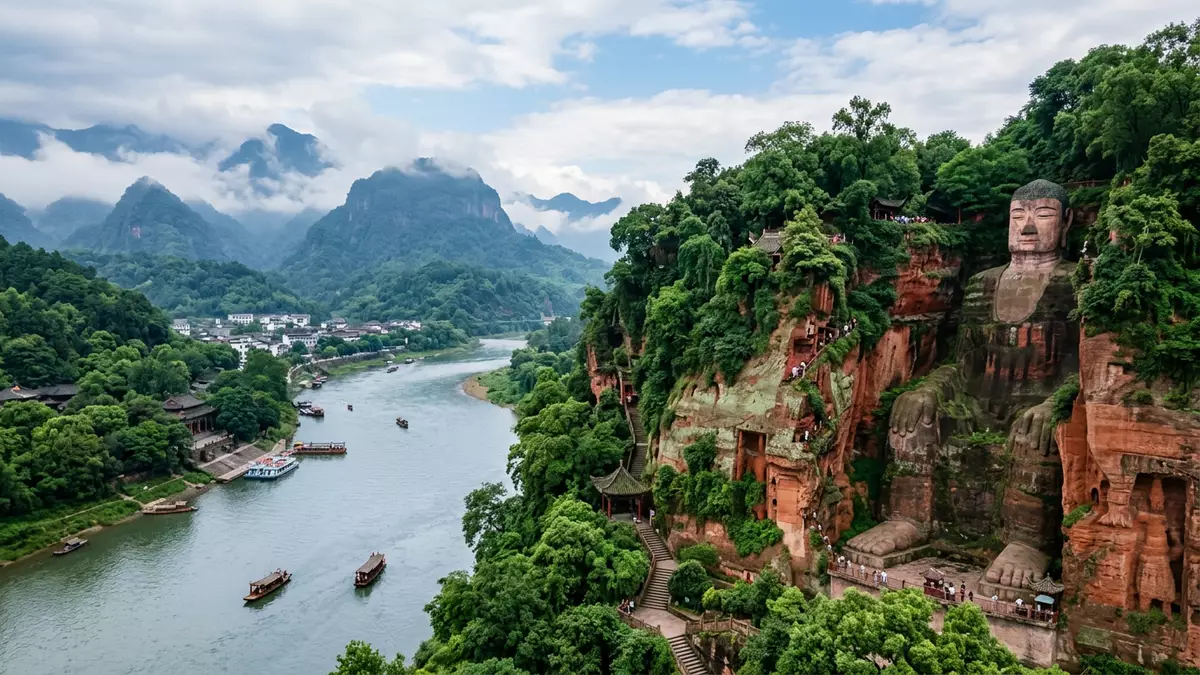
Emei Shan, known in English as Mount Emei, rises above Leshan in south-western China as both a sacred Buddhist mountain and a dramatic high peak. Its slopes carry a chain of temples, pavilions and viewpoints, and in 1996 the Mount Emei Scenic Area, including the Leshan Giant Buddha, was inscribed as a UNESCO World Heritage Site.
A sacred mountain on the edge of the Sichuan basin
Emei Shan stands in Sichuan Province, south of Chengdu and close to the confluence of the Minjiang, Dadu and Qingyi rivers at Leshan. The mountain’s highest peak, known as Wanfo Ding or Golden Summit, rises to about 3,099 m (10,167 ft), giving Emei Shan a substantial height difference from the plains around it and allowing a full sweep of climate and vegetation zones on a single ascent.The mountain’s highest peak is also one of the most recognisable features of the wider Mount Emei Scenic Area, which combines natural and cultural elements in a single protected landscape.
The mountain has been associated with Buddhism for many centuries, with early monastic activity recorded from the Eastern Jin period between the fourth and fifth centuries. Emei Shan is now identified as one of the Four Sacred Buddhist Mountains of China, linked in particular to devotion to the bodhisattva Samantabhadra, and temples on its slopes form an important chain of pilgrimage sites.One of China’s Four Sacred Buddhist Mountains gives Emei Shan a clear place in the religious geography of the country.
Temples, pavilions and the Golden Summit
The lower slopes of Emei Shan are marked by a sequence of temple precincts that serve as gateways into the mountain landscape. Baoguo Temple, close to the main access point near Emeishan City, is one of the best-known starting monasteries, with halls, courtyards and older trees forming a compact complex at the edge of the forest.Baoguo Temple sits near the roadhead and marks the transition from urban Sichuan to the ascending paths of the mountain.
Higher up, Wannian Temple occupies a mid-mountain terrace, associated with long-standing worship of Samantabhadra and rebuilt in several historical periods, while the Qingyin Pavilion area gathers bridges, pavilions and streams in a compact scenic section of the route.Baoguo Temple, Qingyin Pavilion, Wannian Temple and Golden Summit are often grouped together as key scenic areas of the mountain. Above them, the Golden Summit area forms the high-altitude culmination of many visits, combining temple buildings, terraces and extensive views over the surrounding ranges when weather permits.
World Heritage landscape shared with the Leshan Giant Buddha
In 1996 the Mount Emei Scenic Area, including the Leshan Giant Buddha Scenic Area, was added to the UNESCO World Heritage List as a mixed site, recognised under both cultural and natural criteria.Mount Emei Scenic Area, including Leshan Giant Buddha Scenic Area reflects both the mountain’s religious history and the biodiversity of its forests. The listing notes the role of Emei Shan as a place where Buddhism became established on Chinese territory and spread through eastern Asia, and also highlights the variety of plant and animal life that survives in its ravines and ridges.
The joint inscription means that a single World Heritage property now brings together the mountain and the colossal seated Buddha carved at Leshan, which faces the river junction below. The combined area is described in conservation documents as covering about 154 square kilometres, taking in temple complexes, forests, cliffs and watercourses that run through the south-central part of Sichuan Province.The World Heritage datasheet sets out the approximate extent and the mixture of cultural and natural values that underpin the site’s status.
Visiting Emei Shan: what travellers from Western Europe should know
- Emei Shan rises south of Chengdu in Sichuan Province, with main access routes through Emeishan City and Leshan, and railway and road links connecting the area to the wider region.
- The ascent combines paved paths, stepped stairways and forest trails, and sections near the Golden Summit reach high altitude where weather and temperature can change markedly over relatively short vertical distances.
- The mountain lies in a humid, subtropical region, with lush vegetation on the lower slopes and frequent cloud and mist swirling around the higher ridges and temples.
- The official language is Chinese and the currency is the Chinese yuan.
- Entry requirements depend on your nationality; UK travellers can check the FCDO travel advice at gov.uk/foreign-travel-advice, Irish travellers the Department of Foreign Affairs at ireland.ie.
Searching for Emei Shan on social platforms
These links open searches for Emei Shan on each platform.
Frequently asked questions about Emei Shan
Where is Emei Shan?
Emei Shan is in Sichuan Province in south-western China, near Leshan and south of Chengdu, forming part of the Mount Emei Scenic Area and Leshan Giant Buddha World Heritage Site.
What can visitors expect on a visit to Emei Shan?
Visitors encounter a layered ascent from foothill temples and forested paths to high-altitude viewpoints at the Golden Summit, with Buddhist monasteries, pavilions and varying vegetation along the way.
What makes Emei Shan distinctive among Chinese mountains?
Emei Shan combines the status of a sacred Buddhist site with a pronounced elevation range and a joint UNESCO inscription alongside the Leshan Giant Buddha, linking spiritual heritage and mountain landscape in a single protected area.


