
Emei Shan above Leshan, a sacred Buddhist mountain of forests and temples
Published on 09/03/2026 at 18:36 | Editorial responsibility: Rafael Müller, Editor-in-Chief AD HOC NEWS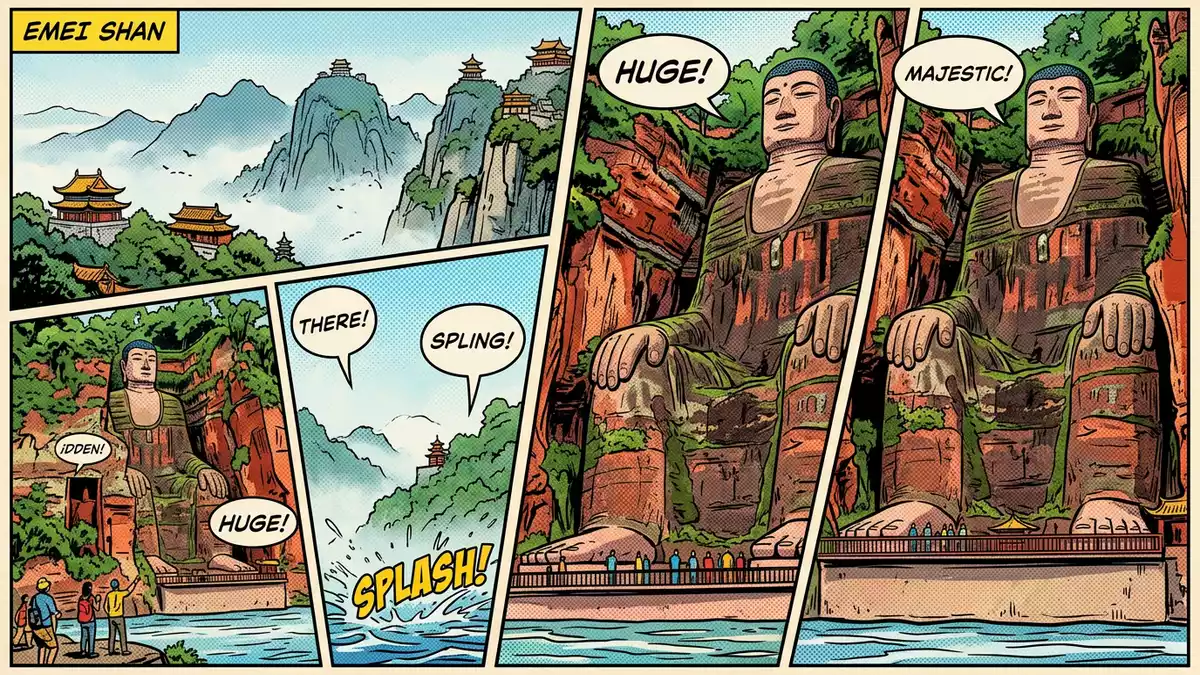
Emei Shan, known in English as Mount Emei, rises above Leshan in Sichuan Province as a sacred Buddhist mountain where steep forested slopes, stone paths and historic temples form a continuous highland landscape.
A sacred summit at the edge of the Sichuan basin
Emei Shan stands in south-western China, within Sichuan Province and close to the prefecture-level city of Leshan, on the margin of the Sichuan basin where lowlands give way to higher ground.Mount Emei in Sichuan Administratively, the mountain lies near Emeishan City, which forms part of the Leshan municipal area and acts as the main gateway towards the lower slopes.Emeishan City near Leshan The massif climbs to a high summit known as Wanfo Ding, reaching about 3,099 m (10,167 ft), so an ascent traverses a full range of altitudes from humid lowland foothills to cool upper ridges.Wanfo Ding summit height
The mountain forms part of the Mount Emei Scenic Area, which, together with the Leshan Giant Buddha Scenic Area at the confluence of the Minjiang, Dadu and Qingyi rivers, holds a joint UNESCO World Heritage inscription under both cultural and natural criteria.Mount Emei Scenic Area World Heritage This recognition reflects both the religious importance of Emei Shan and the biodiversity of its forests, where many plant species, including endemic forms, have been recorded.
Temples, paths and a long Buddhist presence
Emei Shan is widely recognised as one of the Four Sacred Buddhist Mountains of China, associated in particular with the bodhisattva Samantabhadra in East Asian tradition.Four Sacred Buddhist Mountains Buddhism on the mountain is documented from the Eastern Jin period in the fourth century, when the monk Huichi established a temple dedicated to Samantabhadra that later became known as Wannian Temple.Huichi and Wannian Temple Over subsequent centuries, particularly during the Tang, Song, Ming and Qing dynasties, the number of Buddhist sites increased while Daoist presence declined, and the mountain developed into a predominantly Buddhist landscape.
The built heritage on Emei Shan includes a cluster of traditional structures and temples such as Baoguo Temple, Fuhu Temple, the Qingyin Pavilion and the complex around Wannian Temple, many of which are protected on national lists of cultural monuments.Traditional buildings on Emei Shan Stone stairways, paved paths and terraces link these complexes through dense woodland, so a pilgrimage or visit often combines periods of walking with pauses at temple courtyards, viewing platforms and halls that have been rebuilt and maintained across different historical periods.
Landscape, the Leshan Giant Buddha and the wider scenic area
The wider Mount Emei Scenic Area, including the Leshan Giant Buddha Scenic Area, extends across mountainous terrain to the south-west and a river confluence zone to the south-east of Leshan, with the two core areas linked by road over a distance of several tens of kilometres.Layout of scenic areas At Leshan, the Giant Buddha is carved into a cliff at the meeting of the Minjiang, Dadu and Qingyi rivers, facing downstream over the water and forming a focal point in the river landscape.Leshan Giant Buddha at three rivers Together, the riverfront sculpture and the high, forested slopes of Emei Shan create a contrast between vertical cliff faces and the broad mass of the mountain.
UNESCO documentation notes that the first Buddhist temple in China was built in the surroundings of Emei’s summit in the first century AD, and that later additions of temples and sculptures turned the mountain and Leshan complex into one of the holiest Buddhist sites in the country.Early temple and later additions The combined inscription also highlights high plant diversity across the mountain’s slopes, so the scenic area brings together long-standing religious use and a rich natural environment within a single protected landscape.Cultural and natural criteria
Visiting Emei Shan: what travellers from Western Europe should know
- Emei Shan lies in Sichuan Province in south-western China, near Leshan and close to the smaller city of Emeishan, which functions as an access point for the mountain’s lower paths and roads.
- The ascent on Emei Shan involves long stairways and stone paths that climb through forest over considerable elevation, so a visit at higher levels requires sustained walking on steps.
- The wider scenic area includes the Leshan Giant Buddha at the confluence of the Minjiang, Dadu and Qingyi rivers, reached from Leshan by road and forming a separate visit within the same World Heritage property.
- The official language is Chinese and the currency is the renminbi (yuan).
- Entry requirements depend on your nationality; UK travellers can check the FCDO travel advice at gov.uk/foreign-travel-advice, Irish travellers the Department of Foreign Affairs at ireland.ie.
Searching for Emei Shan on social platforms
These links open searches for Emei Shan on each platform.
Frequently asked questions about Emei Shan
Where is Emei Shan located?
Emei Shan is in Sichuan Province in south-western China, near Leshan and close to Emeishan City, forming part of the Mount Emei Scenic Area recognised by UNESCO.
What can visitors expect on a visit to Emei Shan?
A visit to Emei Shan combines long walks on stone steps and paths through forest with time at historic temples and viewpoints, with altitude increasing towards the summit region.
What makes Emei Shan distinctive among Chinese mountains?
Emei Shan is distinctive for its long-recorded Buddhist presence from the first century AD, its association with Samantabhadra, and its joint World Heritage status with the Leshan Giant Buddha.


