
Elmina Castle and the weight of stone on Ghana’s coast
Published on 08/15/2026 at 14:40 | Editorial responsibility: Rafael Müller, Editor-in-Chief AD HOC NEWS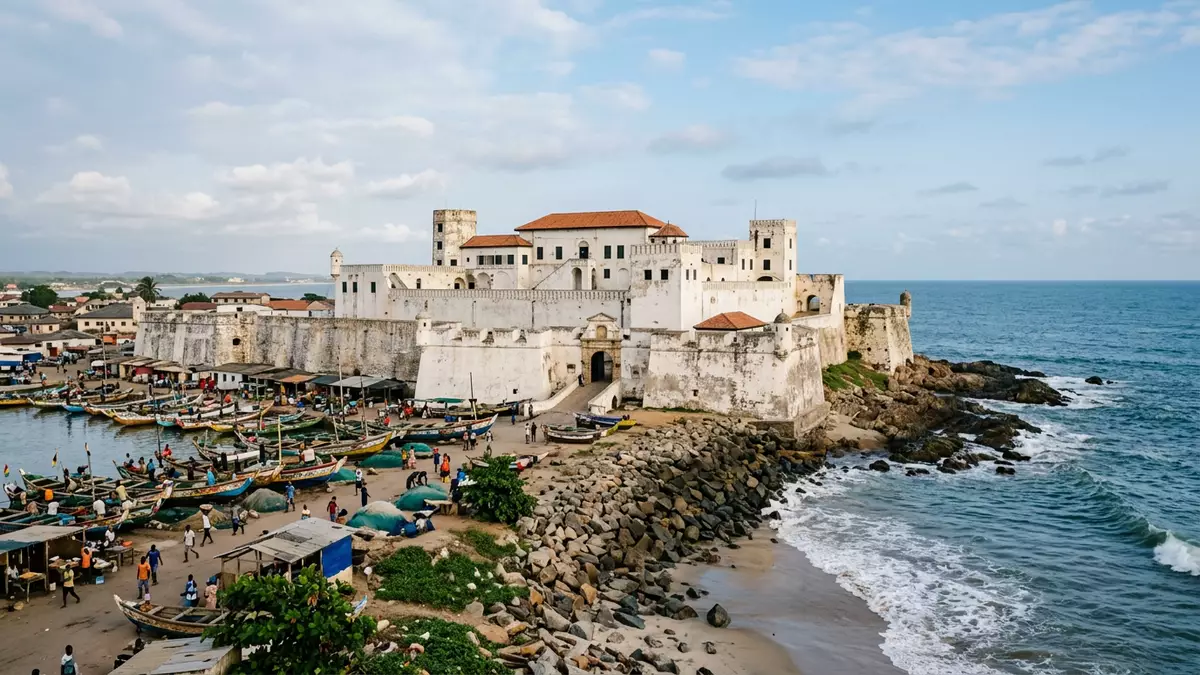
On the shore of the Gulf of Guinea at Elmina in southern Ghana, Elmina Castle stands as a massive whitewashed fortress facing the Atlantic. Built by Portuguese builders in 1482 as São Jorge da Mina, it is one of the oldest surviving European structures in sub-Saharan Africa and a place where stone, sea and history press closely together.
A fortress of stone above the Atlantic
Elmina Castle occupies a rocky headland on the coast, with its walls dropping towards the surf and the fishing harbour of Elmina gathered around it. From a distance, the structure reads as a solid block of pale masonry edged with battlements, its corners marked by projecting towers and its interior arranged around open courtyards.
The original Portuguese complex of São Jorge da Mina was laid out as a fortified trading post, built in stone and lime and ringed by curtain walls and bastions that command views along the shoreline.St George’s Castle in the town of Elmina was founded by the Portuguese in 1482 The name itself, “of the Mine”, refers to the gold that first drew João II’s kingdom to this stretch of coast, and the castle’s thick seaward walls still show the gun ports that guarded ships entering the anchorage.Built in 1482 by the Portuguese to protect the gold trade
From gold to the Atlantic slave trade
In the late fifteenth and early sixteenth centuries, Elmina Castle functioned as a depot for gold and ivory, tying the Akan-speaking interior to caravels bound for Lisbon. The Portuguese name Castelo de São Jorge da Mina appears in early records alongside descriptions of courtyards stacked with trade goods, chapels for Catholic worship and residential quarters for officials.Castelo de São Jorge da Mina served as a trade settlement for Portuguese activities on the Gulf of Guinea
This commercial role changed after the Dutch West India Company seized the fortress in 1637, taking advantage of Portugal’s weakened position and redirecting the stronghold into the networks of the Atlantic slave trade.St George’s d’Elmina Castle, built in 1482, later became part of the wider chain of forts recognised by UNESCO Under Dutch control, new dungeons and holding chambers were integrated into the existing structure, turning parts of the lower levels into cramped spaces where captured men, women and children were confined before embarkation. Later, under British administration in the nineteenth century, the castle’s role shifted again towards military and training uses, but the fabric of the building still carries traces of each era.
A World Heritage site of remembrance
Ghana’s independence in 1957 brought Elmina Castle under national custodianship, and it is now maintained as a historical monument and museum. Along with neighbouring Cape Coast Castle and a chain of other coastal forts, it forms part of a World Heritage listing that recognises their role in centuries of European expansion and African resistance.Elmina Castle, originally Castelo de São Jorge da Mina, is listed as a UNESCO World Heritage Site
Within the compound, visitors encounter contrasting spaces: open courtyards paved in stone, vaulted chambers, military platforms and the narrow passage long known as the “Door of No Return”, which opens directly towards the sea. Plaques and exhibitions interpret the site as both a piece of architecture and a place of mourning, connecting the local fishing town of Elmina with histories that stretch across the Atlantic to the Americas and to communities of African descent worldwide.The castle’s dungeons and the Door of No Return recall its role in the slave trade
Visiting Elmina Castle: what travellers from Western Europe should know
- Elmina lies on Ghana’s central coast, west of Accra, and Elmina Castle stands beside the fishing harbour; the nearest larger city is Cape Coast.
- The interior of the fortress is reached by stairways and uneven stone floors, and some passages and dungeons are low-roofed and confined.
- From the seaward ramparts there are clear views along the coastline and across the clustered houses and boats of Elmina town.
- The official language is English and the currency is the Ghanaian cedi.
- Entry requirements depend on your nationality; UK travellers can check the FCDO travel advice at gov.uk/foreign-travel-advice, Irish travellers the Department of Foreign Affairs at ireland.ie.
Searching for Elmina Castle on social platforms
These links open searches for Elmina Castle on each platform.
Frequently asked questions about Elmina Castle
Where is Elmina Castle located?
Elmina Castle stands on the Gulf of Guinea in the fishing town of Elmina, in the Central Region of Ghana’s Atlantic coast.
What can visitors expect inside Elmina Castle?
Visitors move through stone courtyards, chapels, former officers’ quarters, dungeons and seaward ramparts, with exhibitions that explain the building’s roles in trade and slavery.
What makes Elmina Castle distinctive among coastal forts?
Elmina Castle was begun by the Portuguese in 1482 and later used by Dutch and British powers, giving it an unusually long, layered history within one fortress.


