Ellora Caves in Aurangabad: three religions carved into basalt
Published on 09/07/2026 at 11:40 | Editorial responsibility: Rafael Müller, Editor-in-Chief AD HOC NEWS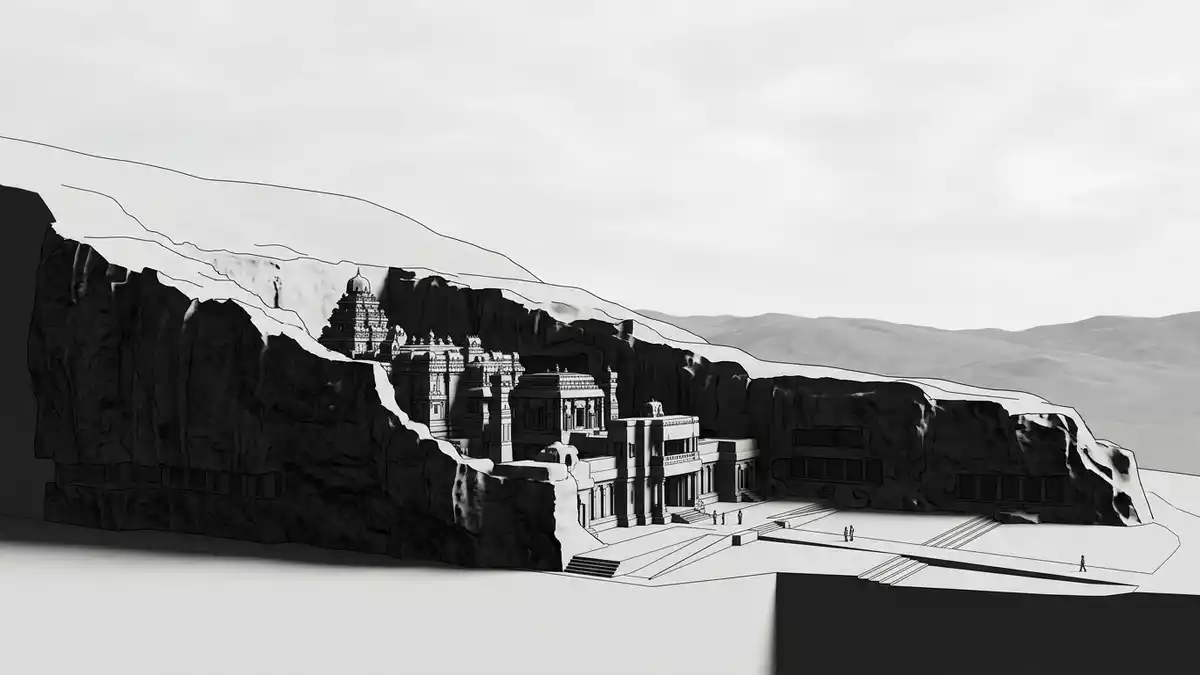
Ellora Caves near Aurangabad in India form a long ribbon of rock-cut monasteries and temples carved into a basalt escarpment, where Buddhist, Hindu and Jain traditions share the same cliff face. The site, inscribed as a UNESCO World Heritage property in 1983, stretches for several kilometres and condenses centuries of religious architecture into one walkable complex from the early medieval period.
Basalt cliff, linear layout
The Ellora complex stands on the western face of the Charanandri or Khuldabad escarpment in Maharashtra, its caves cut into hard volcanic basalt above the surrounding plain. A series of excavated façades runs along the cliff for more than 2 km, with individual cave entrances opening directly into the rock and forming a near-continuous architectural frontage along the slope.extending over more than 2 km The designation as a World Heritage Site in 1983 underlines the international recognition of Ellora’s rock-cut architecture and its cultural importance within India.year of inscription 1983
The arrangement of the caves along the cliff has a clear sequence. At the southern end lie the Buddhist excavations, numbered 1 to 12, which include monasteries with pillared halls and shrines cut from the basalt.Buddhist settlements in caves 1 through 12 In the central section stand the Brahmanical or Hindu caves, numbered 13 to 29, with more elaborate sculptural programmes and free-standing elements carved from the rock mass. Towards the northern end, a smaller cluster of Jain excavations, caves 30 to 34, completes the sequence and shows the same subtractive method applied to a different set of religious images.
Chronology and shared religious landscape
The carving of Ellora took place over several centuries in the early medieval period, with activity running roughly from the sixth to the tenth centuries AD. The sequence of monuments covers an uninterrupted span between around AD 600 and 1000, placing the caves within a broader history of Indian rock-cut architecture that begins in earlier centuries and continues into structural temple building.monuments dating from AD 600 to 1000 This extended chronology means that walking along the cliff is also a walk through changing styles of carving and layout.
Ellora is marked by the presence of three religions within a single continuous site: Buddhist caves at one end, Hindu excavations in the middle section and Jain caves at the far end. The Buddhist group includes monasteries and prayer halls, the Hindu group comprises temples dedicated to deities such as Shiva, and the Jain group carries its own iconography and architectural forms.12 Buddhist, 17 Hindu and 5 Jain caves Ellora therefore offers a rare concentration of religious monuments from different traditions carved side by side into the same basalt, reflecting the complex religious landscape of the Deccan in the first millennium AD without needing interpretation about motives.
Kailasa temple: subtractive architecture in the round
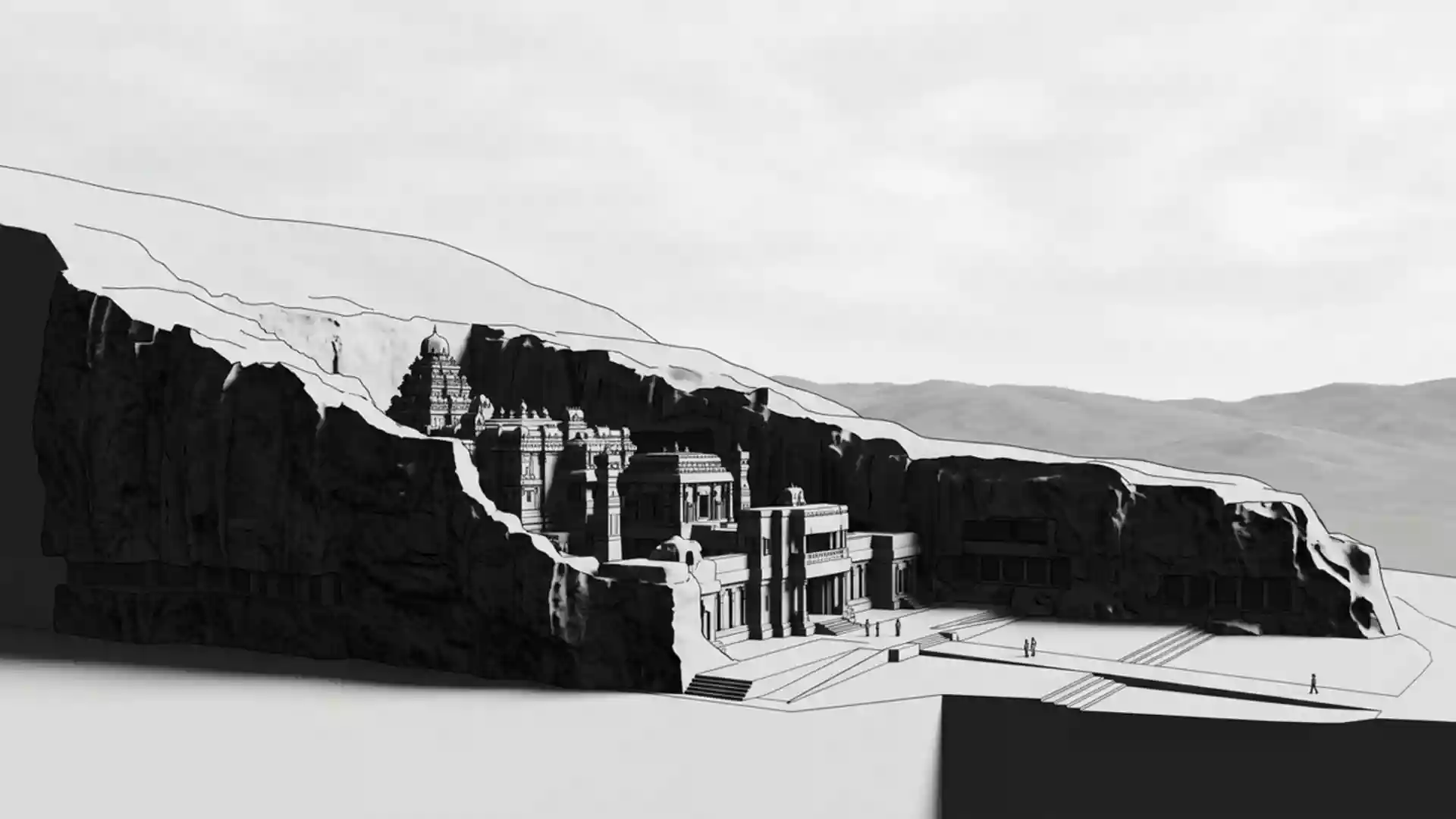
The dramatic focus of Ellora is the Kailasa temple, numbered Cave 16, a freestanding rock-cut complex carved from the basalt cliff rather than simply into its face. This structure stands within the Hindu section and is widely described as the largest monolithic rock-cut temple at the site, with its courtyard, shrines and gateways all sculpted from a single mass of stone rather than assembled from blocks.largest of the rock-cut Hindu temples The temple belongs to the Dravidian architectural idiom, with a pyramidal tower rising above the inner sanctum and a separate pavilion for Nandi, the bull associated with Shiva, carved as part of the same rock composition.South Indian Dravidian idiom
Kailasa is attributed to the Rashtrakuta ruler Krishna I, whose reign falls in the late eighth century and whose patronage is recorded in inscriptions, placing the main phase of its excavation around that period.patronage of Krishna I Artisans began at the top of the basalt and cut vertical trenches around a block to separate it from the cliff, then worked downwards and inwards to release the temple, its courtyard and subsidiary elements from the stone mass.subtractive, top-down method As a result, visitors encounter not only façades but also free-standing pillars, sculpted elephants and layered galleries that together form a three-dimensional composition in basalt, distinct within the otherwise linear sequence of Ellora’s caves.
Visiting Ellora Caves: what travellers from Western Europe should know
- Ellora Caves lie north of Aurangabad in Maharashtra, reached by road towards the village of Ellora, with the Ajanta Caves further to the northeast.
- The site occupies a basalt escarpment, and visiting the caves involves walking along uneven rock surfaces and climbing stairways cut into the cliff.
- The official language is Marathi at state level and Hindi nationally, and the currency is the Indian rupee.
- Entry requirements depend on your nationality; UK travellers can check the FCDO travel advice at gov.uk/foreign-travel-advice, Irish travellers the Department of Foreign Affairs at ireland.ie.
Searching for Ellora Caves on social platforms
These links open searches for Ellora Caves on each platform.Frequently asked questions about Ellora Caves
Where are Ellora Caves located?
Ellora Caves stand near the village of Ellora in Maharashtra, northwest of Aurangabad, on the face of a basalt escarpment in the Deccan.
What can visitors expect on a visit to Ellora?
Visitors encounter a sequence of rock-cut Buddhist, Hindu and Jain caves carved along more than 2 km of cliff, including the freestanding Kailasa temple.
What makes Ellora Caves distinctive among Indian heritage sites?
Ellora brings three religions together in a single continuous complex of rock-cut architecture, with the monolithic Kailasa temple as a striking centrepiece.