Ellora Caves in Aurangabad: basalt cliff of carved faiths
Published on 09/12/2026 at 14:14 | Editorial responsibility: Rafael Müller, Editor-in-Chief AD HOC NEWS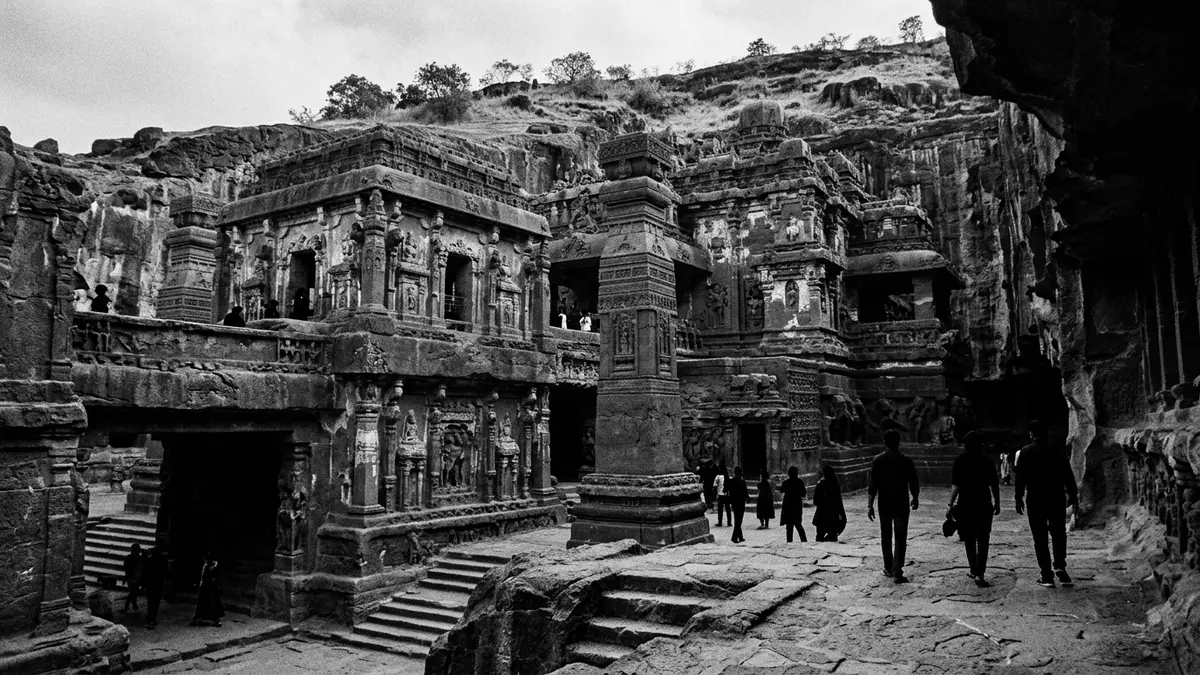
Ellora Caves near Aurangabad in India line a basalt cliff with a continuous sequence of rock-cut monasteries and temples that bring three faiths together in one dramatic landscape. Carved between the early medieval centuries and designated as a UNESCO World Heritage Site in 1983, the complex condenses Buddhist, Hindu and Jain architecture into a walkable stretch of cliff face.
A basalt escarpment turned into architecture
Ellora Caves occupy a basalt escarpment in the Charanandri Hills of Maharashtra, north of Aurangabad and close to the village of Ellora on the Deccan Plateau. Along this cliff, artisans excavated a series of shrines, halls and façades directly from the dark volcanic rock, so that entire temples emerge from the same continuous wall of stone.Ellora Caves The rock itself is part of the Deccan Traps, a vast basalt formation that provides the hard, fine-grained material for crisp carvings and robust structural masses.Carved into the basalt terraces
The complex consists of 34 numbered caves, extending for more than 2 km (about 1.2 miles) along the escarpment, with individual temple fronts, pillared halls and monastery ranges cut side by side into the same cliff.a series of 34 rock-cut temples Walking the line of caves reveals façades that project from the rock in ledges and balconies, while deeper interiors open into multi-level halls whose walls, pillars and ceilings are all part of the original basalt mass.
Three religions sharing one cliff
Ellora Caves are organised broadly into three groups that reflect different religious traditions sharing the same hillside. At the southern end, Buddhist caves form large monastery complexes with pillared assembly halls and cells opening off side corridors, some with sculpted images of the Buddha framed by intricate reliefs.collection of rock-cut temples, monasteries, and chapels Towards the centre of the range, Hindu caves present temple layouts with sanctums, circumambulatory paths and carved mandapa halls, filled with reliefs and freestanding sculptures from Shaiva and Vaishnava traditions.
At the northern end, Jain caves introduce more compact shrines with detailed iconography and finely carved columns, continuing the sequence of religious architecture into a different set of practices.Jain Temples 30–34 The coexistence of these three groups on a single cliff makes Ellora Caves a rare place where Buddhist viharas, Hindu mandapas and Jain shrines occupy adjoining spaces carved during overlapping centuries of patronage.cave temples of Buddhism, Hinduism and Jainism found together
Chronology and the Kailasa temple
The monuments at Ellora are an uninterrupted sequence dating from around AD 600 to 1000, capturing developments in Indian rock-cut architecture over several centuries.monuments dating from AD 600 to 1000 Buddhist caves at the southern end belong to the earlier phase of carving, followed by Hindu temples from the middle centuries and Jain shrines that continue into the later period of activity.Hindu, Buddhist and Jain caves chiselled between the 4th and the 9th centuries
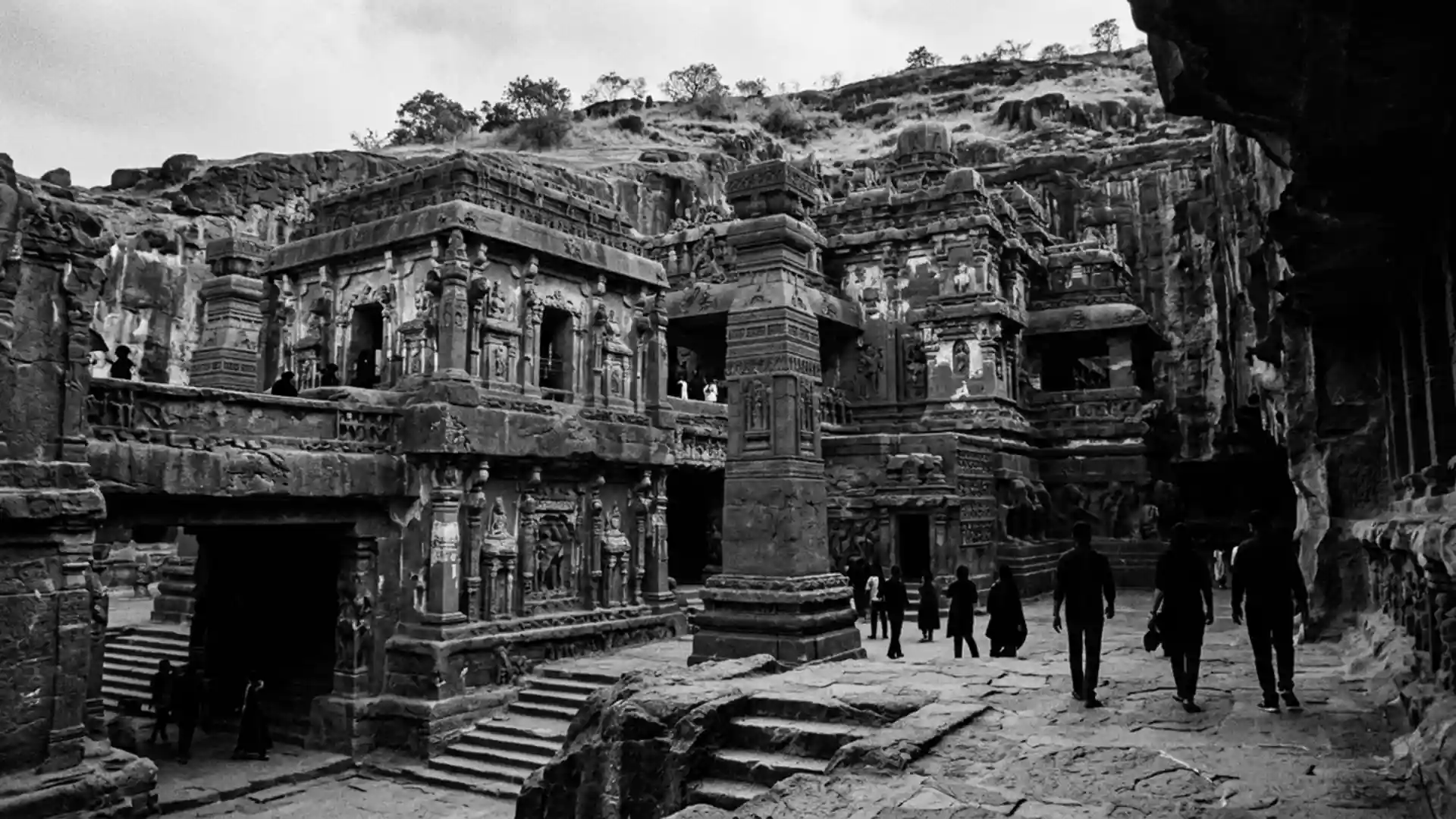
Among the Hindu group, the Kailasa temple in Cave 16 stands out as a free-standing temple complex carved downward from the basalt as a single monolithic mass within the surrounding cliff. The temple is generally associated with the Rashtrakuta dynasty and linked in inscriptions to the reign of Krishna I in the later eighth century.Kailasa Temple, Elloraconstruction attributed to the Rashtrakuta king Krishna I Its towers, columned halls and courtyard are all part of the same block of basalt, cut away from above and around to release temple forms, elephant sculptures and high-relief panels that stand free within a sunken court.
Visiting Ellora Caves: what travellers from Western Europe should know
- Ellora Caves lie north of Aurangabad in Maharashtra, India, near the village of Ellora, with road access from the city and onwards connections to regional rail and air services.
- The complex runs along a rocky hillside, and visiting involves walking between cave entrances on uneven ground, with stairways and stone steps leading into and between the temple interiors.
- The surrounding region is part of the Deccan Plateau, and weather can be hot, so carrying water and being prepared for exposure on the open sections of the cliff approach helps make the walk more comfortable.
- The official language is Hindi alongside Marathi in the state, and the currency is the Indian rupee.
- Entry requirements depend on your nationality; UK travellers can check the FCDO travel advice at gov.uk/foreign-travel-advice, Irish travellers the Department of Foreign Affairs at ireland.ie.
Searching for Ellora Caves on social platforms
These links open searches for Ellora Caves on each platform.
Frequently asked questions about Ellora Caves
Where are Ellora Caves located?
Ellora Caves are in the Aurangabad district of Maharashtra in western India, north of Aurangabad city and close to the village of Ellora.
What should visitors expect on a visit?
Visitors encounter a line of rock-cut monasteries and temples along a basalt hillside, with multiple cave entrances, stone stairways and elaborately carved interiors dedicated to different faiths.
What makes Ellora Caves distinctive?
Ellora Caves are distinctive for bringing Buddhist, Hindu and Jain rock-cut architecture together on a single basalt cliff, in a continuous sequence of 34 caves dating from around AD 600 to 1000.