
Ellora Caves in Aurangabad, a multireligious cliff of stone and faith
Published on 09/03/2026 at 15:22 | Editorial responsibility: Rafael Müller, Editor-in-Chief AD HOC NEWS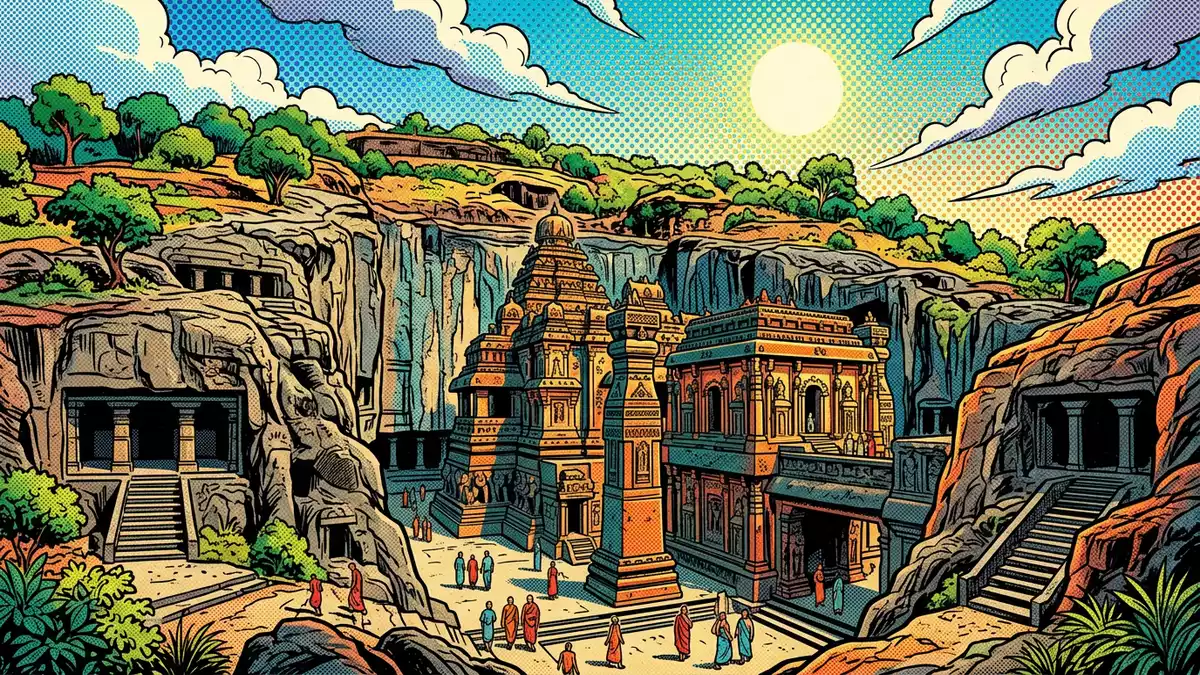
Ellora Caves near Aurangabad in India form a continuous line of monasteries and temples cut into basalt cliffs, where Buddhist, Hindu and Jain traditions share the same rock face. Dating to the period between the sixth and tenth centuries, the complex brings together dozens of shrines in a single geological terrace and has been inscribed as a UNESCO World Heritage Site since 1983, reflecting its importance for the religious and artistic history of the Deccan.
Basalt cliffs carved into temples and monasteries
Ellora Caves occupy an escarpment of volcanic basalt in the Charanandri hills of Maharashtra, where ancient craftsmen carved into a cliff extending for more than 2 km (1.2 miles). The ensemble is formally described as 34 monasteries and temples at Ellora, cut side by side into the wall of a high basalt cliff near Aurangabad, and together they form one of the major rock-cut temple complexes in India.34 monasteries and temples The caves run broadly north–south along the rock face, following the natural line of the ridge and using the vertical cliff as both wall and frame.
The complex is often described as an uninterrupted sequence of monuments dating from around 600 to 1000 CE, cut in successive phases by different religious communities working in the same geology.uninterrupted sequence of monuments The caves are numbered in sequence along the cliff from south to north, a practical way of identifying individual shrines and halls within the continuous rock wall. Basalt, a hard volcanic rock, underlies the entire site and gives the interiors their dark, dense surfaces, contrasted by carved pillars, reliefs and statues emerging directly from the bedrock.
Buddhist, Hindu and Jain caves in one landscape
Ellora is widely recognised for bringing together architectural activities of three major religions of ancient India: Buddhism, Brahmanical Hinduism and Jainism.three major religions The southern group of caves belongs to Buddhist traditions, including monasteries with pillared halls and chapels that were used for meditation and communal gathering. Moving north along the cliff, the sequence shifts into a group of Hindu temples, many of them devoted to Shiva or Vishnu and filled with sculpted panels showing episodes from Sanskrit epics and Puranic stories.world’s largest complex of rock-cut temples
The northernmost part of the complex is occupied by Jain shrines, whose carvings show Tirthankaras and attendant figures in relief and round sculpture.five Jain deities Together, the Buddhist, Hindu and Jain groups cover an extended span of time. Many sources place the beginning of carving around the sixth century, with activity continuing in various phases into the tenth century and beyond, meaning that the cliff records several centuries of changing dynasties and religious patronage in the Deccan plateau.Ellora Caves date back to the 6th century
The Kailasa temple and other standout monuments
Within the numbered sequence, certain caves have acquired particular prominence, above all Cave 16, known as the Kailasa or Kailasanatha temple. Unlike the surrounding caves, Kailasa is a free-standing monolithic temple carved downward and outward from the original basalt, leaving a large court around a central shrine tower. It is widely described as the largest rock-cut temple at Ellora and one of the largest anywhere, and dates to around the eighth century under the Rashtrakuta dynasty, which made the region a centre of monumental Hindu temple building.largest rock-cut monument
The Buddhist group includes multi-storey monastery caves such as those with large pillared halls and sculpted Buddha images, marking the earlier phase of excavation at Ellora in the late ancient and early medieval periods.excavated over a period of several hundred years The Hindu group contains shrines where linga, reliefs of Shiva in various forms and panels from the Ramayana and Mahabharata are carved into the walls and pillars. In the Jain sector, compact temple caves display figures of Jinas under ornamental canopies and detailed ceiling carvings, showing how later patrons adapted the established Ellora idiom for their own religious imagery.
Visiting Ellora Caves: what travellers from Western Europe should know
- Ellora Caves lie in the Aurangabad district of Maharashtra in western India, north of Aurangabad city and near the village of Ellora, reached overland from Aurangabad and other regional centres.
- The site stretches along a basalt cliff, and visiting individual caves involves walking along the terrace and climbing stone steps, with some interiors reached by staircases and uneven rock floors.
- The complex stands in a semi-arid landscape of low hills and plateaus; daytime temperatures on the plateau can be high, and shade inside the caves contrasts with exposed approaches along the cliff.
- The official language in this part of India is Marathi alongside Hindi, and the national currency is the Indian rupee.
- Entry requirements depend on your nationality; UK travellers can check the FCDO travel advice at gov.uk/foreign-travel-advice, Irish travellers the Department of Foreign Affairs at ireland.ie.
Searching for Ellora Caves on social platforms
These links open searches for Ellora Caves on each platform.
Frequently asked questions about Ellora Caves
Where are Ellora Caves and what kind of place is this?
Ellora Caves stand in the Aurangabad district of Maharashtra in India, cut into basalt cliffs in the Charanandri hills as a line of rock-cut monasteries and temples.
What should a visit to Ellora Caves be expected to involve?
A visit involves walking along the cliff terrace to reach individual cave entrances, exploring interiors carved from basalt with pillars, shrines and reliefs, and moving between Buddhist, Hindu and Jain sectors.
What makes Ellora Caves distinctive among Indian heritage sites?
Ellora Caves bring together dozens of rock-cut shrines from Buddhism, Hinduism and Jainism in one continuous cliff, including the monolithic Kailasa temple, and have been recognised as a UNESCO World Heritage Site since 1983.


