
Ellora Caves in Aurangabad: a cliff carved into faith
Published on 09/10/2026 at 14:57 | Editorial responsibility: Rafael Müller, Editor-in-Chief AD HOC NEWS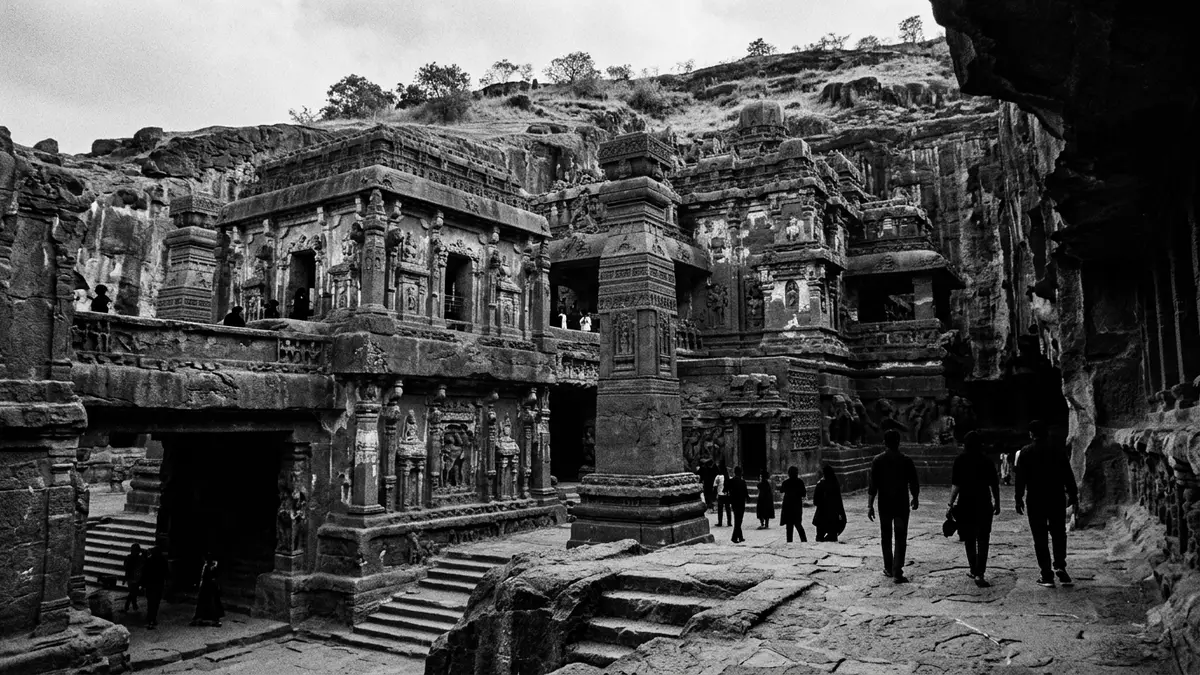
Ellora Caves near Aurangabad in India transform a long basalt escarpment into a continuous band of rock-cut monasteries and temples where Buddhist, Hindu and Jain traditions share the same cliff. Carved between the sixth and the tenth centuries, the complex brings several centuries of Indian religious architecture together along one west-facing wall of stone.
A cliff of caves shared by three religions
The Ellora Caves form a linear group of rock-cut sanctuaries excavated into the basalt of the Charanandri or Khuldabad escarpment north of Aurangabad in Maharashtra. The line of caves extends for more than 2 km (about 1.2 miles) along the cliff, with the entrances opening towards the west and facing an open forecourt of stone.extending over more than 2 km The site lies within the Aurangabad district and close to the village of Ellora, placing this rock-cut landscape within easy reach of the historic city.
In its numbered sequence the complex comprises 34 major caves, a term that covers both simple excavated halls and elaborate temple layouts carved from the basalt. The caves are arranged broadly by religious affiliation, with Buddhist caves occupying the lower numbers, Hindu caves the middle section and Jain caves at the higher end of the sequence.34 rock-cut temples Together they form a rare physical record of three faiths expressed through the same medium of subtractive rock-cut architecture.
From monasteries to Kailasa: architecture in basalt
The Buddhist caves at Ellora include simple excavated cells around central halls and more elaborate chaitya or prayer hall forms, reflecting an early phase of the site’s activity between the sixth and seventh centuries AD.Buddhist caves 1 through 12 Many of these have pillars carved directly from the rock, reliefs of seated Buddhas on their walls and rock-cut benches for monastic use, turning the interior of the cliff into living and worship spaces for communities following Buddhist traditions.
The Hindu section of Ellora, broadly dated from the seventh to the ninth centuries AD, introduces multi-level temple layouts, circumambulatory paths and densely carved programmes, culminating in Cave 16, the Kailasa temple associated with the Rashtrakuta ruler Krishna I in the eighth century.Creator Krishna I Here the rock has been quarried away on all sides to release a freestanding temple block from the cliff, complete with a main shrine, a tower in the Dravidian style and subsidiary elements such as a Nandi pavilion, all carved as one continuous piece of basalt.
Kailasa temple: a mountain carved into a temple
Cave 16, the Kailasa temple, stands at the centre of Ellora’s architectural drama as the largest monolithic rock-cut temple at the site and one of the largest such structures anywhere. The excavation removed a substantial volume of basalt to isolate the temple mass, leaving bridges of rock connecting the resulting courtyard with the escarpment around it.largest monolithic rock structure Within this carved mountain the temple follows a South Indian Dravidian idiom, with a pyramidal tower rising over the main sanctum and sculpted bands of narrative reliefs climbing its walls.
The temple is widely associated with the patronage of Krishna I of the Rashtrakuta dynasty in the eighth century, a period when the rulers of this house established their authority across large parts of the Deccan.Rashtrakuta ruler Krishna I Kailasa is conceived as a representation of Mount Kailasa, the mythic abode of Shiva, and the carved programme includes larger-than-life figures of deities, panels depicting episodes from Hindu epics and detailed ornament connecting the temple’s plinth, walls and superstructure.
Ellora Caves in the wider Indian heritage
Ellora Caves have been inscribed on the UNESCO World Heritage List since 1983 for their uninterrupted sequence of monuments dating from AD 600 to 1000 and for the coexistence of Buddhist, Hindu and Jain works in a single cliff face.uninterrupted sequence of monuments dating from A.D. 600 to 1000 This long span of construction in the same location allows visitors to trace changes in Indian religious architecture across several centuries of activity.
Within the broader development of Indian cave and temple architecture, Ellora occupies an important place because it preserves both early rock-cut monasteries and sophisticated later temples in one site. Observers of the complex can compare the relatively austere volumes of the early Buddhist caves with the layered, sculpturally rich spaces of the Hindu and Jain temples, including the encyclopaedic programme of Kailasa.carved over a period of three hundred and fifty years The combination of religious diversity, technical ambition and chronological depth makes Ellora a central reference point for understanding India’s rock-cut heritage.
Visiting Ellora Caves: what travellers from Western Europe should know
- Ellora Caves lie north of Aurangabad in Maharashtra, near the village of Ellora, and are reached by road from the city and by regional transport connections that converge on Aurangabad.
- The caves are cut into a basalt escarpment, and visiting the complex involves walking on stone surfaces, climbing steps between levels and crossing open courtyards exposed to the sun.
- Ellora Caves are in India, where the official languages include Marathi and Hindi and the currency is the Indian rupee.
- Entry requirements depend on your nationality; UK travellers can check the FCDO travel advice at gov.uk/foreign-travel-advice, Irish travellers the Department of Foreign Affairs at ireland.ie.
Searching for Ellora Caves on social platforms
These links open searches for Ellora Caves on each platform.
Frequently asked questions about Ellora Caves
Where are Ellora Caves located?
Ellora Caves are in the Aurangabad district of Maharashtra in western India, near the village of Ellora north of Aurangabad city.
What should visitors expect on a visit?
Visitors encounter a long basalt cliff with a sequence of rock-cut caves, courtyards and temples, reached by stone paths and steps across the escarpment.
What makes Ellora Caves distinctive?
Ellora Caves are distinctive for combining Buddhist, Hindu and Jain rock-cut monuments along one cliff, including the monolithic Kailasa temple attributed to Krishna I.


