
Ellora Caves and the carved face of a hillside
Published on 09/18/2026 at 16:40 | Editorial responsibility: Rafael Müller, Editor-in-Chief AD HOC NEWS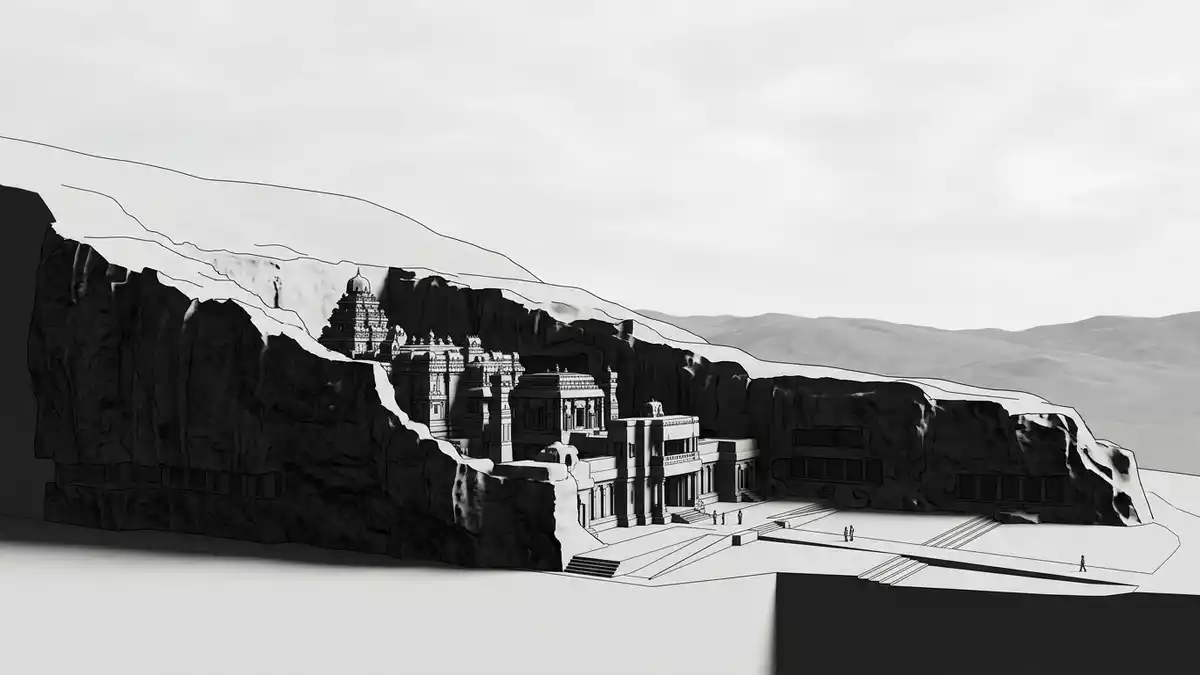
Ellora Caves in Aurangabad presents a hillside cut into rock, with Buddhist, Hindu and Jain spaces carved into the same escarpment. The site is a UNESCO World Heritage Site and one of the clearest examples of rock-cut architecture in western India.UNESCO World Heritage Site
Three religious traditions in one cliff face
The complex contains cave temples and monasteries associated with three traditions, and the groups are arranged along the hillside rather than in a single block. That mix gives Ellora a layered character: Buddhist spaces, Hindu sanctuaries and Jain caves form one continuous rock-cut ensemble.Buddhist, Hindu and Jain
The most famous monument here is the Kailasa temple, a monolithic shrine carved directly from the rock. Its scale and the labour implied by the surviving form make Ellora one of the most striking carved landscapes in Maharashtra.Kailasa temple
Carving across the early medieval centuries
The site belongs to the early medieval centuries, with work spreading from the sixth to the tenth century. That long span places Ellora across the periods of the Kalachuri, Chalukya and Rashtrakuta dynasties, with the later Jain caves completing the sequence.sixth to the tenth century
Ellora’s rock-cut forms show how craftsmen worked the same dark basalt cliff in very different ways. Some chambers are monastic halls, others are temple sanctuaries, and the carved surfaces carry pillars, reliefs and free-standing sculpture within the rock.rock-cut temples
The UNESCO inscription and the site’s setting
UNESCO inscribed Ellora in 1983, and the designation reflects both the artistic range and the density of the complex. The caves lie near the village of Ellora in Maharashtra, with Aurangabad serving as the nearest major city in common English usage.inscribed in 1983
The hillside setting remains part of the experience. The façades sit in a sequence along the cliff, and the result is less like a single monument than a carved route through a religious landscape.near the village of Ellora
Visiting Ellora Caves: what travellers from Western Europe should know
- The caves lie in Aurangabad district, Maharashtra, near the village of Ellora. Aurangabad is the clearest reference point for rail and road travel.
- The site sits in basalt and runs along a hillside, so the setting is uneven and exposed to slope changes. The cave fronts are reached by moving between cut chambers and open rock faces.
- The complex combines Buddhist, Hindu and Jain spaces, so the carved forms vary from hall to hall. The sequence of caves is part of what makes a visit distinctive on the ground.
- Ellora is a stone site rather than a single building, and the monuments are spread along the cliff. That layout gives the place a broad, linear character.
Searching for Ellora Caves on social platforms
These links open searches for Ellora Caves on each platform.
Frequently asked questions about Ellora Caves
Where are Ellora Caves?
Ellora Caves are in Maharashtra, near Aurangabad and the village of Ellora. The site lies in western India and forms part of a wider cave-temple landscape.
What does a visit involve?
The visit centres on rock-cut temples and monasteries spread along a hillside. The caves vary in style and scale, so the place rewards unhurried movement between the carved fronts.
What makes Ellora Caves distinctive?
The site brings together Buddhist, Hindu and Jain monuments in one carved hillside. The combination of religions, the basalt rock and the long carving sequence give Ellora its distinct character.


